
Costa Rica Species
Stenella longirostris
AnimaliaHighest rank in taxonomy. Groups all life into domains: Animalia, Plantae, Fungi, etc.IUCN LCInternational Union for Conservation of Nature — the world authority on species extinction risk, using standardized criteria. — Least Concern — widespread and abundant; not at immediate risk of extinction.In ProgressCurrent stage of this record in the editorial review workflow. Recent Sighting

Stenella longirostris

Spinner Dolphin

(Gray, 1828)

Detailed Texts Multi-lang
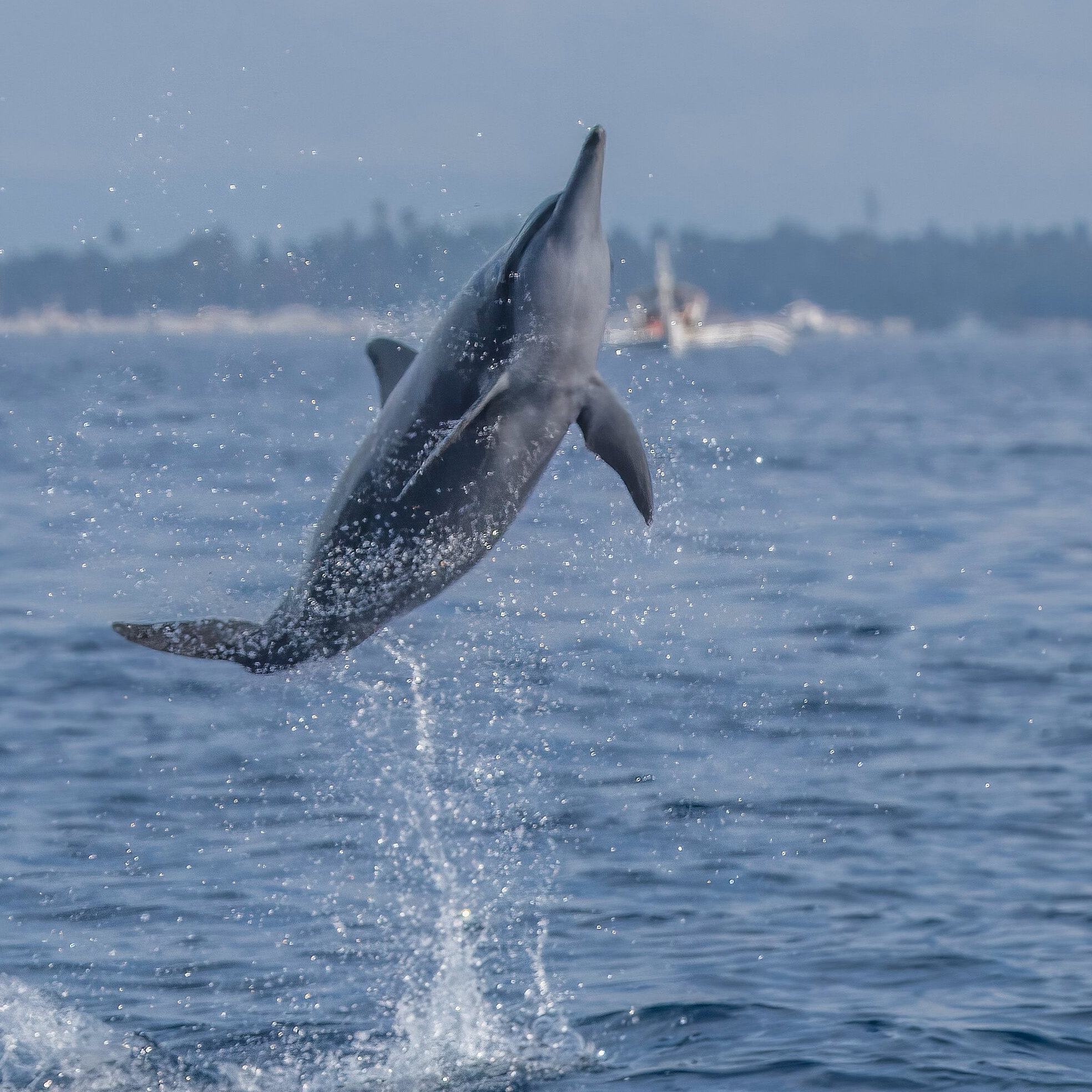
The spinner dolphin (Stenella longirostris) is a small to medium-sized, slender, and extraordinarily hydrodynamic cetacean, world-famous for its incredible aerial acrobatics. It is characterized by a very long and thin beak (rostrum) and a triangular or slightly falcate dorsal fin. Its coloration pattern is tripartite (in three tones): dark gray on the dorsal cape, lighter gray on the flanks, and white or pinkish on the belly. However, in the Eastern Tropical Pacific, there is a subspecies (S. l. orientalis) that tends to be more uniformly dark gray. They are globally renowned for their behavior of leaping out of the water and spinning rapidly on their longitudinal axis (like a spinner) before falling back, a spectacular sight in the open ocean.

Added by

Anonymous Curator

Reviewed by

Under Review

Last modified by

Julia Trouin

TaxonomyBiological classification ranks placing this species within the tree of life, from Kingdom down to Genus.

PhylumRank below Kingdom. Groups organisms sharing a fundamental body plan (e.g., Chordata = vertebrates and some invertebrates).Chordata
ClassRank below Phylum. Subdivides by structural traits (e.g., Mammalia, Aves, Reptilia, Insecta).Mammalia
OrderRank below Class. Groups related families sharing common ancestry (e.g., Carnivora, Primates).Cetartiodactyla
FamilyRank below Order. Groups closely related genera (e.g., Felidae = cats, Canidae = dogs).Delphinidae
GenusRank just above Species. The first word in the two-part binomial scientific name.Stenella
Taxonomic AuthorityThe scientist who first formally described and published this species, followed by the year of publication.(Gray, 1828)
Record Completeness
85%
Coming soon

Ecology & StatusHow this species lives: habitat preferences, diet, behavior, population status, and role in its ecosystem.

OriginWhether the species is native (evolved here), endemic (found only here), or introduced by human activity.

Native

Population TrendDirection of change in population size over time: increasing, stable, decreasing, or unknown.

Stable

Breeding SeasonTime of year when this species typically reproduces or flowers.

Year Round

Trophic RolePosition in the food chain: producer, herbivore, carnivore, omnivore, decomposer, or parasite.

Carnivore

Recent SightingsWhether this species has been observed in the wild in Costa Rica within recent years.

Yes

Habitat SummaryOverview of the specific ecosystems and environments where this species is found in Costa Rica. Multi-lang

It is a pantropical species that inhabits both pelagic (open ocean) and coastal waters of warm oceans. In Costa Rica, it is one of the most common dolphin species on the Pacific coast. They exhibit a rhythmic habitat use: during the day, large pods enter shallow, warm, sandy coastal bays (such as Drake Bay, Golfo Dulce, or the Gulf of Papagayo) to rest and socialize safely. In the late afternoon, they head towards deeper, offshore waters to hunt.

BehaviourDaily activity patterns, movement, territory use, foraging style, and seasonal behavioral changes. Multi-lang

They are highly rhythmic cetaceans. They spend the morning and afternoon resting and socializing in shallow waters, engaging in play, mating, and parental care. Before sunset, the pod gradually heads offshore. As night falls and the 'Deep Scattering Layer' (lanternfish, myctophids, and small squid) emerges, the group disperses into a massive front line that can span kilometers, actively hunting with coordinated echolocation until dawn.

Social ActivitySocial structure: whether the species is solitary, paired, or colonial; hierarchy and communication. Multi-lang

Extremely social and gregarious. They typically live in very fluid pods ranging from several dozen to thousands of individuals. There is a complex hierarchy and a cultural transmission of feeding routes and hunting techniques.

Feeding GuildWhat the species eats, how it forages or hunts, and its role as a consumer in the food web. Multi-lang

Piscivore / Teuthovore (Squid).

Trophic Chain DetailsSpecific interactions in local food webs: prey species, predators, competitors, and scavengers. Multi-lang

Mid to high-level pelagic predator. Its diet consists exclusively of small mesopelagic fish, shrimp, and squid that they swallow whole. They are natural prey for Killer Whales (Orcinus orca), false killer whales, and large sharks (like bull, tiger, or white sharks) that ambush them, especially the calves.

Reproductive BehaviourMating strategies, courtship displays, nesting or spawning behavior, and parental care. Multi-lang

Sexual maturity varies geographically and between genders. After an elaborate courtship of synchronized swimming and fin rubbing, gestation lasts about 10 to 11 months. A single calf is born with light vertical wrinkles on the flanks, measuring about 75 cm long. The maternal bond is intense; lactation can last 1 to 2 years, and the interbirth interval for a female is usually 3 years.

Physical Measures

Length (cm)

130.0 - 210.0 cm

Weight (Grams)

45.00 kg - 75.00 kg

Offspring per cycleTypical number of young (live births, eggs, or seeds) produced by one adult in a single reproductive event or breeding season.1 - 1
Sexual DimorphismObservable physical differences between males and females of the same species (e.g., size, coloration, features).Yes

Lifespan

Sexual MaturityAge at which the individual becomes capable of reproducing for the first time.

84 - 120 Months

Gestation / IncubationDuration from fertilization to birth (mammals) or to hatching (egg-laying species).

300 - 330

Lifespan EstimatedExpected duration of life from birth to natural death under wild conditions.
Males20 - 25 Years
Females20 - 25 Years

Sexual DimorphismPhysical differences in size, coloration, or morphology between males and females of this species.

Males Multi-lang

Adult males (in certain subspecies, like the Eastern Pacific) often have a forward-canted dorsal fin and a post-anal keel.

Females Multi-lang

Generally slightly smaller than males, with more erect or falcate dorsal fins and a smoother belly without a pronounced keel.

Evolutionary AdaptationsInherited traits and behaviors that improve the species' survival and reproduction in its specific environment. Multi-lang

Corkscrew Leaps (Spinning): Their ability to spin up to 7 times in a single leap is not just play; marine biologists believe the loud splashes generated upon reentry are directional acoustic signals to keep the immense pod together in the noisy ocean, as well as helping them dislodge parasites like remoras.
Advanced Echolocation for the Deep Scattering Layer: They use their biosonar clicks to track the vertical migration of their prey at night, hunting small mesopelagic fish and squid that rise to the surface under the cover of darkness.

Main ThreatsDocumented pressures reducing the population: habitat loss, hunting, disease, climate change, and invasive species. Multi-lang

Tuna Purse-Seine Fishing: Historically, and still today in some regions, spinner dolphins and spotted dolphins are caught as bycatch in tuna nets because schools of yellowfin tuna often swim right below these dolphin pods.
Tourism Harassment: Poorly regulated whale-watching tourism in daytime resting bays disrupts their life cycle, causing severe stress, energy depletion, and abandonment of critical habitats.

Interesting FactsSurprising or notable facts that highlight what makes this species unique or ecologically important. Multi-lang

Multispecies Alliances: They are rarely seen alone. In the Costa Rican Pacific, they often associate in immense formations (of thousands of individuals) along with the Pantropical Spotted Dolphin (Stenella attenuata) and large pelagic birds to cooperate in night hunting and protect against predators.
A 'Trance' Rest: Since dolphins must be conscious to breathe, they shut down only one hemisphere of their brain at a time. During the day, they move slowly in formation in protected bays in a synchronous half-sleep state, like marine sleepwalkers.