
Costa Rica Species
Cotinga ridgwayi
AnimaliaHighest rank in taxonomy. Groups all life into domains: Animalia, Plantae, Fungi, etc.IUCN VUInternational Union for Conservation of Nature — the world authority on species extinction risk, using standardized criteria. — Vulnerable — at high risk of extinction if the current adverse conditions continue.In ProgressCurrent stage of this record in the editorial review workflow. Recent Sighting

Cotinga ridgwayi

Turquoise Cotinga

Ridgway, 1887

Detailed Texts Multi-lang
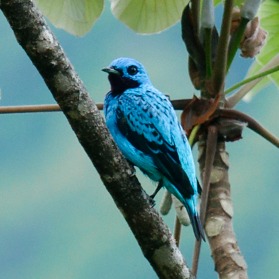
The male of this species is one of the most dazzling birds in the Neotropics, exhibiting a brilliant and metallic turquoise blue plumage that seems to shine with its own light. This iridescent blue is speckled with black mottling on the back, wings, and tail, and contrasts dramatically with an extensive dark purple or plum patch on the throat and center of the belly. It has a short, broad-based black beak adapted for swallowing whole fruits, as well as short gray legs. The female is radically different, designed for invisibility: she presents a dark grayish-brown plumage on the upperparts and paler on the underparts, with a dense scaly or scalloped pattern of whitish and cinnamon edges that grants her perfect camouflage against lichen-mottled branches.

Added by

Anonymous Curator

Reviewed by

Under Review

Last modified by

Julia Trouin

TaxonomyBiological classification ranks placing this species within the tree of life, from Kingdom down to Genus.

PhylumRank below Kingdom. Groups organisms sharing a fundamental body plan (e.g., Chordata = vertebrates and some invertebrates).Chordata
ClassRank below Phylum. Subdivides by structural traits (e.g., Mammalia, Aves, Reptilia, Insecta).Aves
OrderRank below Class. Groups related families sharing common ancestry (e.g., Carnivora, Primates).Passeriformes
FamilyRank below Order. Groups closely related genera (e.g., Felidae = cats, Canidae = dogs).Cotingidae
GenusRank just above Species. The first word in the two-part binomial scientific name.Cotinga
Taxonomic AuthorityThe scientist who first formally described and published this species, followed by the year of publication.Ridgway, 1887
Record Completeness
94%
Coming soon

Ecology & StatusHow this species lives: habitat preferences, diet, behavior, population status, and role in its ecosystem.

OriginWhether the species is native (evolved here), endemic (found only here), or introduced by human activity.

Endemic

Population TrendDirection of change in population size over time: increasing, stable, decreasing, or unknown.

Decreasing

Breeding SeasonTime of year when this species typically reproduces or flowers.

--

Trophic RolePosition in the food chain: producer, herbivore, carnivore, omnivore, decomposer, or parasite.

Frugivore

Recent SightingsWhether this species has been observed in the wild in Costa Rica within recent years.

Yes

Habitat SummaryOverview of the specific ecosystems and environments where this species is found in Costa Rica. Multi-lang

It is an endemic species of the southern Pacific slope of Costa Rica (notably the Osa Peninsula and Golfo Dulce) and extreme western Panama. It inhabits the upper canopy and edges of humid primary lowland and foothill forests, generally below 1,200 meters in altitude. Although it prefers intact forests, it can visit tall remnant trees in shade-grown coffee plantations or forest clearings, provided there is an abundance of mature fruiting trees.

BehaviourDaily activity patterns, movement, territory use, foraging style, and seasonal behavioral changes. Multi-lang

It is a bird of solitary, discreet, and rather inactive nature that spends long periods perched motionlessly on the most prominent branches of the canopy. Lacking a voice, it does not use songs to demarcate its territory; instead, males chase away intruders through rapid and energetic aerial pursuits where the loud buzzing or whistling of their wings acts as a sonic warning. Its straight-line flight is fast and direct, reminiscent of a small dove.

Social ActivitySocial structure: whether the species is solitary, paired, or colonial; hierarchy and communication. Multi-lang

They are markedly solitary and territorial birds outside of brief reproductive encounters. They do not congregate in mixed flocks with other frugivorous bird species. Adult males may tolerate each other at a safe distance only if they coincide in a tree offering an extreme abundance of ripe fruit, but they generally maintain a strict territorial spacing in the canopy, mutually avoiding one another.

Feeding GuildWhat the species eats, how it forages or hunts, and its role as a consumer in the food web. Multi-lang

Strict mid- and upper-canopy frugivore. Its survival and energy depend on a constant supply of fleshy fruits. It feels a particular predilection for the nutritious berries of epiphytic plants like mistletoes, as well as small wild figs (Ficus spp.). Very rarely and exceptionally, it may catch insects in a short flight if it needs to supplement its protein reserves during the breeding season.

Trophic Chain DetailsSpecific interactions in local food webs: prey species, predators, competitors, and scavengers. Multi-lang

It functions as a highly specialized primary consumer and a crucial seed disperser for the maintenance of upper canopy trees, especially from the families Lauraceae, Moraceae, and Loranthaceae (mistletoes). By swallowing whole fruits and regurgitating or defecating the intact seeds at great distances during its territorial flights, it keeps the complex forest structure alive. Within the food web, it is often preyed upon by raptors such as small forest eagles and hawks, while its nests are attacked by arboreal snakes and toucans.

Reproductive BehaviourMating strategies, courtship displays, nesting or spawning behavior, and parental care. Multi-lang

The mating system is polygynous, and males offer no parental care whatsoever. After copulation, the female solely assumes all reproductive responsibility: she builds an extremely small and delicate nest in the shape of a platform or flattened cup, hidden in the fork of a very high canopy branch and disguised with lichens. She lays a single egg (rarely two) of a greenish-gray color with dark spots. The female stealthily incubates for about 20 to 22 days. The chick, born altricial, remains in the tiny nest being fed exclusively by the mother for 25 to 28 days until it develops the strength to fly.

Physical Measures

Length (cm)

17.0 - 19.0 cm

Weight (Grams)

40 g - 55 g

Offspring per cycleTypical number of young (live births, eggs, or seeds) produced by one adult in a single reproductive event or breeding season.1 - 2
Sexual DimorphismObservable physical differences between males and females of the same species (e.g., size, coloration, features).Yes

Lifespan

Sexual MaturityAge at which the individual becomes capable of reproducing for the first time.

1 - 2 Years

Gestation / IncubationDuration from fertilization to birth (mammals) or to hatching (egg-laying species).

20 - 22

Lifespan EstimatedExpected duration of life from birth to natural death under wild conditions.
Males6 - 10 Years
Females6 - 10 Years

Sexual DimorphismPhysical differences in size, coloration, or morphology between males and females of this species.

Males Multi-lang

A visual marvel of the forest: exhibits completely brilliant, iridescent turquoise blue plumage with dense black mottling on the wings and back, adorned by a distinctive dark purple or plum patch covering its throat and center of the chest. This coloration serves as a strong territorial and sexual signal over long distances.

Females Multi-lang

Completely cryptic and with no trace of the male's brilliant colors. Her plumage is of a generalized grayish-brown tone, exquisitely detailed with a whitish and cinnamon scaly or scalloped pattern, designed by natural selection to render her invisible while entirely assuming the silent labor of incubation in the exposed canopy.

Evolutionary AdaptationsInherited traits and behaviors that improve the species' survival and reproduction in its specific environment. Multi-lang

Structural Plumage Coloration: The intense blue of the males does not come from pigments, but from the internal nanostructure of the feathers that refracts sunlight, scattering only the blue spectrum. This ensures that their color never fades or wears out over time.
Evolutionary Silence: Unlike most passerines, Turquoise Cotingas lack complex syringeal musculature (vocal organ). Being evolutionarily nearly mute, males have adapted their primary wing feathers to produce a sharp, mechanical whistling sound during flight as a mechanism for communication and territoriality.

Main ThreatsDocumented pressures reducing the population: habitat loss, hunting, disease, climate change, and invasive species. Multi-lang

Deforestation and Endemic Habitat Loss: Due to its extremely small and confined global distribution, the logging of primary forests in the Southern Pacific for agricultural development, cattle ranching, and coastal real estate expansion directly threatens the viability of the species.
Canopy Nesting Vulnerability: By building extremely small and fragile nests in the crowns of emergent trees, eggs and chicks are highly exposed to severe storms and canopy predators such as toucans, aracaris, and hunting snakes.

Interesting FactsSurprising or notable facts that highlight what makes this species unique or ecologically important. Multi-lang

Motionless Jewels of the Sun: They have the peculiar habit of perching completely motionless for hours on the highest, barest branches of the forest canopy early in the morning, looking like a brilliant turquoise ornament artificially placed on the wood to absorb the first rays of the sun.
Ornithological Tribute: Its scientific name, Cotinga ridgwayi, was given in honor of the eminent American ornithologist Robert Ridgway, who was instrumental in the early study of Central American avifauna during the 19th century.