
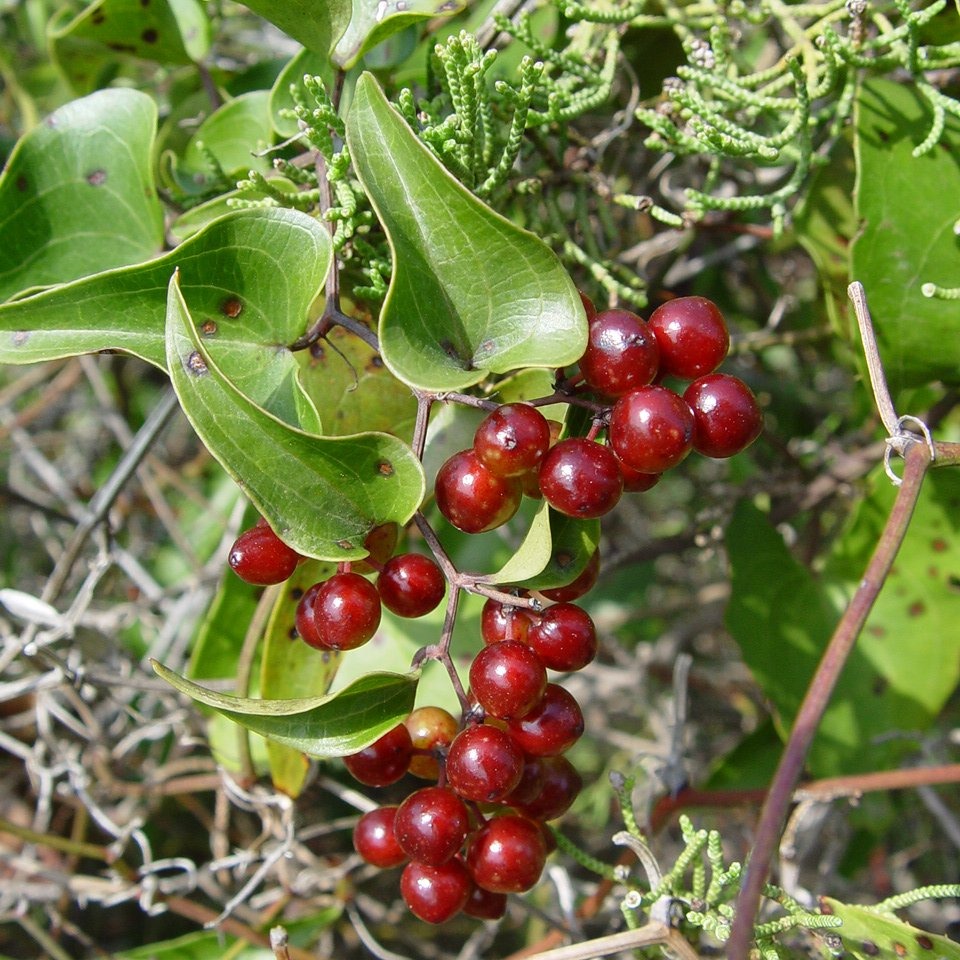
Smilax aspera
Sarsaparilla / Rough Bindweed
L., 1753
Added by
Anonymous Curator
Reviewed by
Under Review
Last modified by
Julia Trouin
TaxonomyBiological classification ranks placing this species within the tree of life, from Kingdom down to Genus.
Ecology & StatusHow this species lives: habitat preferences, diet, behavior, population status, and role in its ecosystem.
OriginWhether the species is native (evolved here), endemic (found only here), or introduced by human activity.
Native
Population TrendDirection of change in population size over time: increasing, stable, decreasing, or unknown.
Stable
Trophic RolePosition in the food chain: producer, herbivore, carnivore, omnivore, decomposer, or parasite.
--
Growth HabitPhysical form and structure of the plant: tree, shrub, herb, vine, epiphyte, aquatic, etc.
--
Leaf TypeLeaf characteristics: deciduous (seasonal shed), evergreen, simple, compound, needle-like, etc.
--
Flowering SeasonTime of year when this species typically reproduces or flowers.
--
Recent SightingsWhether this species has been observed in the wild in Costa Rica within recent years.
Yes
Habitat SummaryOverview of the specific ecosystems and environments where this species is found in Costa Rica. Multi-lang
It thrives in a wide variety of habitats, from maquis and dry scrublands to wet forest edges and oak woodlands. It is highly drought-resistant and prefers well-drained, often stony soils, with good sun exposure or partial shade. It is naturally distributed across the Mediterranean basin, Africa, and Asia, having naturalized in various regions of the Americas.Light & Water NeedsSunlight intensity and moisture levels this plant needs to grow and reproduce successfully. Multi-lang
Information not available in English. Help us expand this record!BehaviourDaily activity patterns, movement, territory use, foraging style, and seasonal behavioral changes. Multi-lang
It is a fundamental species for the structure of the understory and forest edge. By forming dense tangles, it creates 'islands of biodiversity' where birds and small mammals can nest and hide from predators. Its flowers are an important source of nectar for bees and syrphid flies, while its berries are a critical winter food source for migratory and resident birds.Toxicity / UsesToxic compounds present and their documented effects on humans or other organisms. Multi-lang
Information not available in English. Help us expand this record!Physical Measures
Length (cm)
500.0 - 1500.0 cm