
PlantaeIUCN LCIn Progress Recent Sighting
Smilax aspera
Sarsaparilla / Rough Bindweed
L., 1753
Detailed Texts Multi-lang
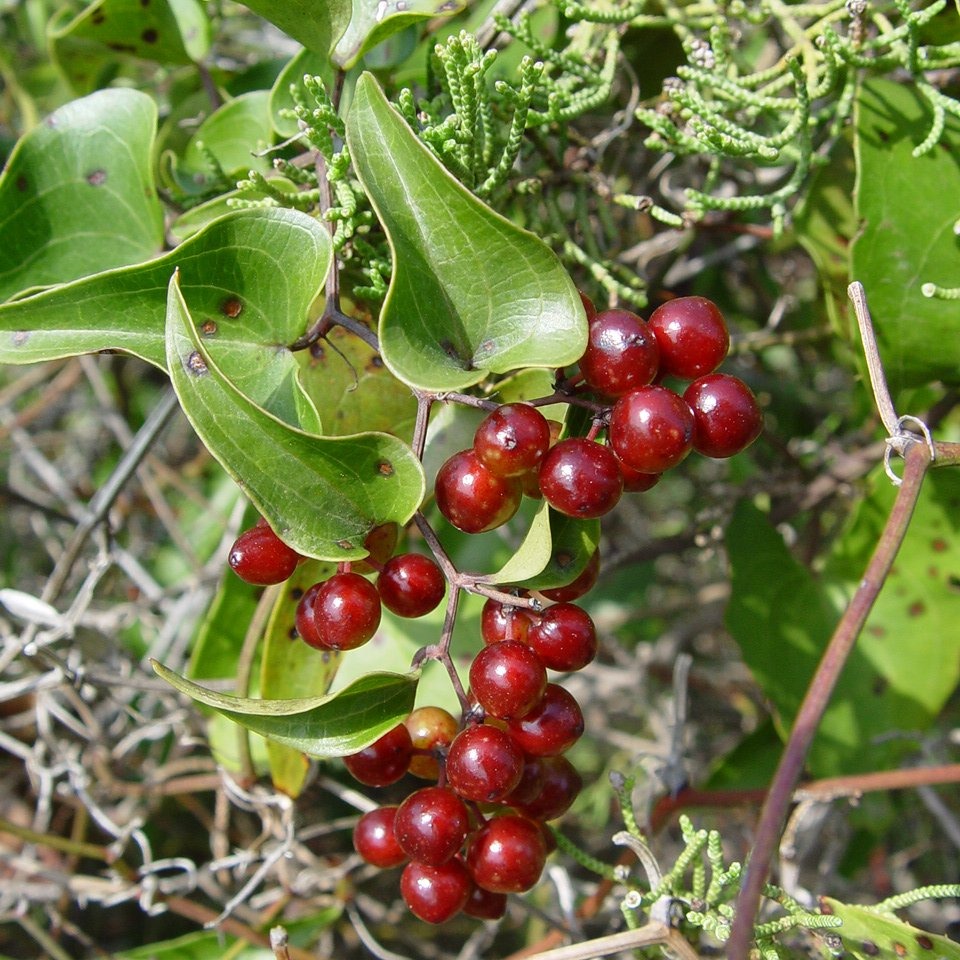
Smilax aspera is a perennial woody climbing plant, iconic for its angular stems armed with sharp prickles and its rhizomatous roots of high medicinal value. Its stems can reach up to 15 meters in length, zigzagging through vegetation using tendrils that arise from the base of the petioles. The leaves are persistent, leathery, and heart- or arrow-shaped, often with whitish spots and prickly margins. The flowers are small, yellowish-white or greenish, grouped in axillary umbels that emit a sweet fragrance. The fruit is a globose berry that ripens from bright red to black, forming striking clusters. It is an architectural species that creates dense, impenetrable thickets, fundamental for the protection of small fauna in Mediterranean and transition ecosystems.
Added by
Anonymous Curator
Reviewed by
Under Review
Last modified by
Julia Trouin
Taxonomy
PhylumTracheophyta
ClassLiliopsida
OrderLiliales
FamilySmilacaceae
GenusSmilax
Taxonomic AuthorityL., 1753
Ecology & Status
Origin
Native
Population Trend
Stable
Growth Habit
--
Leaf Type
--
Flowering Season
--
Recent Sightings
Yes
Habitat Summary Multi-lang
It thrives in a wide variety of habitats, from maquis and dry scrublands to wet forest edges and oak woodlands. It is highly drought-resistant and prefers well-drained, often stony soils, with good sun exposure or partial shade. It is naturally distributed across the Mediterranean basin, Africa, and Asia, having naturalized in various regions of the Americas.Light & Water Needs Multi-lang
Information not available in English. Help us expand this record!Behaviour Multi-lang
It is a fundamental species for the structure of the understory and forest edge. By forming dense tangles, it creates 'islands of biodiversity' where birds and small mammals can nest and hide from predators. Its flowers are an important source of nectar for bees and syrphid flies, while its berries are a critical winter food source for migratory and resident birds.Toxicity / Uses Multi-lang
Information not available in English. Help us expand this record!Physical Measures
Length (cm)
500.0 - 1500.0 cm
Reproductive Structures
Flower Photos (Max 2)
No imageFruit Photos (Max 2)
No imageEvolutionary Adaptations Multi-lang
Double Stipular Tendrils: Unlike other climbers, Smilax has a pair of tendrils emerging from the base of the petiole (modified stipules). This adaptation allows for an extremely firm multidirectional anchor, enabling it to climb smooth surfaces or intertwine in the scrub with great efficiency.
Prickly Stems and Leathery Leaves: The presence of recurved prickles protects the plant from large herbivores and aids in the climbing process by acting as hooks. Its hardened leaves reduce transpiration, allowing it to colonize arid environments.
Main Threats Multi-lang
Overexploitation of roots: Intensive use of its rhizomes in traditional medicine and the beverage industry can deplete local populations if sustainable harvesting is not practiced.
Interesting Facts Multi-lang
The original Sarsaparilla ingredient: Before modern sodas, the roots of this plant were used to create a refreshing and tonic beverage popular in the 19th century, valued for its supposed blood-purifying properties.
Smurfs' Food: In contemporary popular culture (specifically in The Smurfs comics), sarsaparilla berries are the favorite food of these creatures.