AnimaliaIUCN LCIn Progress Recent Sighting
Hyalinobatrachium fleischmanni
Fleischmann's Glass Frog
Boettger, 1893
Detailed Texts Multi-lang
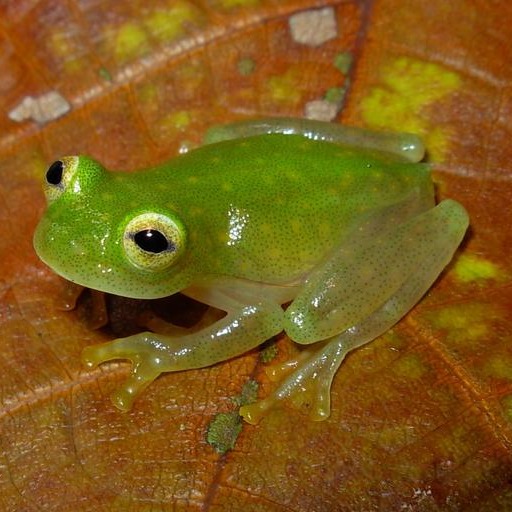
A small, delicate anuran, notable for its transparent ventral skin that allows its internal organs to be observed. Its back is a bright lime green with yellowish spots, which allows it to camouflage effectively among the leaves of riparian vegetation.
Added by
Anonymous Curator
Reviewed by
Under Review
Last modified by
Julia Trouin
Taxonomy
PhylumChordata
ClassAmphibia
OrderAnura
FamilyCentrolenidae
GenusHyalinobatrachium
Taxonomic AuthorityBoettger, 1893
Ecology & Status
Origin
Native
Population Trend
Stable
Breeding Season
Year Round
Trophic Role
Insectivore
Recent Sightings
Yes
Habitat Summary Multi-lang
Lives strictly along crystal-clear water streams in tropical jungles and cloud forests. It is a mostly arboreal species that prefers to perch on the underside of leaves above the water.Behaviour Multi-lang
Nocturnal species highly dependent on humidity. Its behavior focuses on defending territories along the stream and constant care of the egg clutch during the night.Social Activity Multi-lang
Solitary, except during the breeding season. Males are intensely territorial, emitting constant calls and fighting physically with other males for control of the best leaves for nesting.Feeding Guild Multi-lang
Ambush predator. Waits patiently on the underside of the leaf for an insect to land or fly nearby, then lunges with a calculated jump to capture it.Trophic Chain Details Multi-lang
Insectivore. Feeds on small flying insects and arachnids found in the low arboreal vegetation, capturing them with quick and precise movements during the night.Reproductive Behaviour Multi-lang
Oviparous species. The female deposits her eggs in a gelatinous mass on the underside of leaves hanging over streams. After hatching, the tadpoles fall into the water to complete their development.Physical Measures
Length (cm)
1.8 - 2.5 cm
Weight (Grams)
1 g - 2 g
Offspring per cycle15 - 30
Sexual DimorphismYes
Lifespan
Sexual Maturity
1 - 2 Years
Gestation / Incubation
1 - 2
Lifespan Estimated
Males2 - 4 Years
Females2 - 4 Years
Sexual Dimorphism
Males Multi-lang
Males are slightly smaller and possess developed vocal sacs, as well as humeral spines on their front limbs, which they use to fight against other males in territorial disputes.
Females Multi-lang
Females are larger in size and lack humeral spines. Their structure is more voluminous, facilitating the production of the egg mass necessary for reproduction.
Evolutionary Adaptations Multi-lang
Ventral Transparency: This unique adaptation reduces its visibility against the leaf on which it rests when illuminated from above, minimizing the contrast of its silhouette to predators.
Main Threats Multi-lang
Water Pollution: The sensitivity of its eggs and tadpoles to pesticides and sediments in stream water puts its reproductive success at risk in agricultural areas.
Interesting Facts Multi-lang
Male Parental Care: The male dedicates a large part of its energy to patrolling and protecting the egg clutch on the underside of leaves, defending it against predatory insects and preventing them from drying out through constant wetting.