
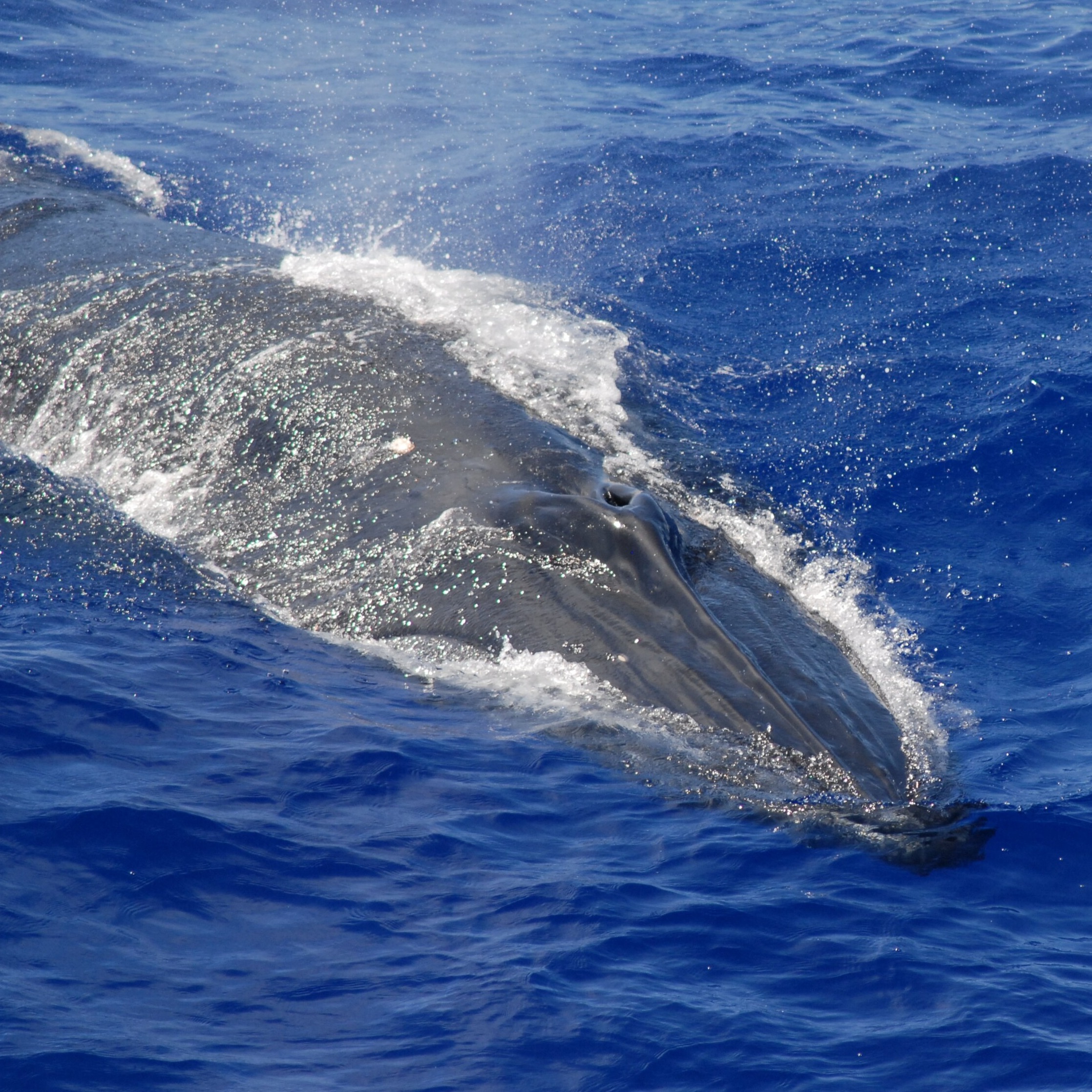
Balaenoptera edeni
Bryde's Whale
Anderson, 1879
Added by
Anonymous Curator
Reviewed by
Under Review
Last modified by
Julia Trouin
TaxonomyBiological classification ranks placing this species within the tree of life, from Kingdom down to Genus.
Ecology & StatusHow this species lives: habitat preferences, diet, behavior, population status, and role in its ecosystem.
OriginWhether the species is native (evolved here), endemic (found only here), or introduced by human activity.
Native
Population TrendDirection of change in population size over time: increasing, stable, decreasing, or unknown.
Unknown
Breeding SeasonTime of year when this species typically reproduces or flowers.
Year Round
Trophic RolePosition in the food chain: producer, herbivore, carnivore, omnivore, decomposer, or parasite.
Carnivore
Recent SightingsWhether this species has been observed in the wild in Costa Rica within recent years.
Yes
Habitat SummaryOverview of the specific ecosystems and environments where this species is found in Costa Rica. Multi-lang
It is the only baleen whale that spends its entire life in tropical and subtropical waters (between 40°N and 40°S). It does not undertake long migrations to the poles to feed like other large whales do. In Costa Rica, it is a resident species and can be observed year-round, being especially common in the South Pacific, in coastal and pelagic zones of the Golfo Dulce, the Osa Peninsula, and the Costa Rica Thermal Dome, where nutrient abundance attracts its prey.BehaviourDaily activity patterns, movement, territory use, foraging style, and seasonal behavioral changes. Multi-lang
They are usually solitary whales or found in pairs (especially mothers with calves), although loose aggregations can form in areas with abundant food. Their swimming can reach 20-25 km/h. They do not raise their tail flukes when diving; instead, they arch their back sharply and disappear. They make relatively short dives, of 5 to 15 minutes, to hunt in the epipelagic layer. They often associate with tunas, dolphins, and seabirds that corral fish at the surface.Social ActivitySocial structure: whether the species is solitary, paired, or colonial; hierarchy and communication. Multi-lang
Not very social. Mainly solitary. They only form small temporary groups in areas with high food concentration or females with their nursing calves.Feeding GuildWhat the species eats, how it forages or hunts, and its role as a consumer in the food web. Multi-lang
Carnivore / Planktivore / Piscivore (Filter feeder).Trophic Chain DetailsSpecific interactions in local food webs: prey species, predators, competitors, and scavengers. Multi-lang
Pelagic filter-predator. Feeds on krill, copepods, but especially on small pelagic fish (sardines, mackerel, anchovies). Occasionally, calves or weak individuals may be attacked by large pods of Killer Whales (Orcinus orca) or large pelagic sharks.Reproductive BehaviourMating strategies, courtship displays, nesting or spawning behavior, and parental care. Multi-lang
Lacking marked polar migrations, they can breed and calve year-round, although regional peaks may exist. The gestation period lasts between 11 and 12 months. A single calf is born, measuring about 4 meters in length and weighing nearly a ton. The calf is nursed for approximately 6 months on extremely fat-rich milk before being weaned and separating from its mother.Physical Measures
Length (cm)
1150.0 - 1500.0 cm
Weight (Grams)
12000.00 kg - 25000.00 kg
Lifespan
Sexual MaturityAge at which the individual becomes capable of reproducing for the first time.
96 - 132 Months
Gestation / IncubationDuration from fertilization to birth (mammals) or to hatching (egg-laying species).
330 - 365