
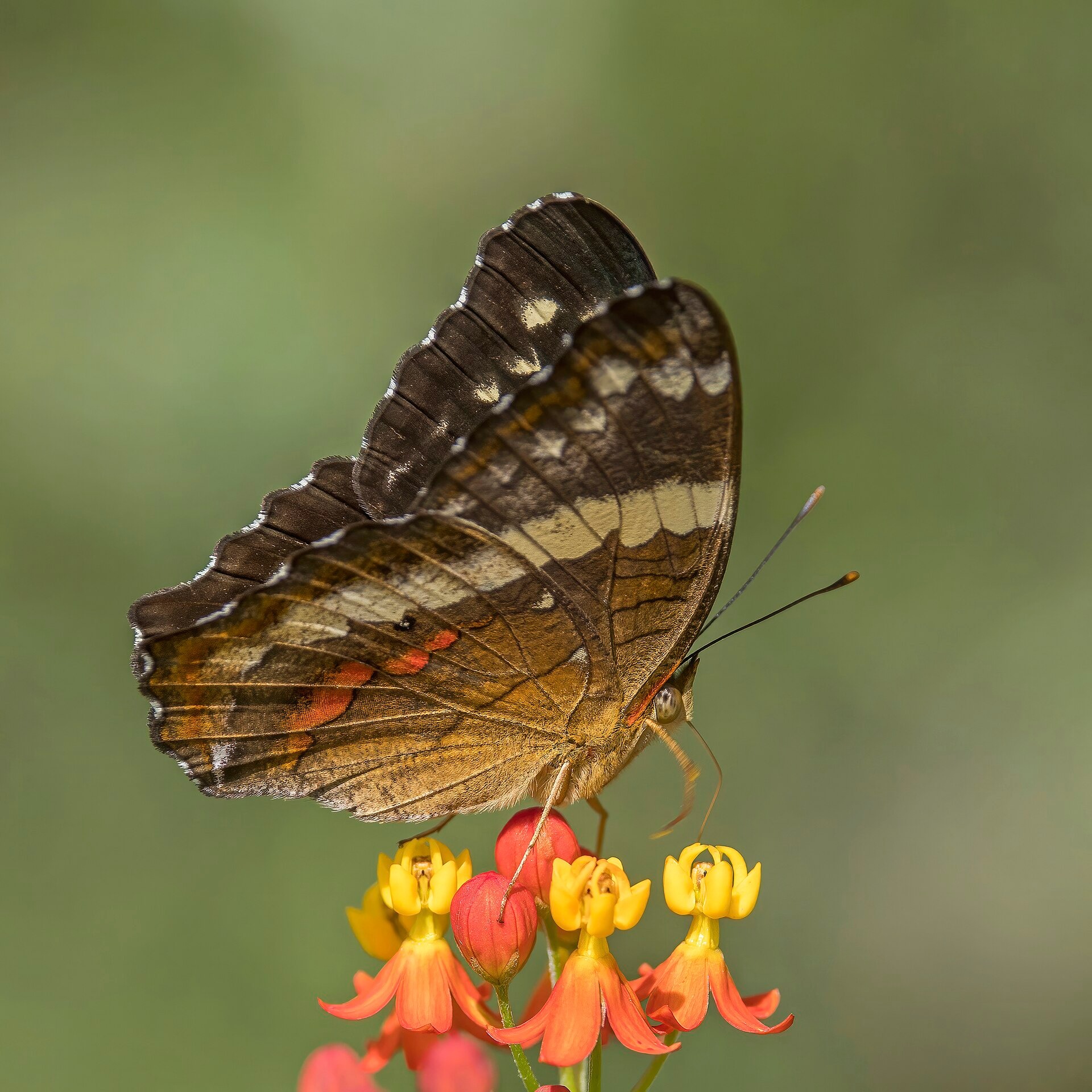
Anartia fatima
Banded Peacock
Fabricius, 1793
Added by
Anonymous Curator
Reviewed by
Under Review
Last modified by
Julia Trouin
TaxonomyBiological classification ranks placing this species within the tree of life, from Kingdom down to Genus.
Ecology & StatusHow this species lives: habitat preferences, diet, behavior, population status, and role in its ecosystem.
OriginWhether the species is native (evolved here), endemic (found only here), or introduced by human activity.
Native
Population TrendDirection of change in population size over time: increasing, stable, decreasing, or unknown.
Stable
Breeding SeasonTime of year when this species typically reproduces or flowers.
Year Round
Trophic RolePosition in the food chain: producer, herbivore, carnivore, omnivore, decomposer, or parasite.
Herbivore
Recent SightingsWhether this species has been observed in the wild in Costa Rica within recent years.
Yes
Habitat SummaryOverview of the specific ecosystems and environments where this species is found in Costa Rica. Multi-lang
It is commonly found in open areas, forest clearings, gardens, and roadsides from Texas to Costa Rica and northern South America. It is an opportunistic species that thrives in disturbed ecosystems.BehaviourDaily activity patterns, movement, territory use, foraging style, and seasonal behavioral changes. Multi-lang
It has active territorial behavior. Males usually perch in sunny and visible spots, fiercely chasing any other intruder (even of other species) that approaches their patrol zone.Social ActivitySocial structure: whether the species is solitary, paired, or colonial; hierarchy and communication. Multi-lang
Solitary individuals are observed patrolling, but they can form small groups near abundant flower sources during peak sunny hours.Feeding GuildWhat the species eats, how it forages or hunts, and its role as a consumer in the food web. Multi-lang
Nectarivore. Its diet consists of nectar from flowers of Ruellia, Lantana, and other Asteraceae common in its range.Trophic Chain DetailsSpecific interactions in local food webs: prey species, predators, competitors, and scavengers. Multi-lang
It is an important link in the food chain as a primary consumer of nectar and, in turn, as prey for spiders, praying mantises, and small birds that inhabit gardens.Reproductive BehaviourMating strategies, courtship displays, nesting or spawning behavior, and parental care. Multi-lang
Females place their eggs individually on the underside of Ruellia leaves. The larvae are solitary and show branched spines for their defense.Physical Measures
Length (cm)
5.0 - 6.5 cm
Weight (Grams)
0.3 g - 0.7 g
Lifespan
Sexual MaturityAge at which the individual becomes capable of reproducing for the first time.
1 - 2 Months
Gestation / IncubationDuration from fertilization to birth (mammals) or to hatching (egg-laying species).
8 - 12