
Costa Rica Species
Ramphocelus passerinii
AnimaliaHighest rank in taxonomy. Groups all life into domains: Animalia, Plantae, Fungi, etc.IUCN LCInternational Union for Conservation of Nature — the world authority on species extinction risk, using standardized criteria. — Least Concern — widespread and abundant; not at immediate risk of extinction.In ProgressCurrent stage of this record in the editorial review workflow. Recent Sighting

Ramphocelus passerinii

Passerini's Tanager

Bonaparte, 1831

Detailed Texts Multi-lang
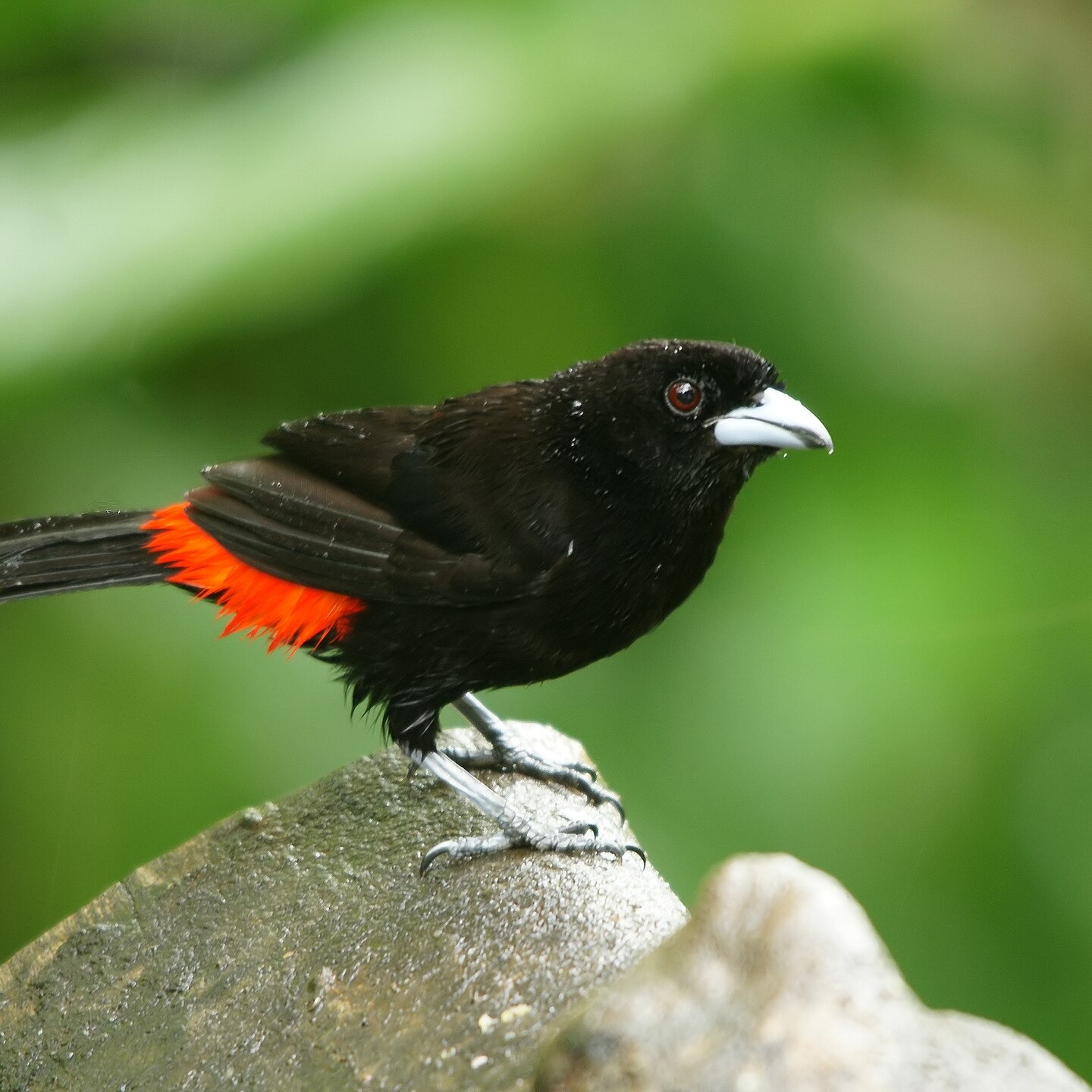
Passerini's tanager (Ramphocelus passerinii) is a medium-sized passerine bird belonging to the Thraupidae family, widely recognized in Costa Rica for the dramatic plumage of the male. Formerly considered conspecific with Cherrie's tanager (Ramphocelus costaricensis) under the name 'scarlet-rumped tanager', it is now recognized as a distinct species restricted to the Caribbean slope of Central America, from southern Mexico to western Panama. It has a thick, conical bill, adapted for an omnivorous diet with a strong frugivorous inclination, featuring a pale silvery-blue lower base. It is a highly conspicuous and gregarious species, often moving in small noisy groups through the understory and forest edges. Unlike birds that rely on camouflage, this species uses the intense contrast of its colors for visual communication and sexual selection in the dense tropical vegetation.

Added by

Anonymous Curator

Reviewed by

Under Review

Last modified by

Julia Trouin

TaxonomyBiological classification ranks placing this species within the tree of life, from Kingdom down to Genus.

PhylumRank below Kingdom. Groups organisms sharing a fundamental body plan (e.g., Chordata = vertebrates and some invertebrates).Chordata
ClassRank below Phylum. Subdivides by structural traits (e.g., Mammalia, Aves, Reptilia, Insecta).Aves
OrderRank below Class. Groups related families sharing common ancestry (e.g., Carnivora, Primates).Passeriformes
FamilyRank below Order. Groups closely related genera (e.g., Felidae = cats, Canidae = dogs).Thraupidae
GenusRank just above Species. The first word in the two-part binomial scientific name.Ramphocelus
Taxonomic AuthorityThe scientist who first formally described and published this species, followed by the year of publication.Bonaparte, 1831
Record Completeness
94%
Coming soon

Ecology & StatusHow this species lives: habitat preferences, diet, behavior, population status, and role in its ecosystem.

OriginWhether the species is native (evolved here), endemic (found only here), or introduced by human activity.

Native

Population TrendDirection of change in population size over time: increasing, stable, decreasing, or unknown.

Stable

Breeding SeasonTime of year when this species typically reproduces or flowers.

--

Trophic RolePosition in the food chain: producer, herbivore, carnivore, omnivore, decomposer, or parasite.

Frugivore

Recent SightingsWhether this species has been observed in the wild in Costa Rica within recent years.

Yes

Habitat SummaryOverview of the specific ecosystems and environments where this species is found in Costa Rica. Multi-lang

It is one of the most abundant species on the Caribbean slope of Costa Rica, inhabiting from sea level up to approximately 1,200 meters in altitude. It thrives in humid and very humid tropical zones, showing a strong preference for semi-open and disturbed habitats. It is commonly found in primary and secondary forest edges, dense thickets, young secondary growth areas, banana and cacao plantations, humid tropical gardens, and clearings with abundant shrubs. It avoids the deep interior of closed mature forests, preferring zones where direct sunlight allows the growth of pioneer fruiting plants and vines. It is a species that has adapted to and benefited from partial deforestation, provided that shrubs and fruit trees are maintained in the landscape.

BehaviourDaily activity patterns, movement, territory use, foraging style, and seasonal behavioral changes. Multi-lang

It is a bird of diurnal habits, very restless and vivacious, almost in constant motion. It moves with agile hops through shrubs and vines, rarely stopping for more than a few seconds. It uses persistent vocal communication, emitting constant harsh 'wac' or 'chuck' calls to keep the group together while foraging. Males often perch on high, visible perches at dawn to claim territory, emitting a squeaky, sharp song, and occasionally open their wings or fluff their rump feathers to display the vibrant red patch. It frequently associates indirectly with other large frugivorous birds, visiting fruiting trees in the company of honeycreepers, euphonias, and even oropendolas. They are very wary on the forest floor but bold in the mid-canopy layer.

Social ActivitySocial structure: whether the species is solitary, paired, or colonial; hierarchy and communication. Multi-lang

It is a highly gregarious bird outside the reproductive peak, moving in flocks of 4 to 12 individuals that often include adult males, females, and immature individuals. They are aggressively territorial around the nest but social when foraging. It is very common to observe multiple Passerini's tanagers interacting noisily in banana plantations. They freely join mixed flocks with other tanagers (Thraupis spp., Ramphocelus sanguinolentus) and woodpeckers when foraging in the canopy. Their strong group cohesion is maintained through constant vocal contact and nervous visual displays of the red patch in males.

Feeding GuildWhat the species eats, how it forages or hunts, and its role as a consumer in the food web. Multi-lang

Understory and mid-stratum omnivore (Frugivore/Insectivore). Although its strong, conical bill allows it to exploit a wide range of foods, its primary diet consists of small to medium fleshy fruits, berries, and arils, tearing off pieces with twisting motions of the bill. It is a regular at banana, papaya, Cecropia, and Melastomataceae fruits. For animal proteins, it methodically searches through foliage (gleaning), checking the undersides of leaves and crevices in branches for caterpillars, crickets, spiders, and winged beetles. It supplements this by visiting floral nectar sources or large flowers, and readily eats at bird feeders in Costa Rican tropical lodges.

Trophic Chain DetailsSpecific interactions in local food webs: prey species, predators, competitors, and scavengers. Multi-lang

It acts primarily as a frugivorous and insectivorous primary consumer, occupying a key niche in the dispersal of early-successional seeds in the Caribbean region. Its robust diet of Cecropia, Miconia, and Melastomataceae shrubs fruits ensures forest regeneration in deforested areas, as they excrete the seeds intact. They supplement this diet with insects (caterpillars, beetles, spiders) gleaned from leaves to provide protein, especially during the breeding season to rear chicks. Small frogs and lizards occasionally enter their diet. They are regular prey for forest raptors such as the semiplumbeous hawk (Leucopternis semiplumbeus) and various snakes (like the tiger ratsnake, Spilotes pullatus) that prey on adults, while their nests are attacked by small mammals, toucans, and reptiles.

Reproductive BehaviourMating strategies, courtship displays, nesting or spawning behavior, and parental care. Multi-lang

The breeding season strongly coincides with the Caribbean tropical climate, extending from March to August. The male performs a courtship display by presenting the scarlet patch to the female, raising his tail and pointing his bill upwards. The female alone undertakes the construction of a bulky cup-shaped nest, structured from broad leaves (frequently banana), rootlets, and spiderwebs, hidden in dense thickets or shrubs at low height (usually 1 to 3 meters). She lays two pale blue to grayish eggs with abundant dark brown irregular spots and scrawls. Incubation lasts about 12 to 14 days and is performed exclusively by the female, while the male guards the area and occasionally brings her food. Once the altricial chicks hatch, both parents eagerly take turns feeding them protein-rich insects and small fruits. The chicks leave the nest after 11-12 days, although they continue to be fed by the parents for several more weeks in the dense understory.

Physical Measures

Length (cm)

15.0 - 17.0 cm

Weight (Grams)

28 g - 35 g

Offspring per cycleTypical number of young (live births, eggs, or seeds) produced by one adult in a single reproductive event or breeding season.2 - 3
Sexual DimorphismObservable physical differences between males and females of the same species (e.g., size, coloration, features).Yes

Lifespan

Sexual MaturityAge at which the individual becomes capable of reproducing for the first time.

1 Years

Gestation / IncubationDuration from fertilization to birth (mammals) or to hatching (egg-laying species).

12 - 14

Lifespan EstimatedExpected duration of life from birth to natural death under wild conditions.
Males5 - 10 Years
Females5 - 10 Years

Sexual DimorphismPhysical differences in size, coloration, or morphology between males and females of this species.

Males Multi-lang

The adult male is unmistakable and spectacular: all its plumage is a deep, velvety matte black, with the exception of an intense, brilliant (almost incandescent) scarlet red patch covering the entire lower back (rump) and the upper-tail coverts. The bill, strong and swollen at the base, is black on the upper mandible and silvery or bright bluish-white on the large swollen base of the lower mandible, serving as an additional contrast. The eyes are dark red (almost maroon) or brown, and the legs are dark gray or black.

Females Multi-lang

The female completely lacks the spectacular red and black of the male (extreme dimorphism). Her plumage is designed for camouflage during incubation. The upper parts (head, back, wings, and tail) are a dull, dark olive-brown hue. The throat and underparts are an ochre-yellow to yellowish-olive color, without stark markings, fading slightly towards the belly. Unlike the male, the female does not have the silvery basal bill; her bill is uniformly blackish or dark horn-gray. Passerini's tanager females (R. passerinii) differ from females of the closely related R. costaricensis because they lack the bright orange band on the breast.

Evolutionary AdaptationsInherited traits and behaviors that improve the species' survival and reproduction in its specific environment. Multi-lang

Extreme contrast plumage (Visual aposematism in males): The matte velvety black of the male absorbs light, causing the scarlet red rump patch to stand out with an almost luminescent intensity in the filtered light conditions of the Caribbean understory. This coloration serves as a strong visual signal for both territorial warning and sexual attraction, allowing them to communicate at a distance in dense tropical vegetation where acoustic signals might be lost.
Reflective lower mandible: Males possess a basal widening on the lower mandible of the bill that is a silvery bluish-white color that reflects light. It works in conjunction with the red rump during courtship and aggression displays. By raising the head and pointing the bill upward, this patch reflects the scarce forest light, operating as a 'mirror' that intimidates rivals or attracts females.
Gregarious foraging behavior: They routinely forage in noisy groups of 3 to 12 individuals. This strategy minimizes individual predation risk through collective vigilance, allowing them to explore open forest edge areas where solitary birds would be more vulnerable to hawks. Additionally, by moving together, they manage to displace competing species from productive fruiting trees.

Main ThreatsDocumented pressures reducing the population: habitat loss, hunting, disease, climate change, and invasive species. Multi-lang

Window collisions: Due to their high density in peri-urban zones of the Caribbean slope and their habit of moving quickly in groups through gardens, they suffer a high mortality rate from striking reflective glass on buildings and ecotourism-oriented hotels.
Nest predation: Given that they build open cup-shaped nests in relatively low shrubs (usually between 1 and 5 meters high), their eggs and chicks are highly vulnerable to arboreal snakes (such as the eyelash viper), toucans (Ramphastos sulfuratus), small mammals like coatis (Nasua narica), and domestic cats.

Interesting FactsSurprising or notable facts that highlight what makes this species unique or ecologically important. Multi-lang

The common name 'Sargento' (Sergeant) by which it is popularly known in Costa Rica alludes to the red stripes or epaulets worn by military sergeants on their uniforms, in parallelism with the vibrant scarlet patch that contrasts with the matte black plumage on the male's lower back.
Until a few decades ago, this species and Cherrie's tanager (Ramphocelus costaricensis, typical of Costa Rica's southern Pacific) were considered the same species, called the 'Scarlet-rumped Tanager'. Although males of both are visually identical in the field, females of R. costaricensis have a vivid orange breast band that is absent in R. passerinii females. Today they are divided by the Talamanca Mountain Range and recognized as distinct species.