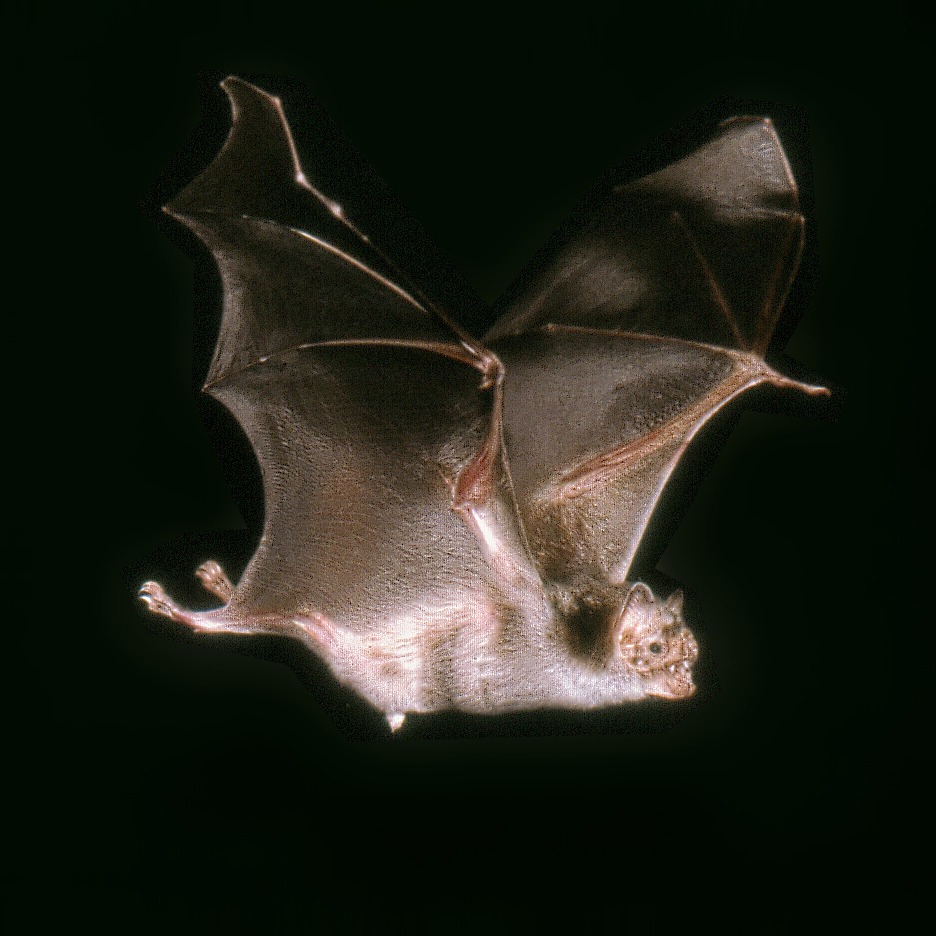
Desmodus rotundus
Common Vampire Bat
(É. Geoffroy, 1810)
Added by
Anonymous Curator
Reviewed by
Under Review
Last modified by
Julia Trouin
TaxonomyBiological classification ranks placing this species within the tree of life, from Kingdom down to Genus.
Ecology & StatusHow this species lives: habitat preferences, diet, behavior, population status, and role in its ecosystem.
OriginWhether the species is native (evolved here), endemic (found only here), or introduced by human activity.
Native
Population TrendDirection of change in population size over time: increasing, stable, decreasing, or unknown.
Stable
Breeding SeasonTime of year when this species typically reproduces or flowers.
Year Round
Trophic RolePosition in the food chain: producer, herbivore, carnivore, omnivore, decomposer, or parasite.
Carnivore
Recent SightingsWhether this species has been observed in the wild in Costa Rica within recent years.
Yes
Habitat SummaryOverview of the specific ecosystems and environments where this species is found in Costa Rica. Multi-lang
It is a highly adaptable bat that inhabits a variety of tropical and subtropical ecosystems, including wet rainforests, dry forests, and scrublands. It requires dark roosts such as deep caves, tunnels, abandoned mines, or hollow trees. Its distribution and abundance have been drastically favored by the introduction of livestock (cows, horses, pigs) in pastures, providing it with an endless food source. In Costa Rica, it is ubiquitous in rural and livestock areas on both slopes.BehaviourDaily activity patterns, movement, territory use, foraging style, and seasonal behavioral changes. Multi-lang
It is strictly nocturnal. Contrary to myth, they do not 'suck' blood. They land silently on the ground near their sleeping prey (usually cows or horses), walk stealthily on all fours, make a small 3 mm cut with their incisors, and then lap up the free-flowing blood with their grooved tongue, consuming about 20-30 ml (half their weight) in half an hour.Social ActivitySocial structure: whether the species is solitary, paired, or colonial; hierarchy and communication. Multi-lang
Highly gregarious and social. They form colonies ranging from dozens to thousands of individuals. They maintain strong social bonds, engaging in mutual grooming and food sharing.Feeding GuildWhat the species eats, how it forages or hunts, and its role as a consumer in the food web. Multi-lang
Sanguivore (Hematophagous).Trophic Chain DetailsSpecific interactions in local food webs: prey species, predators, competitors, and scavengers. Multi-lang
Hematophagous parasite. Feeds exclusively on the blood of medium and large mammals. It is preyed upon mainly by owls (like the barn owl), arboreal snakes that invade their caves, and occasionally by other carnivorous mammals if caught on the ground.Reproductive BehaviourMating strategies, courtship displays, nesting or spawning behavior, and parental care. Multi-lang
They breed year-round. Gestation is surprisingly long for a bat of its size, lasting approximately 7 months (200-215 days). A single, well-developed pup is born, nursed with milk for the first month, and then mothers begin to regurgitate blood for them. Pups become independent and join the blood-sharing network at around 5 to 6 months of age.Physical Measures
Length (cm)
7.0 - 9.0 cm
Weight (Grams)
25 g - 45 g
Lifespan
Sexual MaturityAge at which the individual becomes capable of reproducing for the first time.
9 - 10 Months
Gestation / IncubationDuration from fertilization to birth (mammals) or to hatching (egg-laying species).
205 - 215