
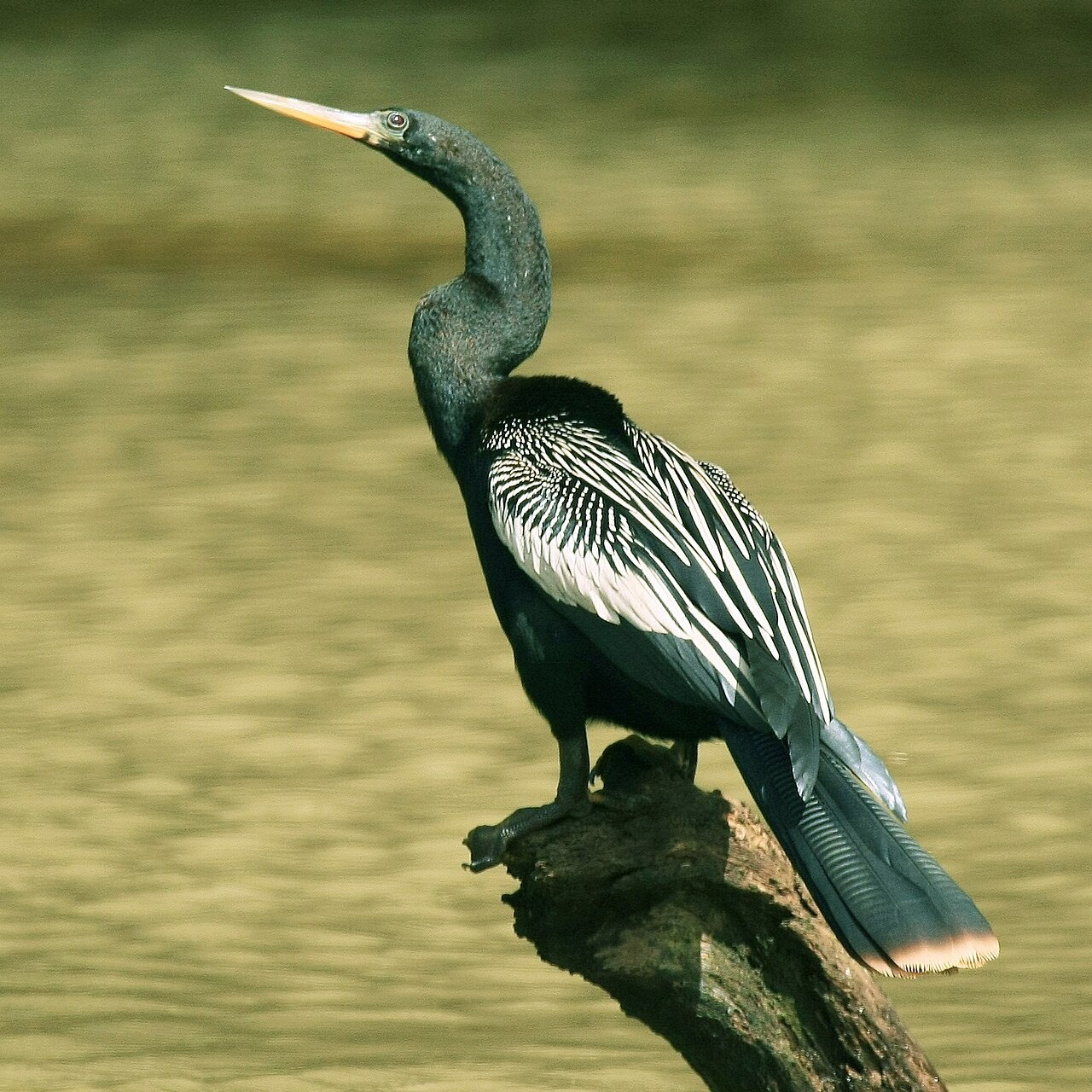
Anhinga anhinga
Anhinga / Snakebird
(Linnaeus, 1766)
Added by
Anonymous Curator
Reviewed by
Under Review
Last modified by
Julia Trouin
TaxonomyBiological classification ranks placing this species within the tree of life, from Kingdom down to Genus.
Ecology & StatusHow this species lives: habitat preferences, diet, behavior, population status, and role in its ecosystem.
OriginWhether the species is native (evolved here), endemic (found only here), or introduced by human activity.
Native
Population TrendDirection of change in population size over time: increasing, stable, decreasing, or unknown.
Stable
Breeding SeasonTime of year when this species typically reproduces or flowers.
Year Round
Trophic RolePosition in the food chain: producer, herbivore, carnivore, omnivore, decomposer, or parasite.
Carnivore
Recent SightingsWhether this species has been observed in the wild in Costa Rica within recent years.
Yes
Habitat SummaryOverview of the specific ecosystems and environments where this species is found in Costa Rica. Multi-lang
It is a species strictly linked to freshwater and brackish wetlands with calm or slow-moving waters. It inhabits lagoons, swamps, estuaries, mangrove channels, and river margins bordered by forests or dead trees. It imperatively requires low branches, fallen logs, or protruding roots to perch and dry its wings. In Costa Rica, it is a common and very conspicuous bird in areas like Caño Negro National Wildlife Refuge, Palo Verde National Park, Tortuguero, and the Tempisque River basin, from sea level up to 600 meters in elevation.BehaviourDaily activity patterns, movement, territory use, foraging style, and seasonal behavioral changes. Multi-lang
It is a strictly diurnal bird. It spends much of its time hunting slowly underwater, searching for fish hidden among submerged vegetation. Because its plumage becomes soaked, it loses heat quickly in the water. After hunting, it must imperatively seek a sunny perch (like a dead tree), where it will stand with its wings fully extended for hours. This iconic pose serves not only to dry the feathers so it can fly again but also to absorb solar radiation and thermoregulate its body temperature.Social ActivitySocial structure: whether the species is solitary, paired, or colonial; hierarchy and communication. Multi-lang
They generally hunt solitarily to maintain stealth. However, they are social birds when roosting (sharing dead trees with cormorants and herons) and strongly gregarious for nesting, forming bustling colonies.Feeding GuildWhat the species eats, how it forages or hunts, and its role as a consumer in the food web. Multi-lang
Carnivore / Piscivore.Trophic Chain DetailsSpecific interactions in local food webs: prey species, predators, competitors, and scavengers. Multi-lang
Carnivore (Specialized piscivore). Its diet consists almost 90% of small to medium-sized, slow-moving fish (such as mojarras and cichlids), supplemented with amphibians, water snakes, crustaceans, and aquatic insects. Adults are hunted in the water by caimans and large crocodiles. Their nests are highly vulnerable to climbing snakes, raccoons, and birds of prey.Reproductive BehaviourMating strategies, courtship displays, nesting or spawning behavior, and parental care. Multi-lang
They are seasonally monogamous birds. They nest in colonies on tall trees or shrubs projecting directly over the water to hinder access to terrestrial predators. The male collects sticks and leafy branches which the female weaves to form a bulky platform nest. The female lays 2 to 5 (usually 4) greenish-white eggs. Both sexes share incubation (about 25-30 days). The chicks hatch naked and defenseless (altricial), soon developing a dense white down, and are fed by regurgitation of partially digested fish by their parents.Physical Measures
Length (cm)
85.0 - 95.0 cm
Weight (Grams)
1.00 kg - 1.35 kg
Lifespan
Sexual MaturityAge at which the individual becomes capable of reproducing for the first time.
24 Months
Gestation / IncubationDuration from fertilization to birth (mammals) or to hatching (egg-laying species).
25 - 30