
AnimaliaIUCN NEIn Progress Recent Sighting
Eciton burchellii
Army Ant
Westwood, 1842
Detailed Texts Multi-lang
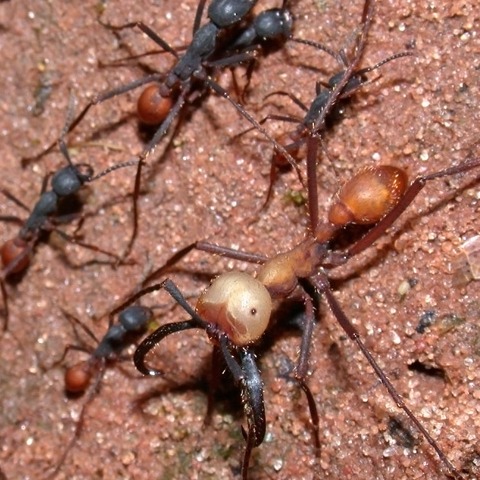
A nomadic ant species known for its massive predatory raids. They lack permanent nests, forming temporary bivouacs with their own bodies instead. They exhibit extreme polymorphism among worker castes, ranging from tiny ants to soldiers with scythe-shaped mandibles.
Added by
Anonymous Curator
Reviewed by
Under Review
Last modified by
Julia Trouin
Taxonomy
PhylumArthropoda
ClassInsecta
OrderHymenoptera
FamilyFormicidae
GenusEciton
Taxonomic AuthorityWestwood, 1842
Ecology & Status
Origin
Native
Population Trend
Stable
Breeding Season
Year Round
Trophic Role
Carnivore
Recent Sightings
Yes
Habitat Summary Multi-lang
They inhabit mainly dense tropical rainforests from Mexico to Argentina. They require large areas of continuous forest to sustain their massive colonies and nomadic predatory lifestyle.Behaviour Multi-lang
Their behavior is cyclical: they alternate between a nomadic phase where they move and hunt, and a stationary phase (bivouac) where the queen lays eggs and larvae develop. Their raids are true ecological events that mobilize much of the understory fauna.Social Activity Multi-lang
Highly eusocial. The colony operates as a superorganism where decisions are not made centrally, but through individual interactions and chemical pheromone signals.Feeding Guild Multi-lang
Strict carnivore: They feed on a wide variety of insects, spiders, scorpions, and even small vertebrates found in their path.Trophic Chain Details Multi-lang
They act as generalist invertebrate predators. They are a critical link that maintains the balance of insect and arthropod populations on the forest floor, as well as providing food for numerous specialized birds and reptiles.Reproductive Behaviour Multi-lang
The queen, which is an ergatogyne (wingless) female, is fertilized by winged males. Egg-laying is massive and synchronized with the colony's life cycle.Physical Measures
Length (cm)
0.5 - 1.5 cm
Weight (Grams)
0.01 g - 0.05 g
Offspring per cycle50000 - 200000
Sexual DimorphismYes
Lifespan
Sexual Maturity
1 - 2 Years
Gestation / Incubation
2 - 3
Lifespan Estimated
Males1 Months
Females1 Months
Sexual Dimorphism
Males Multi-lang
Males are significantly larger than workers, have robust wings, and highly developed compound eyes for queen detection during nuptial flight.
Females Multi-lang
Females (workers) exhibit polymorphism, from the smallest ones to large 'soldiers' with voluminous heads and mandibles adapted for defense.
Evolutionary Adaptations Multi-lang
Bivouac formation: The colony uses the bodies of interlocked workers to build a protective structure for the queen and larvae, regulating temperature and humidity.
Main Threats Multi-lang
Forest fragmentation: The reduction of forest connectivity disrupts their nomadic migration cycles, affecting the survival of entire colonies.
Interesting Facts Multi-lang
Avian symbiosis: Many species of insectivorous birds (antbirds) faithfully follow army ant raids to capture insects fleeing the tide of ants.