
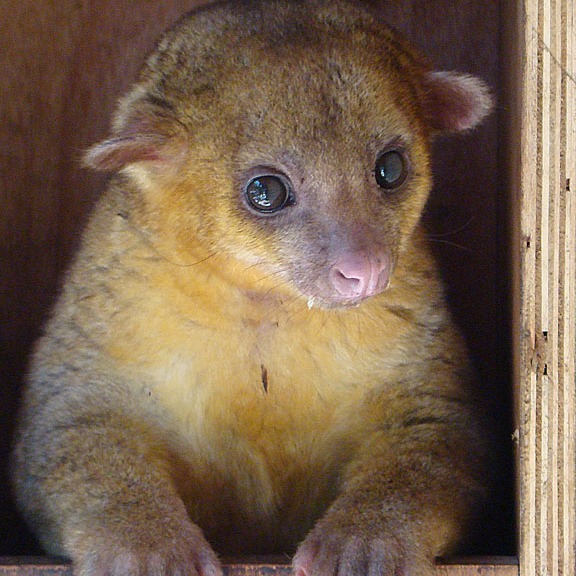
Potos flavus
Kinkajou
(Schreber, 1774)
Added by
Anonymous Curator
Reviewed by
Under Review
Last modified by
Julia Trouin
TaxonomyBiological classification ranks placing this species within the tree of life, from Kingdom down to Genus.
Ecology & StatusHow this species lives: habitat preferences, diet, behavior, population status, and role in its ecosystem.
OriginWhether the species is native (evolved here), endemic (found only here), or introduced by human activity.
Native
Population TrendDirection of change in population size over time: increasing, stable, decreasing, or unknown.
Decreasing
Breeding SeasonTime of year when this species typically reproduces or flowers.
Year Round
Trophic RolePosition in the food chain: producer, herbivore, carnivore, omnivore, decomposer, or parasite.
Frugivore
Recent SightingsWhether this species has been observed in the wild in Costa Rica within recent years.
Yes
Habitat SummaryOverview of the specific ecosystems and environments where this species is found in Costa Rica. Multi-lang
It inhabits exclusively the canopy and subcanopy of tropical moist and very moist forests, gallery forests, premontane forests, and occasionally lowland cloud forests. It rarely descends to the ground. It prefers continuous, mature forests with an abundance of fruit trees and tubular-flowering plants, although it can also survive in advanced secondary forests and biological corridors with canopy connectivity. It occupies altitudes from sea level to 2,500 meters in mountainous areas of Central America. Its presence is an indicator of relatively well-conserved forests with an intact canopy.BehaviourDaily activity patterns, movement, territory use, foraging style, and seasonal behavioral changes. Multi-lang
The kinkajou is strictly nocturnal, beginning activity shortly after nightfall and returning to its resting site — a hollow in an old tree or a dense leaf nest — before dawn. It spends virtually its entire life in the canopy, descending to the ground only in exceptional circumstances. It has a home range of 30 to 75 hectares that it travels along relatively fixed and memorized routes night after night. Its most notable ecological role is the dual function of frugivorous seed disperser and nocturnal pollinator, being one of the few species that visits night-opening flowers that remain inaccessible to most diurnal pollinators.Social ActivitySocial structure: whether the species is solitary, paired, or colonial; hierarchy and communication. Multi-lang
Semi-social with a tendency toward solitary foraging but social aggregation for resting. Individuals frequently share their sleeping trees with others of the same species — typically groups of 2 to 5 individuals — in a relationship of mutual non-territorial tolerance during the day. At night, each individual follows its own feeding routes. Communication includes sharp alarm vocalizations audible at great distances, soft contact calls between individuals of the same group, and chemical communication through secretions from glands on the snout, throat, and abdomen with which they rub branches to mark their routes.Feeding GuildWhat the species eats, how it forages or hunts, and its role as a consumer in the food web. Multi-lang
Frugivore-nectarivore with opportunistic mellivorous behavior. Its diet consists primarily of ripe, soft fruits (up to 70–90% of the total), supplemented with nectar from tubular flowers visited at night and honey from wild bee hives, which it locates by smell. It occasionally consumes small vertebrates, bird eggs, insect larvae, and tender shoots. It does not store food. Diet varies seasonally according to the fruiting phenology of the forest.Trophic Chain DetailsSpecific interactions in local food webs: prey species, predators, competitors, and scavengers. Multi-lang
Although classified in the order Carnivora, it acts ecologically as a frugivorous-nectarivorous primary consumer. It ingests whole fruits and defecates intact seeds at distances of tens to hundreds of meters from the mother tree, thereby performing long-distance seed dispersal of key canopy plant species. Its main natural predators are the ocelot (Leopardus pardalis), jaguar (Panthera onca), boa constrictor (Boa constrictor), and large nocturnal raptors such as the spectacled owl (Pulsatrix perspicillata). As a pollinator, it establishes mutualistic links with plant species of chiropterophilous or chiropterogamic pollination that also accept visits from non-flying mammals.Reproductive BehaviourMating strategies, courtship displays, nesting or spawning behavior, and parental care. Multi-lang
Reproduction occurs year-round with no marked seasonality. Courtship includes prolonged aerial chases in the canopy and contact vocalizations between the pair. After a gestation of 98–120 days, a single altricial young is born (rarely two), with closed eyes and sparse fur. The young opens its eyes around 18–20 days and begins actively climbing at one month of age. The mother carries it hanging from her belly or tail during the first weeks. Weaning occurs around 4 months. Young reach sexual maturity between 18 and 30 months, with females being more precocious than males. The male does not participate in rearing.Physical Measures
Length (cm)
40.0 - 60.0 cm
Weight (Grams)
1.40 kg - 4.60 kg
Lifespan
Sexual MaturityAge at which the individual becomes capable of reproducing for the first time.
18 - 30 Months
Gestation / IncubationDuration from fertilization to birth (mammals) or to hatching (egg-laying species).
98 - 120