Costa Rica Species
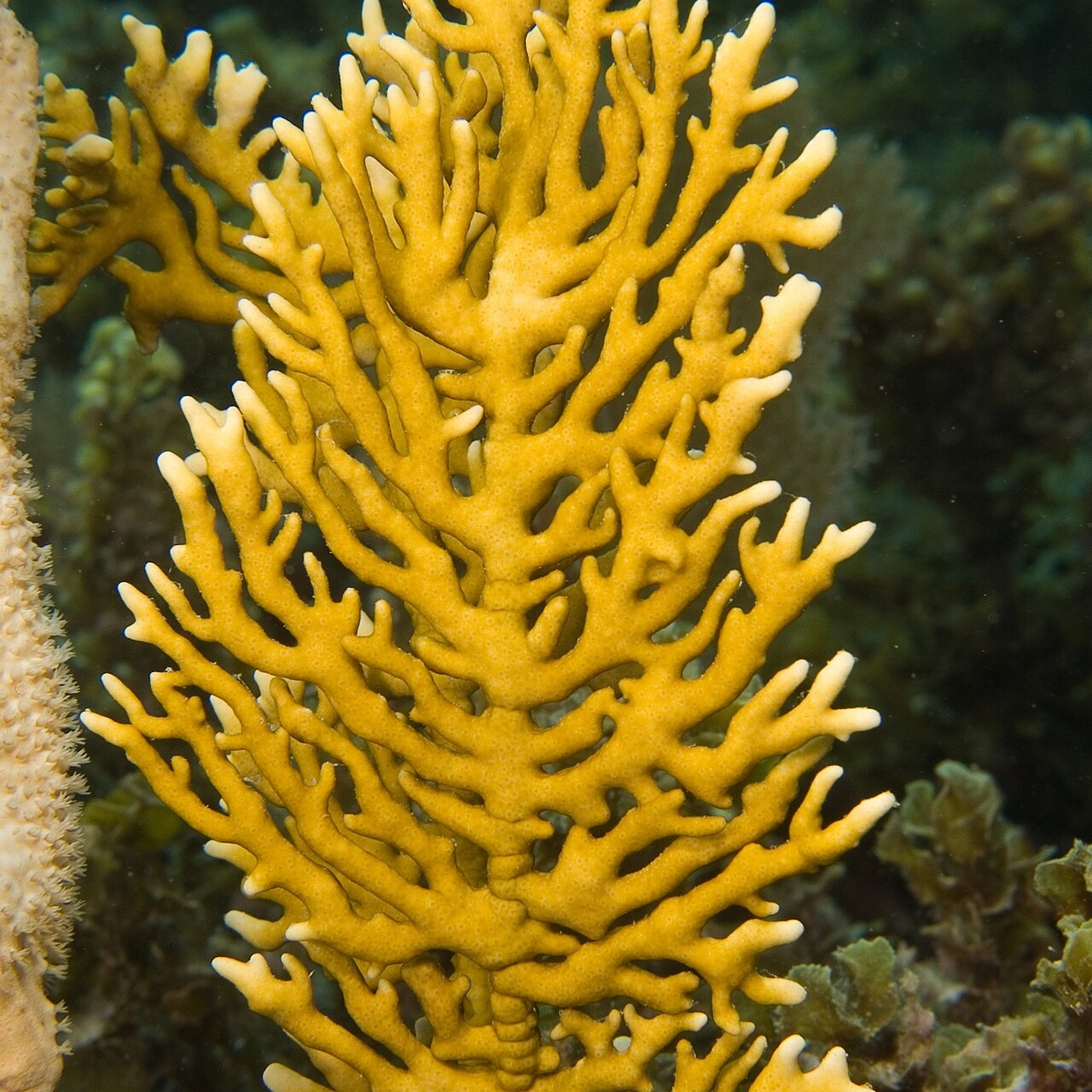
Millepora alcicornis
AnimaliaHighest rank in taxonomy. Groups all life into domains: Animalia, Plantae, Fungi, etc.IUCN LCInternational Union for Conservation of Nature — the world authority on species extinction risk, using standardized criteria. — Least Concern — widespread and abundant; not at immediate risk of extinction.In ProgressCurrent stage of this record in the editorial review workflow. Recent Sighting

Millepora alcicornis

Branching fire coral

(Linnaeus, 1758)

Detailed Texts Multi-lang
The branching fire coral (Millepora alcicornis) is not a true coral, but a reef-building marine hydrozoan. It is recognized by its mustard yellow color with white tips and its powerful nematocysts, which cause an intense burning sensation upon contact.

Added by

Anonymous Curator

Reviewed by

Under Review

Last modified by

Julia Trouin

TaxonomyBiological classification ranks placing this species within the tree of life, from Kingdom down to Genus.

PhylumRank below Kingdom. Groups organisms sharing a fundamental body plan (e.g., Chordata = vertebrates and some invertebrates).Cnidaria
ClassRank below Phylum. Subdivides by structural traits (e.g., Mammalia, Aves, Reptilia, Insecta).Hydrozoa
OrderRank below Class. Groups related families sharing common ancestry (e.g., Carnivora, Primates).Anthoathecata
FamilyRank below Order. Groups closely related genera (e.g., Felidae = cats, Canidae = dogs).Milleporidae
GenusRank just above Species. The first word in the two-part binomial scientific name.Millepora
Taxonomic AuthorityThe scientist who first formally described and published this species, followed by the year of publication.(Linnaeus, 1758)
Record Completeness
95%
Coming soon

Ecology & StatusHow this species lives: habitat preferences, diet, behavior, population status, and role in its ecosystem.

OriginWhether the species is native (evolved here), endemic (found only here), or introduced by human activity.

Native

Population TrendDirection of change in population size over time: increasing, stable, decreasing, or unknown.

Stable

Breeding SeasonTime of year when this species typically reproduces or flowers.

Year Round

Trophic RolePosition in the food chain: producer, herbivore, carnivore, omnivore, decomposer, or parasite.

Carnivore

Recent SightingsWhether this species has been observed in the wild in Costa Rica within recent years.

Yes

Habitat SummaryOverview of the specific ecosystems and environments where this species is found in Costa Rica. Multi-lang

Inhabits shallow tropical waters, reef slopes, and areas with strong currents, from the surface down to 40 meters deep.

BehaviourDaily activity patterns, movement, territory use, foraging style, and seasonal behavioral changes. Multi-lang

Benthic colonial organism. It is an aggressive species that actively competes for space on the reef, often smothering and overgrowing other sessile organisms.

Social ActivitySocial structure: whether the species is solitary, paired, or colonial; hierarchy and communication. Multi-lang

Forms large sessile colonies composed of thousands of highly specialized microscopic zooids (defensive dactylozooids and feeding gastrozooids) connected to each other.

Feeding GuildWhat the species eats, how it forages or hunts, and its role as a consumer in the food web. Multi-lang

Mixotroph / Planktivore. It obtains nutrients from the photosynthesis of its zooxanthellae and supplements its diet by capturing zooplankton with its stinging tentacles.

Trophic Chain DetailsSpecific interactions in local food webs: prey species, predators, competitors, and scavengers. Multi-lang

Contributes significantly to the primary productivity of the reef. Its main natural predators are the bearded fireworm (Hermodice carunculata) and certain specialized nudibranchs immune to its venom.

Reproductive BehaviourMating strategies, courtship displays, nesting or spawning behavior, and parental care. Multi-lang

Exhibits alternation of generations. The sessile colony releases small, short-lived planktonic medusae which, in turn, release eggs and sperm into the water for fertilization.

Physical Measures

Length (cm)

10.0 - 100.0 cm

Weight (Grams)

500 g - 5.00 kg

Offspring per cycleTypical number of young (live births, eggs, or seeds) produced by one adult in a single reproductive event or breeding season.10000 - 500000
Sexual DimorphismObservable physical differences between males and females of the same species (e.g., size, coloration, features).No

Lifespan

Sexual MaturityAge at which the individual becomes capable of reproducing for the first time.

2 - 5 Years

Gestation / IncubationDuration from fertilization to birth (mammals) or to hatching (egg-laying species).

1 - 3

Lifespan EstimatedExpected duration of life from birth to natural death under wild conditions.
Males10 - 50 Years
Females10 - 50 Years

Evolutionary AdaptationsInherited traits and behaviors that improve the species' survival and reproduction in its specific environment. Multi-lang

Stinging cells: It possesses microscopic pores from which defensive tentacles loaded with toxins emerge to paralyze prey and deter threats.
Phenotypic plasticity: It can grow as independent branching structures or encrust over dead gorgonians and corals, adopting their shape.

Main ThreatsDocumented pressures reducing the population: habitat loss, hunting, disease, climate change, and invasive species. Multi-lang

Coral bleaching: Like true corals, it expels its symbiotic microalgae under thermal stress, which can be lethal.
Physical damage: Its branches are fragile and easily broken by anchors, severe storms, or careless contact by divers.

Interesting FactsSurprising or notable facts that highlight what makes this species unique or ecologically important. Multi-lang

False coral: Although it builds massive calcareous structures, taxonomically it is more closely related to jellyfish and the Portuguese man o’ war than to stony corals.