
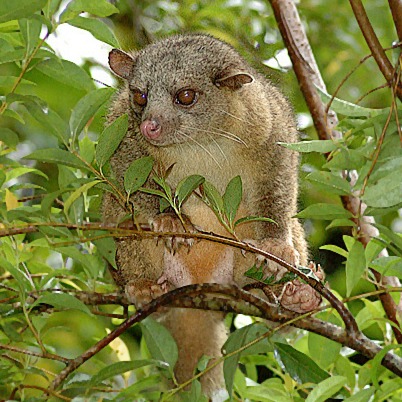
Bassaricyon gabbii
Bushy-tailed Olingo
J.A. Allen, 1876
Added by
Anonymous Curator
Reviewed by
Under Review
Last modified by
Julia Trouin
TaxonomyBiological classification ranks placing this species within the tree of life, from Kingdom down to Genus.
Ecology & StatusHow this species lives: habitat preferences, diet, behavior, population status, and role in its ecosystem.
OriginWhether the species is native (evolved here), endemic (found only here), or introduced by human activity.
Native
Population TrendDirection of change in population size over time: increasing, stable, decreasing, or unknown.
Decreasing
Breeding SeasonTime of year when this species typically reproduces or flowers.
Year Round
Trophic RolePosition in the food chain: producer, herbivore, carnivore, omnivore, decomposer, or parasite.
Frugivore
Recent SightingsWhether this species has been observed in the wild in Costa Rica within recent years.
Yes
Habitat SummaryOverview of the specific ecosystems and environments where this species is found in Costa Rica. Multi-lang
It inhabits exclusively the canopy and subcanopy of tropical moist and very moist forests, premontane forests, and cloud forests between 400 and 2,000 meters in altitude. It shows a marked preference for continuous mature forests with a high volume of fruit-bearing trees in production, although it can also occupy advanced secondary forests with canopy connectivity. It is considerably more dependent on intact forest cover than the kinkajou, and its presence declines sharply in fragmented landscapes. In Costa Rica it is primarily recorded in the Caribbean foothills, the Talamanca Mountain Range, and the humid forests of the Northern Zone.BehaviourDaily activity patterns, movement, territory use, foraging style, and seasonal behavioral changes. Multi-lang
The olingo is strictly nocturnal and arboreal, beginning activity shortly after nightfall. It moves agilely through the canopy via leaps and runs along branches, using its bushy tail as a counterbalance. It rarely descends to the ground. Its home range is approximately 15 to 40 hectares, smaller than the kinkajou's, reflecting its greater fidelity to specific forest patches. It is notably cryptic: it remains motionless when it detects human presence or predators, relying on its brown fur as camouflage. It frequently shares the same fruit trees with the kinkajou and other nocturnal frugivorous species, although it is usually displaced to peripheral positions of the tree by more dominant competitors.Social ActivitySocial structure: whether the species is solitary, paired, or colonial; hierarchy and communication. Multi-lang
Primarily solitary. Individuals maintain home ranges with a degree of tolerated overlap, especially between females and their subadult offspring. Intraspecific communication occurs through vocalizations (alarm squeals, contact grunts), chemical signals deposited on branches via facial and anal glands, and postural signals. During the reproductive season, encounters between males and females occur that are initially antagonistic before developing into courtship. They do not form stable groups. Occasionally two individuals are observed sharing a fruit tree in apparent mutual tolerance without agonistic interaction.Feeding GuildWhat the species eats, how it forages or hunts, and its role as a consumer in the food web. Multi-lang
Opportunistic frugivore-nectarivore. Its diet is fundamentally based on ripe, soft fruits of various canopy tree species, supplemented with nectar from nocturnal flowers, small invertebrates, eggs, and floral nectar when fruits are scarce. Unlike the kinkajou, it does not have a specialized tongue for extracting nectar from deep tubular flowers, so it is limited to flowers with more accessible corollas. It also does not store food. The composition of its diet varies seasonally according to the fruiting phenology of the forest it inhabits.Trophic Chain DetailsSpecific interactions in local food webs: prey species, predators, competitors, and scavengers. Multi-lang
Frugivorous primary consumer that ingests whole fruits and disperses their seeds at moderate distances through defecation. It also contributes secondarily to the pollination of some plants with nocturnal flowers when visiting inflorescences in search of nectar, although its pollinating contribution is smaller than the kinkajou's due to the absence of a specialized tongue. Its main predators are the ocelot (Leopardus pardalis), puma (Puma concolor), boa constrictor (Boa constrictor), and large nocturnal raptors such as the spectacled owl (Pulsatrix perspicillata) and solitary eagle (Buteogallus solitarius). It shares its trophic niche with the kinkajou, which it occupies in a subordinate manner.Reproductive BehaviourMating strategies, courtship displays, nesting or spawning behavior, and parental care. Multi-lang
Reproduction occurs year-round with no clearly defined seasonal peaks. Courtship includes canopy chases and vocalizations between the pair. After a gestation of approximately 70 to 75 days — considerably shorter than the kinkajou's — usually a single altricial young is born with closed eyes and sparse fur. The young opens its eyes around 20–27 days of age and begins moving with increasing autonomy by six weeks. The mother raises the young alone without male participation. Weaning occurs at approximately 3 months. Young reach sexual maturity between 21 and 24 months. A female may have one young per year.Physical Measures
Length (cm)
35.0 - 47.0 cm
Weight (Grams)
970 g - 1.50 kg
Lifespan
Sexual MaturityAge at which the individual becomes capable of reproducing for the first time.
21 - 24 Months
Gestation / IncubationDuration from fertilization to birth (mammals) or to hatching (egg-laying species).
70 - 75