
AnimaliaIUCN LCIn Progress Recent Sighting
Bassaricyon gabbii
Bushy-tailed Olingo
J.A. Allen, 1876
Detailed Texts Multi-lang
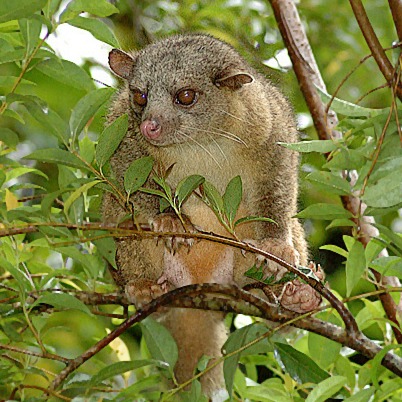
The olingo (Bassaricyon gabbii) is a nocturnal arboreal mammal of the family Procyonidae, closely related to raccoons, coatis, and the kinkajou. It has a slender, elongated body with short, robust legs, dense, soft fur ranging from grayish-brown to golden-brown on the dorsum, and a yellowish or cream-colored belly. Its tail is long, bushy, and non-prehensile — its most useful characteristic for distinguishing it from the kinkajou (Potos flavus), with which it shares habitat and which it superficially resembles. It has large, dark eyes well adapted to nocturnal vision, an elongated snout, and rounded ears. It is the only representative of its genus in Central America, with a distribution spanning from central Nicaragua to northwestern Colombia and Venezuela.
Added by
Anonymous Curator
Reviewed by
Under Review
Last modified by
Julia Trouin
Taxonomy
PhylumChordata
ClassMammalia
OrderCarnivora
FamilyProcyonidae
GenusBassaricyon
Taxonomic AuthorityJ.A. Allen, 1876
Ecology & Status
Origin
Native
Population Trend
Decreasing
Breeding Season
Year Round
Trophic Role
Frugivore
Recent Sightings
Yes
Habitat Summary Multi-lang
It inhabits exclusively the canopy and subcanopy of tropical moist and very moist forests, premontane forests, and cloud forests between 400 and 2,000 meters in altitude. It shows a marked preference for continuous mature forests with a high volume of fruit-bearing trees in production, although it can also occupy advanced secondary forests with canopy connectivity. It is considerably more dependent on intact forest cover than the kinkajou, and its presence declines sharply in fragmented landscapes. In Costa Rica it is primarily recorded in the Caribbean foothills, the Talamanca Mountain Range, and the humid forests of the Northern Zone.Behaviour Multi-lang
The olingo is strictly nocturnal and arboreal, beginning activity shortly after nightfall. It moves agilely through the canopy via leaps and runs along branches, using its bushy tail as a counterbalance. It rarely descends to the ground. Its home range is approximately 15 to 40 hectares, smaller than the kinkajou's, reflecting its greater fidelity to specific forest patches. It is notably cryptic: it remains motionless when it detects human presence or predators, relying on its brown fur as camouflage. It frequently shares the same fruit trees with the kinkajou and other nocturnal frugivorous species, although it is usually displaced to peripheral positions of the tree by more dominant competitors.Social Activity Multi-lang
Primarily solitary. Individuals maintain home ranges with a degree of tolerated overlap, especially between females and their subadult offspring. Intraspecific communication occurs through vocalizations (alarm squeals, contact grunts), chemical signals deposited on branches via facial and anal glands, and postural signals. During the reproductive season, encounters between males and females occur that are initially antagonistic before developing into courtship. They do not form stable groups. Occasionally two individuals are observed sharing a fruit tree in apparent mutual tolerance without agonistic interaction.Feeding Guild Multi-lang
Opportunistic frugivore-nectarivore. Its diet is fundamentally based on ripe, soft fruits of various canopy tree species, supplemented with nectar from nocturnal flowers, small invertebrates, eggs, and floral nectar when fruits are scarce. Unlike the kinkajou, it does not have a specialized tongue for extracting nectar from deep tubular flowers, so it is limited to flowers with more accessible corollas. It also does not store food. The composition of its diet varies seasonally according to the fruiting phenology of the forest it inhabits.Trophic Chain Details Multi-lang
Frugivorous primary consumer that ingests whole fruits and disperses their seeds at moderate distances through defecation. It also contributes secondarily to the pollination of some plants with nocturnal flowers when visiting inflorescences in search of nectar, although its pollinating contribution is smaller than the kinkajou's due to the absence of a specialized tongue. Its main predators are the ocelot (Leopardus pardalis), puma (Puma concolor), boa constrictor (Boa constrictor), and large nocturnal raptors such as the spectacled owl (Pulsatrix perspicillata) and solitary eagle (Buteogallus solitarius). It shares its trophic niche with the kinkajou, which it occupies in a subordinate manner.Reproductive Behaviour Multi-lang
Reproduction occurs year-round with no clearly defined seasonal peaks. Courtship includes canopy chases and vocalizations between the pair. After a gestation of approximately 70 to 75 days — considerably shorter than the kinkajou's — usually a single altricial young is born with closed eyes and sparse fur. The young opens its eyes around 20–27 days of age and begins moving with increasing autonomy by six weeks. The mother raises the young alone without male participation. Weaning occurs at approximately 3 months. Young reach sexual maturity between 21 and 24 months. A female may have one young per year.Physical Measures
Length (cm)
35.0 - 47.0 cm
Weight (Grams)
970 g - 1.50 kg
Offspring per cycle1 - 1
Sexual DimorphismNo
Lifespan
Sexual Maturity
21 - 24 Months
Gestation / Incubation
70 - 75
Lifespan Estimated
Males10 - 25 Years
Females10 - 25 Years
Ecological Relationships
Mutualism (+/+)
Information not available in English. Help us expand this record!
Evolutionary Adaptations Multi-lang
Long, bushy tail with a balancing function — not prehensile — that acts as a stability rudder during rapid canopy movement, allowing it to adjust its center of gravity on thin branches and during leaps between tree crowns.
Highly developed sense of smell that allows it to locate ripe fruits and nectar-bearing flowers in the darkness of the nocturnal canopy, compensating for the limitations imposed by low light on long-distance visual detection.
Curved, sharp claws on all four limbs that provide a tenacious grip on the wet, mossy bark of trees characteristic of the cloud and premontane forests it frequents, where branch surfaces can be particularly slippery.
Tapetum lucidum in the retina that amplifies available light under the canopy, combined with a high proportion of rod cells, granting it vision in near-total darkness conditions, effective for detecting the outline and color of ripe fruits at close distances during nocturnal foraging.
Main Threats Multi-lang
Habitat loss and fragmentation due to deforestation for livestock, export agriculture, and road infrastructure development in the premontane and foothill zones of its range. The olingo is particularly vulnerable to fragmentation due to its limited ability to move between forest patches separated by open terrain.
Historical taxonomic confusion that has hampered its monitoring and conservation: for decades it was grouped with other species of the genus Bassaricyon under the collective name 'olingo', generating gaps in information about the actual status of each species and delaying the design of specific protection measures.
Capture for the exotic pet market and illegal wildlife trade, favored by its striking appearance and frequent confusion with the kinkajou, which has greater demand in that market. Although its extraction from the wild is less documented than that of other procyonids, it represents a real threat in rural areas with low institutional oversight.
Interesting Facts Multi-lang
The olingo and the kinkajou (Potos flavus) are one of the most frequently confused pairs of unrelated species in the tropical forests of Central America. Although they share habitat, activity schedule, and similar diet, they are clearly distinguished by one decisive trait: the olingo's tail is bushy and non-prehensile, while the kinkajou's is bare on its ventral surface and fully prehensile. Furthermore, the olingo lacks the kinkajou's characteristically long tongue.
The genus Bassaricyon was for nearly a century mired in one of the greatest taxonomic tangles of Neotropical mammals. Until the revision by Kristofer Helgen and colleagues in 2013, all olingos from Central and South America were grouped as one or a few species. That same revision also described a species entirely new to science: the olinguito (Bassaricyon neblina), the first carnivore discovered on the American continent in more than 35 years.
Unlike the kinkajou, with which it shares the canopy, the olingo completely lacks a prehensile tail, forcing it to adopt different locomotion strategies: it moves more cautiously between branches and rarely hangs in an inverted position. This anatomical difference reflects a notable evolutionary divergence within the same family, despite ecological convergence in diet and nocturnal arboreal habit.
The olingo can produce a surprisingly rich variety of vocalizations for a procyonid: sharp alarm squeals, soft contact grunts, and nasal sounds when disturbed. During encounters with the kinkajou at the same fruit trees, interspecific competition interactions have been documented in which the olingo generally defers to the kinkajou, which is more robust and territorially dominant.
Ecological Relationships
Mutualism (+/+)
Information not available in English. Help us expand this record!