
Costa Rica Species
Aramides cajaneus
AnimaliaHighest rank in taxonomy. Groups all life into domains: Animalia, Plantae, Fungi, etc.IUCN LCInternational Union for Conservation of Nature — the world authority on species extinction risk, using standardized criteria. — Least Concern — widespread and abundant; not at immediate risk of extinction.In ProgressCurrent stage of this record in the editorial review workflow. Recent Sighting

Aramides cajaneus

Grey-necked Wood-Rail

(Statius Müller, 1776)

Detailed Texts Multi-lang
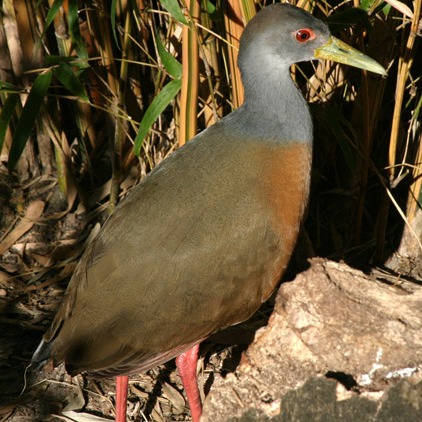
The Grey-necked Wood-Rail (Aramides cajaneus) is a medium-sized wetland bird with a stout, laterally compressed body. It has a highly striking coloration pattern: its head and neck are a leaden grey, its chest and belly are a deep rufous-chestnut, and its back is olive-green to brown. Its rump and short tail are a deep black. Its face is highlighted by a piercing red eye surrounded by a bare reddish orbital ring, along with a straight, strong bill that is yellow-green at the base. Its legs are long, robust, and a bright coral red or pink. It is a thin bird when viewed from the front, a typical adaptation of rails for moving agilely through dense swamp vegetation.

Added by

Anonymous Curator

Reviewed by

Under Review

Last modified by

Julia Trouin

TaxonomyBiological classification ranks placing this species within the tree of life, from Kingdom down to Genus.

PhylumRank below Kingdom. Groups organisms sharing a fundamental body plan (e.g., Chordata = vertebrates and some invertebrates).Chordata
ClassRank below Phylum. Subdivides by structural traits (e.g., Mammalia, Aves, Reptilia, Insecta).Aves
OrderRank below Class. Groups related families sharing common ancestry (e.g., Carnivora, Primates).Gruiformes
FamilyRank below Order. Groups closely related genera (e.g., Felidae = cats, Canidae = dogs).Rallidae
GenusRank just above Species. The first word in the two-part binomial scientific name.Aramides
Taxonomic AuthorityThe scientist who first formally described and published this species, followed by the year of publication.(Statius Müller, 1776)
Record Completeness
95%
Coming soon

Ecology & StatusHow this species lives: habitat preferences, diet, behavior, population status, and role in its ecosystem.

OriginWhether the species is native (evolved here), endemic (found only here), or introduced by human activity.

Native

Population TrendDirection of change in population size over time: increasing, stable, decreasing, or unknown.

Stable

Breeding SeasonTime of year when this species typically reproduces or flowers.

Wet Season

Trophic RolePosition in the food chain: producer, herbivore, carnivore, omnivore, decomposer, or parasite.

Omnivore

Recent SightingsWhether this species has been observed in the wild in Costa Rica within recent years.

Yes

Habitat SummaryOverview of the specific ecosystems and environments where this species is found in Costa Rica. Multi-lang

It is a species strictly tied to aquatic environments with dense vegetative cover. It inhabits mangroves, gallery forests, river margins, shaded streams, wooded swamps, and temporarily flooded areas. It rarely strays far from the protection provided by bushes or tree roots near the water. In Costa Rica, it is a very common bird in the lowlands of both slopes (Caribbean and Pacific), from sea level up to about 1,200 meters in elevation.

BehaviourDaily activity patterns, movement, territory use, foraging style, and seasonal behavioral changes. Multi-lang

It is a bird of primarily crepuscular and diurnal habits, although it tends to be stealthy. It feeds by walking through mud, shallow waters, or over the forest leaf litter, actively probing with its bill. When frightened, it prefers to run swiftly into the thicket rather than fly; in fact, its flight is heavy, clumsy, and short-distance (often just to climb up to low branches).

Social ActivitySocial structure: whether the species is solitary, paired, or colonial; hierarchy and communication. Multi-lang

They are usually found in strongly bonded pairs or small family groups. They are highly territorial birds and will defend their feeding zone in the mangrove or river from other intruders of their species through loud calls.

Feeding GuildWhat the species eats, how it forages or hunts, and its role as a consumer in the food web. Multi-lang

Omnivore / Ground forager.

Trophic Chain DetailsSpecific interactions in local food webs: prey species, predators, competitors, and scavengers. Multi-lang

Opportunistic omnivore. Its diet includes crustaceans (like fiddler crabs), snails, large insects, spiders, frogs, seeds, fallen mangrove fruits, and occasionally eggs of other birds. They are preyed upon by caimans, snakes (like fer-de-lance or boas), ocelots, and large forest raptors.

Reproductive BehaviourMating strategies, courtship displays, nesting or spawning behavior, and parental care. Multi-lang

They are monogamous birds. They build a bulky cup-shaped nest using branches, leaves, vines, and grasses, which they place well-hidden in bushes or low branches, generally 1 to 3 meters high, suspended over the swamp water or very close to it. The female lays 3 to 7 eggs (with brown spots). Both the male and female share incubation, which lasts about 20 days. The chicks are precocial; they hatch covered in dense black down and leave the nest very quickly to follow their parents through the mud.

Physical Measures

Length (cm)

35.0 - 40.0 cm

Weight (Grams)

350 g - 460 g

Offspring per cycleTypical number of young (live births, eggs, or seeds) produced by one adult in a single reproductive event or breeding season.3 - 7
Sexual DimorphismObservable physical differences between males and females of the same species (e.g., size, coloration, features).No

Lifespan

Sexual MaturityAge at which the individual becomes capable of reproducing for the first time.

12 - 24 Months

Gestation / IncubationDuration from fertilization to birth (mammals) or to hatching (egg-laying species).

20

Lifespan EstimatedExpected duration of life from birth to natural death under wild conditions.
Males5 - 10 Years
Females5 - 10 Years

Evolutionary AdaptationsInherited traits and behaviors that improve the species' survival and reproduction in its specific environment. Multi-lang

Compressed Body: Like most members of the Rallidae family, its body is laterally compressed (very narrow). This morphology allows it to run quickly and slip through the dense, tangled vegetation of mangroves and reed beds without getting stuck.
Very Long, Unwebbed Toes: Its toes are exceptionally long and lack interdigital webbing. This structure acts like a snowshoe, distributing its weight and allowing it to walk nimbly over soft mud or lily pads without sinking.

Main ThreatsDocumented pressures reducing the population: habitat loss, hunting, disease, climate change, and invasive species. Multi-lang

Wetland Loss and Drainage: The deforestation of gallery forests, the destruction of mangroves for coastal construction, and the draining of swamps for agriculture diminish its critical habitat.
Domestic Predators: Because it is a bird that forages and largely spends its time on the ground, it is extremely vulnerable to attacks by feral domestic dogs and cats in areas where human development encroaches on wetlands.

Interesting FactsSurprising or notable facts that highlight what makes this species unique or ecologically important. Multi-lang

The Mangrove Chorus: Its most notable feature is not visual, but auditory. At dawn, dusk, or in response to loud noises, pairs or groups perform a deafening, rhythmic, and repetitive duet that sounds like crazy laughter or a loud 'pop-ti-yoi!'.
Constant Tail-flicking: When walking in search of food, it has a nervous habit of rapidly flicking its short black tail up and down, revealing flashes of its dark feathers, like a constant tic.