
Costa Rica Species
Crax rubra
AnimaliaHighest rank in taxonomy. Groups all life into domains: Animalia, Plantae, Fungi, etc.IUCN VUInternational Union for Conservation of Nature — the world authority on species extinction risk, using standardized criteria. — Vulnerable — at high risk of extinction if the current adverse conditions continue.In ProgressCurrent stage of this record in the editorial review workflow. Recent Sighting

Crax rubra

Great Curassow

Linnaeus, 1758

Detailed Texts Multi-lang
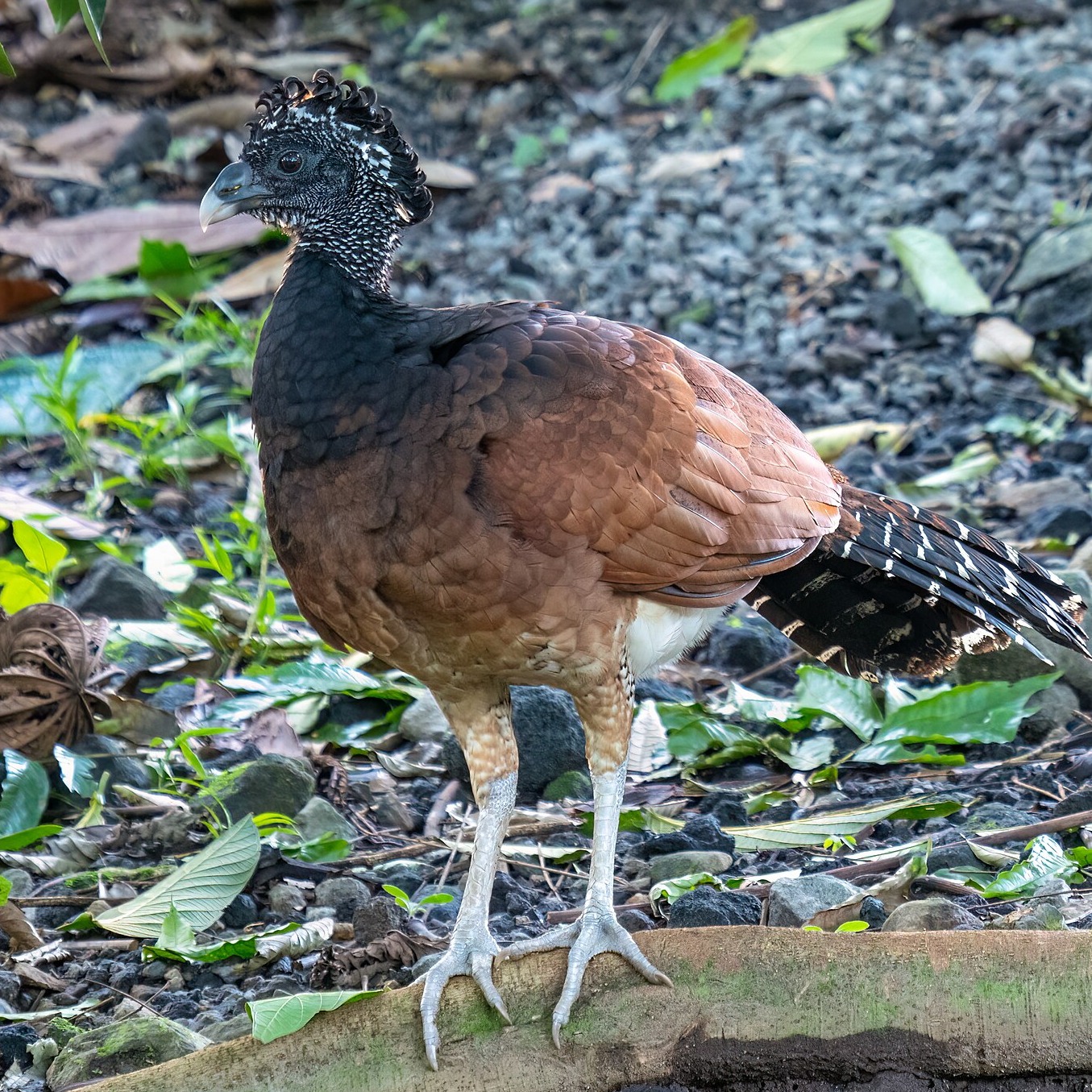
The great curassow (Crax rubra) is the largest land bird in Central America, belonging to the family Cracidae — the curassows and chachalacas. It is an imposing bird superficially resembling a peacock: the male is entirely iridescent black with bluish and greenish reflections on the back and wings, with a pure white belly that contrasts sharply with the rest of the body. Its most characteristic feature is the cephalic crest of forward-curling pointed feathers, always erectile, and a bright yellow or orange protuberance at the base of the bill — the 'knob' or 'cere' — exclusive to adult males and increasing in size with age. The bill is robust and hooked. The female displays an extraordinarily marked and variable sexual dimorphism: she can be of a barred morph — with chestnut plumage barred with black and white on the back, wings, and tail — or a dark morph — similar to the male but with a black-and-white-streaked crest. The iris is brown in both sexes. The legs are robust and pinkish-gray. It is a markedly terrestrial bird although capable of climbing trees to sleep and nest. Its range extends from southern Mexico to northwestern Ecuador.

Added by

Anonymous Curator

Reviewed by

Under Review

Last modified by

Julia Trouin

TaxonomyBiological classification ranks placing this species within the tree of life, from Kingdom down to Genus.

PhylumRank below Kingdom. Groups organisms sharing a fundamental body plan (e.g., Chordata = vertebrates and some invertebrates).Chordata
ClassRank below Phylum. Subdivides by structural traits (e.g., Mammalia, Aves, Reptilia, Insecta).Aves
OrderRank below Class. Groups related families sharing common ancestry (e.g., Carnivora, Primates).Galliformes
FamilyRank below Order. Groups closely related genera (e.g., Felidae = cats, Canidae = dogs).Cracidae
GenusRank just above Species. The first word in the two-part binomial scientific name.Crax
Taxonomic AuthorityThe scientist who first formally described and published this species, followed by the year of publication.Linnaeus, 1758
Record Completeness
94%
Coming soon

Ecology & StatusHow this species lives: habitat preferences, diet, behavior, population status, and role in its ecosystem.

OriginWhether the species is native (evolved here), endemic (found only here), or introduced by human activity.

Native

Population TrendDirection of change in population size over time: increasing, stable, decreasing, or unknown.

Decreasing

Breeding SeasonTime of year when this species typically reproduces or flowers.

--

Trophic RolePosition in the food chain: producer, herbivore, carnivore, omnivore, decomposer, or parasite.

Herbivore

Recent SightingsWhether this species has been observed in the wild in Costa Rica within recent years.

Yes

Habitat SummaryOverview of the specific ecosystems and environments where this species is found in Costa Rica. Multi-lang

The great curassow inhabits exclusively the interior of mature, continuous lowland and premontane tropical moist and very moist forests, between sea level and 1,500 meters in altitude. It requires large expanses of primary or advanced secondary forest with closed canopy, high density of fruits fallen on the ground, deep leaf litter-covered soils, and large trees for sleeping and nesting. It is extremely sensitive to fragmentation and human disturbance: it disappears rapidly from degraded forests, areas with occasional hunting, and landscapes with less than 70% forest cover. In Costa Rica it is concentrated primarily in Corcovado National Park, Lomas de Barbudal Biological Reserve, Tortuguero National Park, the Northern Zone, and the continuous Caribbean forests. It is considered a premier indicator of the conservation status of lowland forests: its presence signals high-integrity primary forest; its absence indicates excessive hunting or critical fragmentation.

BehaviourDaily activity patterns, movement, territory use, foraging style, and seasonal behavioral changes. Multi-lang

The great curassow is primarily terrestrial and diurnal, with greatest activity in the early morning hours and at dusk. It spends most of the day walking slowly across the forest floor, scratching leaf litter with its feet and picking up fruits, seeds, and invertebrates. When disturbed, its first response is to walk rapidly toward dense vegetation before flying — which it does effortfully and noisily — and only as a last resort. Males proclaim their territory at dawn through the characteristic deep boom emitted from the ground or low branches. Territories can exceed 100 hectares per pair. It sleeps in trees at heights of 5–20 meters. In areas without hunting — such as Corcovado National Park — it becomes notably trusting and can be observed from distances of a few meters without showing alarm, which contrasts dramatically with its extremely wary behavior in areas with hunting pressure.

Social ActivitySocial structure: whether the species is solitary, paired, or colonial; hierarchy and communication. Multi-lang

The great curassow lives primarily in stable monogamous pairs or small family groups of 3 to 6 individuals — the breeding pair plus juveniles from the previous year. Pairs maintain long-term bonds and are seen together throughout the year. Males are territorial and actively defend their territory through the dawn boom song, plumage displays, and physical pursuits of intruding males. Contact between groups from different territories usually results in vocal and display encounters that rarely escalate to physical contact between adult males. Communication within the pair includes soft contact vocalizations and mutual preening behavior. Outside the breeding season, groups of up to 10 individuals may tolerate each other in trees with high fruit production. In Corcovado, where there is no hunting, groups of up to 8-12 individuals are observed in areas of high fruit concentration, suggesting that the solitude observed elsewhere may be a learned behavior in response to hunting pressure.

Feeding GuildWhat the species eats, how it forages or hunts, and its role as a consumer in the food web. Multi-lang

Terrestrial omnivore with strong frugivorous-granivorous dominance. The diet consists primarily of large fallen fruits — especially Ficus spp., palms (Astrocaryum, Bactris, Iriartea), Brosimum alicastrum, Dipteryx panamensis, and Manicaria saccifera — large seeds, terrestrial fungi, soil invertebrates (adult beetles and larvae, earthworms, millipedes, snails), and occasionally frogs, lizards, and small snakes. It forages primarily by scratching and removing leaf litter with its feet on the forest floor. The proportion of animal protein increases during the breeding season to meet the nutritional requirements of the chicks. It does not store food.

Trophic Chain DetailsSpecific interactions in local food webs: prey species, predators, competitors, and scavengers. Multi-lang

Omnivorous primary consumer with critical ecosystem importance as a seed disperser and soil disturber. It feeds primarily on fallen fruits (Ficus spp., palms, Brosimum spp., Dipteryx spp.), large seeds, fungi, soil invertebrates (beetles, earthworms, millipedes), and occasionally small vertebrates (frogs, lizards, small snakes). By defecating seeds at distances of up to 500 meters from the mother tree — both intact and scarified by the gizzard — it is the most important seed disperser of several large-seeded canopy tree species in tropical forests that are not efficiently dispersed by other vertebrates. Its main predators are the jaguar (Panthera onca) — the only regular adult predator — the puma (Puma concolor), ocelot (Leopardus pardalis) for chicks and juveniles, boa constrictor (Boa constrictor), and harpy eagle (Harpia harpyja). Nests are vulnerable to the white-nosed coati (Nasua narica), raccoon (Procyon lotor), and snakes such as the boa.

Reproductive BehaviourMating strategies, courtship displays, nesting or spawning behavior, and parental care. Multi-lang

The breeding season in Costa Rica extends primarily from February to June, with the peak of hatchings between April and May. The male proclaims his territory and attempts to attract the female through the territorial dawn boom, plumage displays — crest erection, inflation of the vocal sac, spread of the white belly — and active pursuits of the female over days or weeks. The nest is a voluminous platform of branches, leaves, and stems built in the lower canopy or subcanopy at 3–15 meters height, generally in the fork of a large tree. The clutch invariably consists of 2 rough-shelled eggs, white to cream in color. Only the female incubates, for 32 to 34 days. Chicks hatch precocial — with open eyes and covered in dense down — and can walk a few hours after hatching, though they depend on both parents for thermoregulation and antipredator vigilance during the first weeks. The family remains together for at least 6 months. Juveniles reach adult size at 6-8 months but full adult plumage and sexual maturity at 2-3 years. A pair can reproduce once or twice per year if the first clutch fails.

Physical Measures

Length (cm)

82.0 - 100.0 cm

Weight (Grams)

2.80 kg - 4.50 kg

Offspring per cycleTypical number of young (live births, eggs, or seeds) produced by one adult in a single reproductive event or breeding season.2 - 2
Sexual DimorphismObservable physical differences between males and females of the same species (e.g., size, coloration, features).Yes

Lifespan

Sexual MaturityAge at which the individual becomes capable of reproducing for the first time.

2 - 3 Years

Gestation / IncubationDuration from fertilization to birth (mammals) or to hatching (egg-laying species).

32 - 34

Lifespan EstimatedExpected duration of life from birth to natural death under wild conditions.
Males15 - 25 Years
Females15 - 25 Years

Sexual DimorphismPhysical differences in size, coloration, or morphology between males and females of this species.

Males Multi-lang

The male is entirely shiny black with bluish and greenish iridescence on the back, wings, and head. The belly is pure white, with a well-defined demarcation between the black chest and the white belly. The cephalic crest is black with forward-curling pointed feathers, always erect. The bright yellow or orange protuberance at the base of the upper mandible — the 'knob' — is exclusive to adult males and increases in size with age: small and pale yellow in males 2-3 years old, large and intensely orange in males over 6 years old. The bill is black with a slightly hooked tip. The legs are robust and pinkish-gray.

Females Multi-lang

The female presents an extraordinarily marked sexual dimorphism from the male and exists in two distinct color morphs equally frequent in wild populations. Barred morph: black head with alternating black and white curled crest feathers, chestnut-cinnamon neck and back with intricate black and white barring, wings barred brown, black, and white, whitish belly with dark barring, black tail barred with white. Dark morph: similar to the male in general black coloration but with the crest streaked black and white and without the yellow bill protuberance. In both morphs the female lacks the male's yellow knob. The legs are similar in color to the male. The bill is robust and black without a protuberance.

Evolutionary AdaptationsInherited traits and behaviors that improve the species' survival and reproduction in its specific environment. Multi-lang

Yellow or orange protuberance at the base of the male's bill — known as the 'knob' or 'cere' — whose size and chromatic saturation increase with age and reflect the individual's hormonal and health condition. This structure functions as an honest fitness signal during mate selection: females prefer males with larger knobs and more intense color, generating selection pressure that maintains signal honesty.
Robust legs with long toes and curved nails developed for scratching and removing forest floor leaf litter in search of fruits, seeds, invertebrates, and small vertebrates. This scratching behavior — which can last hours in the same spot — removes volumes of leaf litter equivalent to those of a similar-sized mammal, contributing to the aeration and mixing of forest soil and the exposure of seeds and spores for germination.
Low-frequency vocalization — a deep, profound, resonant boom emitted by the male from the ground or low branches at dawn — that can propagate up to 1.5 km in the forest interior thanks to its frequency band of 100–300 Hz, the same at which forest trees offer minimal acoustic absorption. This territorial boom is audible to the human ear as an almost infrasonic vibration felt in the chest before being clearly heard.
Digestive tract adapted to processing seeds with hard, large endocarps: the muscular gizzard is exceptionally powerful and can crush seeds up to 3 cm in diameter that other gallinaceous birds and frugivorous mammals cannot process. By defecating these seeds intact or partially scarified at distances of tens to hundreds of meters from the mother tree, the curassow acts as a long-distance seed disperser of several key tropical forest tree species.

Main ThreatsDocumented pressures reducing the population: habitat loss, hunting, disease, climate change, and invasive species. Multi-lang

Subsistence and intensive hunting for meat consumption: the great curassow is the most sought-after bird species for subsistence hunting in Central America and Mexico due to its large body size — up to 4.5 kg — making it the most profitable hunting target in terms of meat per shot. Its relatively trusting behavior near humans — a product of a long evolutionary history without efficient hunters before the arrival of firearms — makes it extremely vulnerable to hunting. A single rural family can eliminate the local breeding population of a forest plot in a few years of uncontrolled hunting.
Loss and fragmentation of primary and advanced lowland forest: the great curassow is one of the most habitat-demanding bird species in Central America. It requires continuous mature forests of at least several thousand hectares to sustain viable populations. The conversion of lowland tropical moist forests to pastures, oil palm, pineapple, and export crops in the Central and South Pacific and Caribbean regions of Costa Rica has eliminated most of the potential habitat of the species outside protected areas.
Low reproductive rate limiting population recovery capacity: the great curassow produces only 2 eggs per clutch and may have only one or two successful clutches per year. Juveniles take 2 to 3 years to reach reproductive maturity. This combination of low fecundity and late maturity means that a local population reduced by excessive hunting or habitat loss requires decades to recover without active conservation intervention, even if hunting pressure ceases completely.

Interesting FactsSurprising or notable facts that highlight what makes this species unique or ecologically important. Multi-lang

The great curassow is one of the most reliable ecological indicators of the conservation status of lowland tropical forests. Ecologists call it a 'sentinel species': in forests where the curassow is present, virtually all other mature forest-dependent fauna species are also present. Its absence from a forest where it historically existed is almost always direct evidence of excessive hunting — the 'empty forest syndrome' described by Kent Redford for Tropical America — and not necessarily of habitat degradation.
The male great curassow sings at dawn from the forest floor with a deep boom that the human ear perceives as a vibration before a conventional sound — literally felt in the chest before being heard. This low-frequency song is produced by an inflatable vocal sac at the base of the neck and can be heard up to 1.5 km away in dense forest. Males respond immediately to playbacks of their own recordings, making this species relatively easy to detect with playback during wildlife surveys.
The sexual dimorphism of the great curassow is so extreme that for centuries naturalists described the male and the barred morph female as two completely distinct species. The female can display two radically different color morphs — barred and dark — equally frequent in wild populations and not correlated with the genotype of the male she mates with, raising unresolved questions about the evolutionary basis of this unusual female chromatic polymorphism in gallinaceous birds.
Despite its large size and imposing terrestrial appearance, the great curassow sleeps exclusively in trees, at heights of 5 to 20 meters above the ground. Each individual or pair selects a fixed roosting tree — generally an emergent tree with an open canopy — used night after night for months or years. This extreme fidelity to the roosting site makes them extremely vulnerable to nighttime spotlight hunting, a technique documented as a significant mortality cause in rural areas of Central America where access to protected areas is limited.