Costa Rica Species
Mabuya unimarginata
AnimaliaHighest rank in taxonomy. Groups all life into domains: Animalia, Plantae, Fungi, etc.IUCN LCInternational Union for Conservation of Nature — the world authority on species extinction risk, using standardized criteria. — Least Concern — widespread and abundant; not at immediate risk of extinction.In ProgressCurrent stage of this record in the editorial review workflow. Recent Sighting

Mabuya unimarginata

Central American Skink

Cope, 1862

Detailed Texts Multi-lang
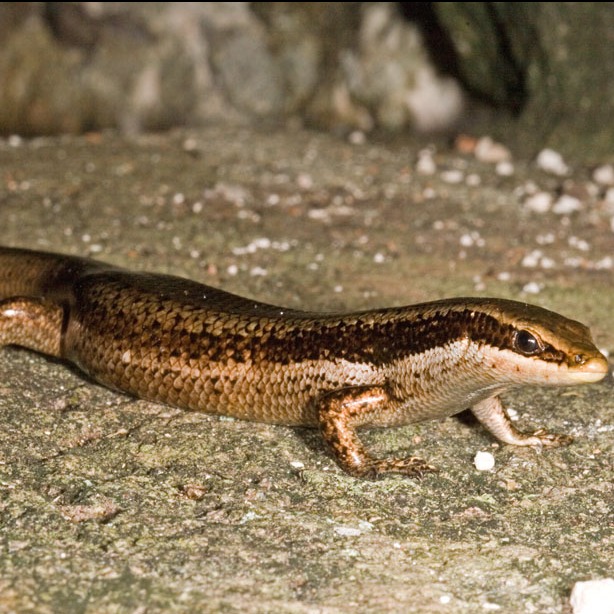
This small saurian has a cylindrical, robust, and elongated body, covered by smooth and shiny cycloid scales that give it a moist appearance. It exhibits a dorsal coloration ranging from bronzed brown to olive, with a distinctive lateral band, often lighter or silvery, that runs along its flanks from the snout to the tail. Its limbs are proportionally short, which reinforces its morphology adapted to life among leaf litter, and it features a short conical snout and a long tail that can represent more than half of its total length.

Added by

Anonymous Curator

Reviewed by

Under Review

Last modified by

Julia Trouin

TaxonomyBiological classification ranks placing this species within the tree of life, from Kingdom down to Genus.

PhylumRank below Kingdom. Groups organisms sharing a fundamental body plan (e.g., Chordata = vertebrates and some invertebrates).Chordata
ClassRank below Phylum. Subdivides by structural traits (e.g., Mammalia, Aves, Reptilia, Insecta).Reptilia
OrderRank below Class. Groups related families sharing common ancestry (e.g., Carnivora, Primates).Squamata
FamilyRank below Order. Groups closely related genera (e.g., Felidae = cats, Canidae = dogs).Scincidae
GenusRank just above Species. The first word in the two-part binomial scientific name.Mabuya
Taxonomic AuthorityThe scientist who first formally described and published this species, followed by the year of publication.Cope, 1862
Record Completeness
93%
Coming soon

Ecology & StatusHow this species lives: habitat preferences, diet, behavior, population status, and role in its ecosystem.

OriginWhether the species is native (evolved here), endemic (found only here), or introduced by human activity.

Native

Population TrendDirection of change in population size over time: increasing, stable, decreasing, or unknown.

Stable

Breeding SeasonTime of year when this species typically reproduces or flowers.

--

Trophic RolePosition in the food chain: producer, herbivore, carnivore, omnivore, decomposer, or parasite.

Insectivore

Recent SightingsWhether this species has been observed in the wild in Costa Rica within recent years.

Yes

Habitat SummaryOverview of the specific ecosystems and environments where this species is found in Costa Rica. Multi-lang

It predominantly inhabits the lower strata of dry, humid, and premontane tropical forests, preferring areas with abundant leaf litter, fallen logs, and areas with partial shade. It is common in gardens, agricultural zones, and forest edges in Costa Rica.

BehaviourDaily activity patterns, movement, territory use, foraging style, and seasonal behavioral changes. Multi-lang

It is a predominantly diurnal and terrestrial species. It spends most of its time active on the ground, moving under layers of dry leaves in search of food. It is a solitary animal that does not establish social bonds, its most notable behavior being territoriality during mate searching and the defense of resource-rich micro-habitats.

Social ActivitySocial structure: whether the species is solitary, paired, or colonial; hierarchy and communication. Multi-lang

It is an eminently solitary animal. It does not form social groups, flocks, or permanent interspecific associations. Its interaction with other individuals of the same species is limited to aggressive or defensive behaviors to protect territory or, during the brief breeding season, to courtship and mating rituals.

Feeding GuildWhat the species eats, how it forages or hunts, and its role as a consumer in the food web. Multi-lang

Generalist soil insectivore. Its feeding strategy consists of actively patrolling the understory and scavenging under logs, rocks, and leaf litter. It detects its prey mainly through subtle movements and vibrations, attacking quickly using its bifid tongue to detect environmental chemoreceptors.

Trophic Chain DetailsSpecific interactions in local food webs: prey species, predators, competitors, and scavengers. Multi-lang

It is positioned as a secondary consumer within the ecosystem, playing a vital role in controlling populations of small invertebrates. Its main prey include spiders, small beetles, crickets, and other arthropods that inhabit leaf litter. In turn, the skink serves as a food source for a wide range of predators, including insectivorous birds, small snakes, and medium-sized mammals.

Reproductive BehaviourMating strategies, courtship displays, nesting or spawning behavior, and parental care. Multi-lang

Viviparous species, where the female develops embryos internally. It does not build conventional nests, but rather seeks protected and humid micro-habitats (such as under rotting logs) to give birth. The mother does not provide parental care after birth; the offspring, which are born fully independent and with developed survival instincts, begin to hunt small arthropods immediately.

Physical Measures

Length (cm)

8.0 - 12.0 cm

Weight (Grams)

10 g - 25 g

Offspring per cycleTypical number of young (live births, eggs, or seeds) produced by one adult in a single reproductive event or breeding season.2 - 6
Sexual DimorphismObservable physical differences between males and females of the same species (e.g., size, coloration, features).No

Lifespan

Sexual MaturityAge at which the individual becomes capable of reproducing for the first time.

1 - 2 Years

Gestation / IncubationDuration from fertilization to birth (mammals) or to hatching (egg-laying species).

3 - 4

Lifespan EstimatedExpected duration of life from birth to natural death under wild conditions.
Males3 - 5 Years
Females3 - 5 Years

Evolutionary AdaptationsInherited traits and behaviors that improve the species' survival and reproduction in its specific environment. Multi-lang

Serpentiform Locomotion: Despite having legs, its body is highly flexible, allowing it to glide through dense leaf litter with fluid movement, similar to that of a snake, minimizing friction and allowing a quick escape from predators.
Caudal Autotomy: It possesses the ability to voluntarily detach its tail when captured by a predator. The tail continues to contort for a few moments, distracting the attacker while the individual escapes to regenerate the appendage later.

Main ThreatsDocumented pressures reducing the population: habitat loss, hunting, disease, climate change, and invasive species. Multi-lang

Landscape Fragmentation: The expansion of human infrastructure and the conversion of natural habitats into agricultural areas reduce the availability of suitable leaf litter patches, hindering their dispersal and communication between populations.
Pesticide Use: As insectivores that live near plantations, the accumulation of toxic chemicals in their prey and in the soil directly affects their reproductive health and life expectancy.

Interesting FactsSurprising or notable facts that highlight what makes this species unique or ecologically important. Multi-lang

Evolutionary Viviparity: Unlike many reptiles that lay eggs, many skink species within the Mabuya genus exhibit viviparity, giving birth to live young that are better developed and have higher survival rates against predators from birth.
Passive Thermoregulation: These lizards depend deeply on ambient temperature and often seek patches of filtered sunlight to raise their body temperature, but always near their refuge in the leaf litter to be able to disappear in seconds.