FungiIUCN LCIn Progress Recent Sighting
Daldinia concentrica
King Alfred's Cakes / Cramp Balls
(Bolton) Ces. & De Not., 1863
Detailed Texts Multi-lang
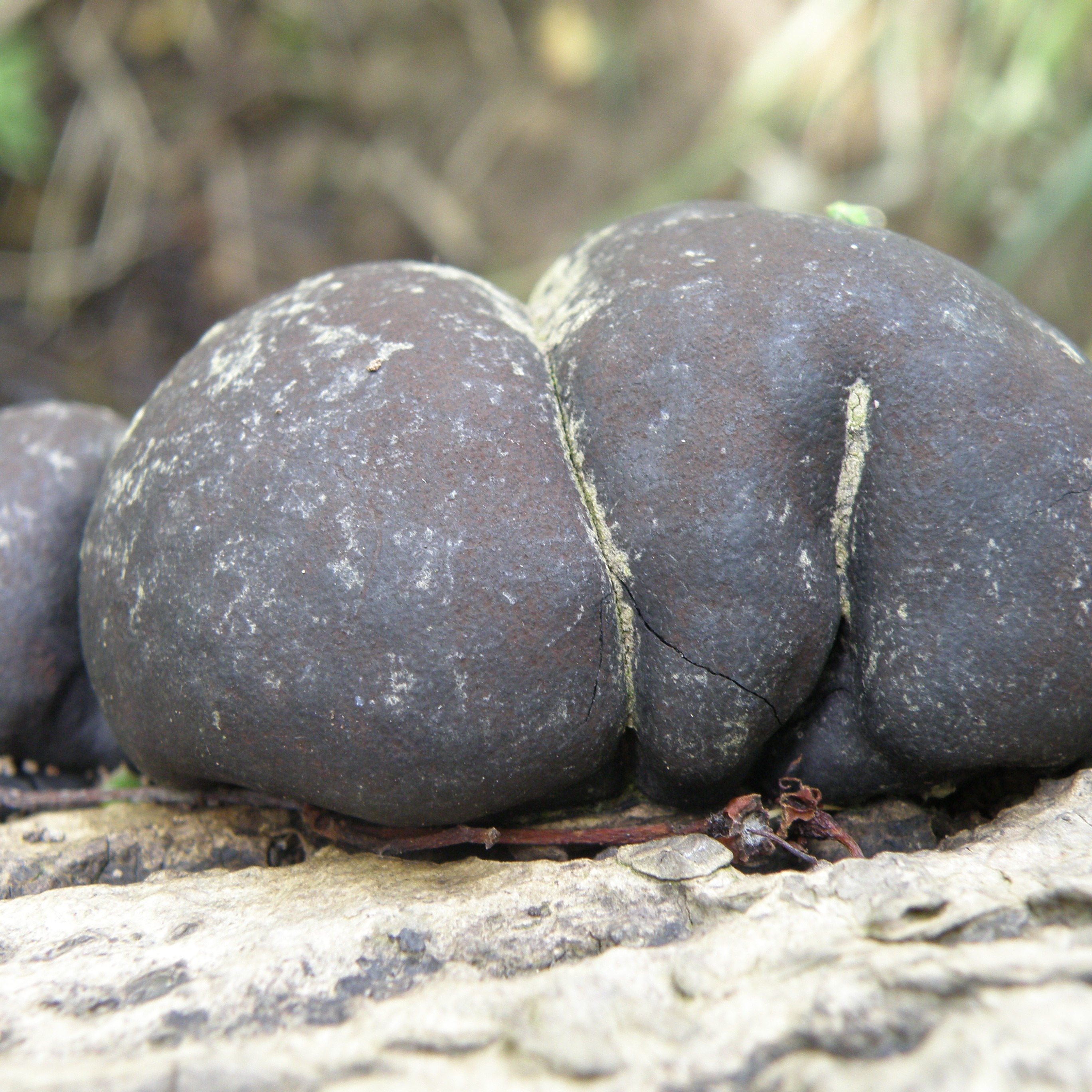
Daldinia concentrica is an unmistakable ascomycete fungus that resembles pieces of charcoal attached to wood. The fruiting body (stroma) is globose or hemispherical, 2 to 10 cm in diameter, with a smooth surface that matures from reddish-brown to a dull coal-black. Its most fascinating feature is revealed when cut: the interior shows silver and black concentric rings reminiscent of a tree's growth rings. The surface is dotted with tiny pores (perithecia) where spores are produced. It is a hard, dry, and persistent fungus that lacks a stalk and grows directly on decaying broad-leaved tree logs. Its 'burnt cake' appearance is a clear sign of its identity in the forest ecosystem.
Added by
Anonymous Curator
Reviewed by
Under Review
Last modified by
Julia Trouin
Taxonomy
PhylumAscomycota
ClassSordariomycetes
OrderXylariales
FamilyHypoxylaceae
GenusDaldinia
Taxonomic Authority(Bolton) Ces. & De Not., 1863
Ecology & Status
Origin
Native
Population Trend
Stable
Edibility
--
Cap Shape
--
Hymenium Type
--
Fruiting Season
Year Round
Recent Sightings
Yes
Habitat Summary Multi-lang
It inhabits deciduous and mixed forests, growing almost exclusively on logs and fallen branches of broad-leaved trees, with a marked preference for the Fraxinus (ash) genus, though it colonizes other hardwoods. It prefers environments with seasonal humidity, but its structure allows it to persist in dry conditions. In Costa Rica, it is found in mid and low-elevation forested areas, taking advantage of decaying wood from native species year-round.Substrate Multi-lang
Information not available in English. Help us expand this record!Behaviour Multi-lang
It is a saprophytic hardwood decomposer causing white rot. It plays a crucial role in carbon recycling by breaking down complex wood polymers. Unlike other fungi, it has a prolonged and nocturnal spore release cycle. It serves as habitat for specialist insects, especially moths of the Tineidae family that feed on its structure.Physical Measures
Length (cm)
2.0 - 10.0 cm
Hymenium Structures
No hymenium surface images available.
Evolutionary Adaptations Multi-lang
Zoned Interior for Water Storage: The internal concentric rings act as moisture reservoirs. This adaptation allows the fungus to continue releasing spores during drought periods, even when the external environment is arid, giving it an advantage over fleshier fungi.
Protective Carbonized Stroma: Its hard, black surface is highly resistant to insect attack and UV radiation, protecting the internal perithecia while the wood slowly decomposes.
Main Threats Multi-lang
Intensive forestry practices: Removal of dead wood and overly clean forest management reduce available substrates for this fungus.
Interesting Facts Multi-lang
King Alfred's Cakes: The name comes from an English legend where King Alfred the Great, hiding in a cottage, let some cakes burn that he was supposed to watch. Seeing these black fungi, people joked they were the king's burnt cakes.
Natural Tinder: Once dry, these fungi are excellent for starting fires. They can maintain a smoldering coal internally for a long time without a flame, allowing ancient fire-carriers to transport fire between locations.