
Costa Rica Species
Campephilus guatemalensis
AnimaliaHighest rank in taxonomy. Groups all life into domains: Animalia, Plantae, Fungi, etc.IUCN LCInternational Union for Conservation of Nature — the world authority on species extinction risk, using standardized criteria. — Least Concern — widespread and abundant; not at immediate risk of extinction.In ProgressCurrent stage of this record in the editorial review workflow. Recent Sighting

Campephilus guatemalensis

Pale-billed Woodpecker

(Hartlaub, 1844)

Detailed Texts Multi-lang
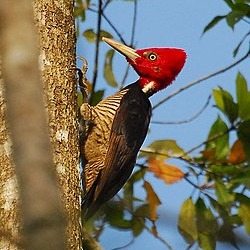
The Pale-billed Woodpecker (Campephilus guatemalensis) is a large, formidable-looking woodpecker. Its body is predominantly deep black, highlighted by two unmistakable white stripes running down the sides of the neck and joining on the back to form a large letter 'V' (unlike the Lineated Woodpecker, whose stripes do not join). Its head sports a spectacular, long, bright crimson red crest. As its English name indicates, it has a huge, robust, chisel-shaped bill of a distinctive pale ivory or silvery color. Its eyes are a piercing light yellow. It climbs vertically, supported by a stiff tail of spiny black feathers.

Added by

Anonymous Curator

Reviewed by

Under Review

Last modified by

Julia Trouin

TaxonomyBiological classification ranks placing this species within the tree of life, from Kingdom down to Genus.

PhylumRank below Kingdom. Groups organisms sharing a fundamental body plan (e.g., Chordata = vertebrates and some invertebrates).Chordata
ClassRank below Phylum. Subdivides by structural traits (e.g., Mammalia, Aves, Reptilia, Insecta).Aves
OrderRank below Class. Groups related families sharing common ancestry (e.g., Carnivora, Primates).Piciformes
FamilyRank below Order. Groups closely related genera (e.g., Felidae = cats, Canidae = dogs).Picidae
GenusRank just above Species. The first word in the two-part binomial scientific name.Campephilus
Taxonomic AuthorityThe scientist who first formally described and published this species, followed by the year of publication.(Hartlaub, 1844)
Record Completeness
85%
Coming soon

Ecology & StatusHow this species lives: habitat preferences, diet, behavior, population status, and role in its ecosystem.

OriginWhether the species is native (evolved here), endemic (found only here), or introduced by human activity.

Native

Population TrendDirection of change in population size over time: increasing, stable, decreasing, or unknown.

Decreasing

Breeding SeasonTime of year when this species typically reproduces or flowers.

Dry Season

Trophic RolePosition in the food chain: producer, herbivore, carnivore, omnivore, decomposer, or parasite.

Insectivore

Recent SightingsWhether this species has been observed in the wild in Costa Rica within recent years.

Yes

Habitat SummaryOverview of the specific ecosystems and environments where this species is found in Costa Rica. Multi-lang

It demands forested habitats with an abundance of mature trees. It is found in humid lowland forests, deciduous dry forests, gallery forests, and advanced secondary jungles. It depends critically on the presence of large standing dead or decaying trees. In Costa Rica, it is a widely distributed bird in the lowlands and foothills of both slopes (Caribbean and Pacific), generally from sea level up to 1,200 meters in elevation.

BehaviourDaily activity patterns, movement, territory use, foraging style, and seasonal behavioral changes. Multi-lang

It is a bird of slow and methodical movements. It spends long hours spiraling up large trunks. Its foraging method is noisy and leaves massive physical evidence: dead trunks completely stripped of their bark. They have vocalizations that sound like a nasal laugh or a bleat ('kwe-haar!'). They are usually seen in pairs and both members maintain constant contact in the dense forest through the sound of their drumming.

Social ActivitySocial structure: whether the species is solitary, paired, or colonial; hierarchy and communication. Multi-lang

They are strongly monogamous birds that are almost always observed in closely bonded pairs. Territories are very large, and the pair patrols the forest staying within a short distance of each other.

Feeding GuildWhat the species eats, how it forages or hunts, and its role as a consumer in the food web. Multi-lang

Insectivore / Bark excavator and scaler.

Trophic Chain DetailsSpecific interactions in local food webs: prey species, predators, competitors, and scavengers. Multi-lang

Carnivore (Xylophagous insect specialist). Its diet consists primarily of huge wood-boring beetle larvae (Cerambycidae and Buprestidae), termites, carpenter ants, and other arthropods, although they occasionally eat berries. They are ecosystem engineers; their abandoned cavities are used by toucans, parrots, and owls. Eggs and chicks can be preyed upon by snakes, monkeys, and tayras, while the White Hawk (Pseudastur albicollis) is one of the few raptors capable of hunting adults.

Reproductive BehaviourMating strategies, courtship displays, nesting or spawning behavior, and parental care. Multi-lang

Strictly monogamous birds. The pair invests a great effort in chiseling a large cavity in a dead trunk or tall palm tree, usually at a height of between 4 and 15 meters. The entrance hole has a characteristic asymmetrical or elongated oval shape. They do not use any soft lining material, depositing 2 white eggs directly on the wood shavings at the bottom of the chamber. Both parents share the incubation (approximately 15 days) and feed the altricial chicks by regurgitating larvae and insects until they fledge at 4 weeks.

Physical Measures

Length (cm)

33.0 - 38.0 cm

Weight (Grams)

200 g - 280 g

Offspring per cycleTypical number of young (live births, eggs, or seeds) produced by one adult in a single reproductive event or breeding season.2 - 2
Sexual DimorphismObservable physical differences between males and females of the same species (e.g., size, coloration, features).Yes

Lifespan

Sexual MaturityAge at which the individual becomes capable of reproducing for the first time.

12 - 24 Months

Gestation / IncubationDuration from fertilization to birth (mammals) or to hatching (egg-laying species).

14 - 16

Lifespan EstimatedExpected duration of life from birth to natural death under wild conditions.
Males7 - 12 Years
Females7 - 12 Years

Sexual DimorphismPhysical differences in size, coloration, or morphology between males and females of this species.

Males Multi-lang

The male possesses the entirety of the head, crest, throat, and face in a uniform bright crimson red color.

Females Multi-lang

The female has a red crest, but presents a solid black forehead, throat, and a broad black stripe extending through the eye.

Evolutionary AdaptationsInherited traits and behaviors that improve the species' survival and reproduction in its specific environment. Multi-lang

The Double-knock: Instead of vocalizing to mark territory, this genus of woodpeckers uses percussive acoustic communication. They strike a hollow trunk forcefully, producing a resounding and extremely rapid 'TOC-TOC!' (two strikes in a fraction of a second) that echoes for miles in the thick jungle.
Shock-absorbing Skull and Tripod Tail: Its skull possesses special spongy bone and muscles that act as shock absorbers to prevent brain damage when chiseling hard wood. Additionally, its central tail feathers are extremely stiff and pointed, acting as the third leg of a tripod to support its considerable weight while working vertically.

Main ThreatsDocumented pressures reducing the population: habitat loss, hunting, disease, climate change, and invasive species. Multi-lang

Loss of Old-growth Trees: Since their diet relies on extracting huge larvae buried deep in the wood, and they require immense trees to carve their nests, the selective logging of old and dead trees in forestry farms deprives them of food and shelter.
Habitat Fragmentation: Being large birds, they require extensive foraging territories. The fragmentation of continuous forests isolates pairs and decreases the density of available wood-boring prey.

Interesting FactsSurprising or notable facts that highlight what makes this species unique or ecologically important. Multi-lang

The Ivory-bill's Cousin: It belongs to the same genus (Campephilus) as the legendary and presumably extinct Imperial Woodpecker of Mexico and the Ivory-billed Woodpecker of the US, sharing with them its large size, pale bill, and double-knock call.
Scaling Technique: Unlike other woodpeckers that drill deep holes, the pale-billed often forages by peeling (scaling) large strips of bark off the tree with lateral blows of its chisel-shaped bill to expose insect colonies hidden just under the surface.