Costa Rica Species
Phillipsia domingensis
FungiHighest rank in taxonomy. Groups all life into domains: Animalia, Plantae, Fungi, etc.IUCN NEInternational Union for Conservation of Nature — the world authority on species extinction risk, using standardized criteria. — Not Evaluated — not yet assessed against the IUCN Red List criteria.In ProgressCurrent stage of this record in the editorial review workflow. Recent Sighting

Phillipsia domingensis

Pink Cup Fungus

(Berk.) Berk., 1881

Detailed Texts Multi-lang
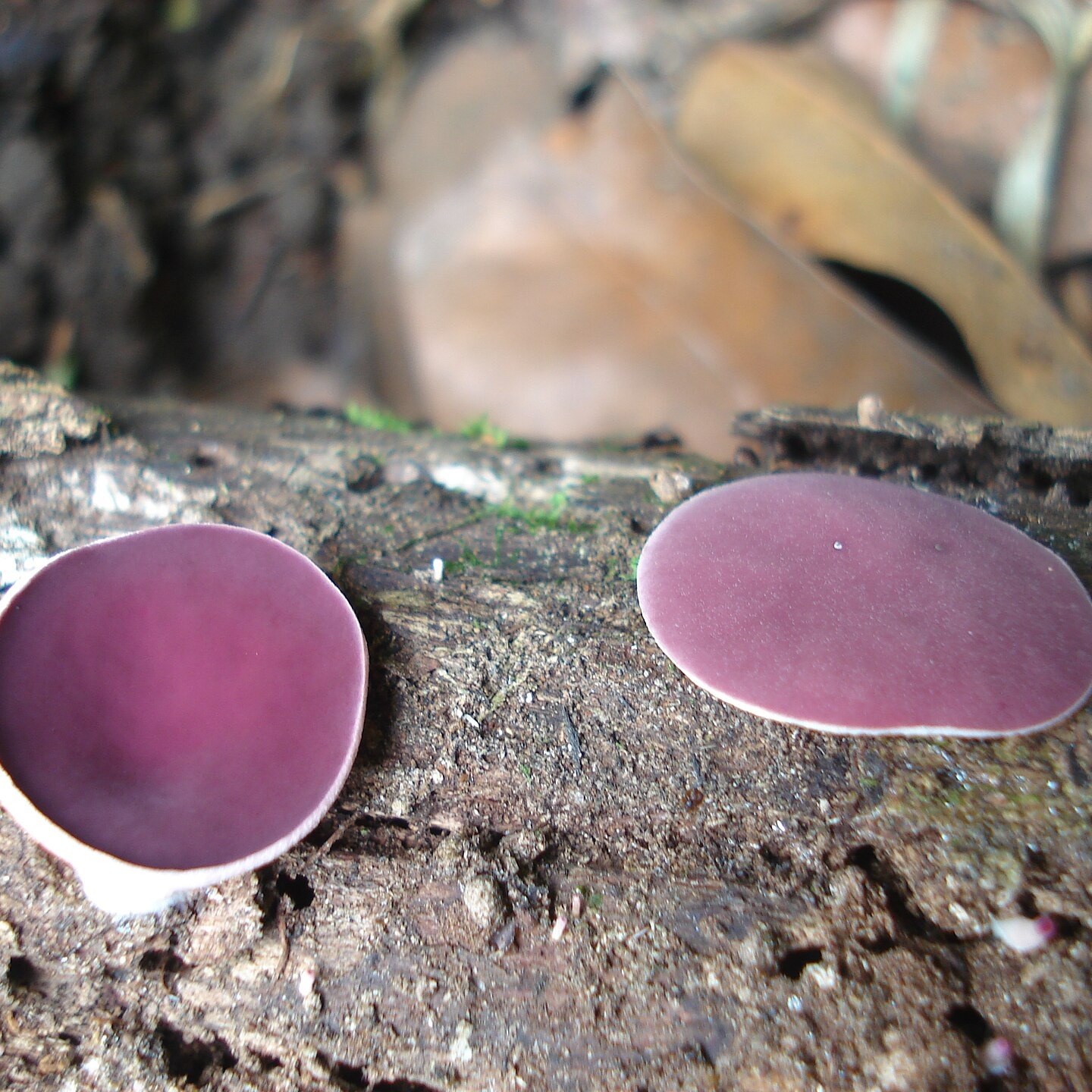
Phillipsia domingensis is a spectacular ascomycete fungus that forms cup- or saucer-shaped fruiting bodies (apothecia), 2 to 6 cm in diameter. Its inner surface (the hymenium) features an intense pink, fuchsia, or reddish-purple color, extremely bright and smooth, while the outer surface is whitish or pale pink and somewhat rough in texture. The fungus is sessile (lacks a stalk) or has a very rudimentary one, attaching directly to the wood. Its flesh is firm, somewhat leathery, and white. It is a saprophytic fungus specialized in the decomposition of fallen logs and branches of broad-leaved trees, becoming a visual gem on the dark floor of wet rainforests.

Added by

Anonymous Curator

Reviewed by

Under Review

Last modified by

Julia Trouin

TaxonomyBiological classification ranks placing this species within the tree of life, from Kingdom down to Genus.

PhylumRank below Kingdom. Groups organisms sharing a fundamental body plan (e.g., Chordata = vertebrates and some invertebrates).Ascomycota
ClassRank below Phylum. Subdivides by structural traits (e.g., Mammalia, Aves, Reptilia, Insecta).Pezizomycetes
OrderRank below Class. Groups related families sharing common ancestry (e.g., Carnivora, Primates).Pezizales
FamilyRank below Order. Groups closely related genera (e.g., Felidae = cats, Canidae = dogs).Sarcoscyphaceae
GenusRank just above Species. The first word in the two-part binomial scientific name.Phillipsia
Taxonomic AuthorityThe scientist who first formally described and published this species, followed by the year of publication.(Berk.) Berk., 1881
Record Completeness
84%
Coming soon

Ecology & StatusHow this species lives: habitat preferences, diet, behavior, population status, and role in its ecosystem.

OriginWhether the species is native (evolved here), endemic (found only here), or introduced by human activity.

Native

Population TrendDirection of change in population size over time: increasing, stable, decreasing, or unknown.

Stable

Trophic RolePosition in the food chain: producer, herbivore, carnivore, omnivore, decomposer, or parasite.

--

EdibilityWhether this mushroom is edible, toxic, hallucinogenic, or of unknown safety. Never eat based solely on this data.

--

Cap ShapeShape of the mushroom cap (pileus): convex, flat, umbonate, funnel-shaped, bell-shaped, etc.

--

Hymenium TypeThe spore-bearing surface of a fungus: gills, pores, teeth, ridges, smooth, or wrinkled.

--

Fruiting SeasonTime of year when this species typically reproduces or flowers.

Year Round

Recent SightingsWhether this species has been observed in the wild in Costa Rica within recent years.

Yes

Habitat SummaryOverview of the specific ecosystems and environments where this species is found in Costa Rica. Multi-lang

It inhabits wet tropical and subtropical forests, growing exclusively on dead wood (logs and fallen branches) of broad-leaved trees. It prefers shaded environments with constant high humidity. In Costa Rica, it is a common native fungus on both slopes, especially in low and middle elevations, where forest humidity favors its development on decaying wood.

SubstrateThe organic material or host organism this fungus colonizes and decomposes. Multi-lang

Information not available in English. Help us expand this record!

BehaviourDaily activity patterns, movement, territory use, foraging style, and seasonal behavioral changes. Multi-lang

It acts as a primary or secondary wood decomposer, helping to recycle woody biomass. Its appearance is usually solitary or in small groups. Like other ascomycetes, it can release its spores in microscopic 'clouds' when there are sudden changes in pressure or humidity.

Physical Measures

Length (cm)

2.0 - 6.0 cm

Hymenium StructuresMacro photographs of the spore-bearing surfaces used for mushroom identification.

No hymenium surface images available.

Evolutionary AdaptationsInherited traits and behaviors that improve the species' survival and reproduction in its specific environment. Multi-lang

Apothecium Shape for Dispersal: Its open cup-shaped structure maximizes the exposure of the asci (where spores are produced). Airflow passing over the disc facilitates spores being carried away from the wood's stagnant microclimate.
Resistant Leathery Texture: Unlike softer fungi, Phillipsia has a firm consistency that allows it to last longer on the wood, better resisting insect attacks and immediate bacterial decomposition.

Main ThreatsDocumented pressures reducing the population: habitat loss, hunting, disease, climate change, and invasive species. Multi-lang

Deforestation: The loss of mature primary and secondary forests drastically reduces the amount of fallen wood needed for its life cycle.

Interesting FactsSurprising or notable facts that highlight what makes this species unique or ecologically important. Multi-lang

Fantasy Fungus: Due to its almost unreal color, it looks like something out of a storybook. Its pink coloration is maintained even in mature specimens, making it a favorite target for macro photography in the forest.