
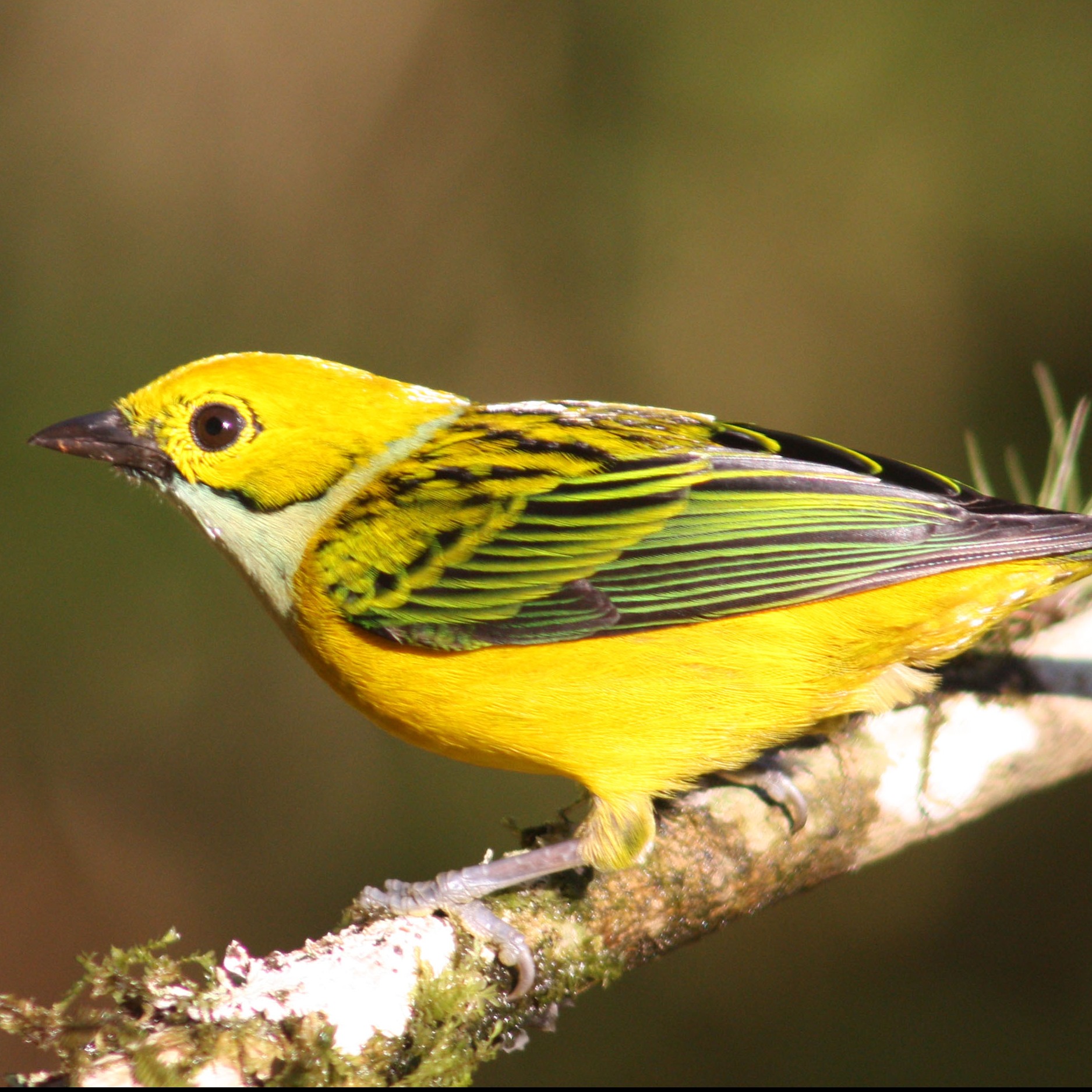
Tangara icterocephala
Silver-throated Tanager
Bonaparte, 1851
Added by
Anonymous Curator
Reviewed by
Under Review
Last modified by
Julia Trouin
TaxonomyBiological classification ranks placing this species within the tree of life, from Kingdom down to Genus.
Ecology & StatusHow this species lives: habitat preferences, diet, behavior, population status, and role in its ecosystem.
OriginWhether the species is native (evolved here), endemic (found only here), or introduced by human activity.
Native
Population TrendDirection of change in population size over time: increasing, stable, decreasing, or unknown.
Stable
Breeding SeasonTime of year when this species typically reproduces or flowers.
--
Trophic RolePosition in the food chain: producer, herbivore, carnivore, omnivore, decomposer, or parasite.
Omnivore
Recent SightingsWhether this species has been observed in the wild in Costa Rica within recent years.
Yes
Habitat SummaryOverview of the specific ecosystems and environments where this species is found in Costa Rica. Multi-lang
It is widely distributed in montane regions from Costa Rica and western Panama, extending along the Colombian and Ecuadorian Andes. In Costa Rican territory, it is an extremely common inhabitant of foothills and middle highlands, occupying altitudes ranging from 600 to 1,700 meters above sea level, although it performs downward altitudinal migrations toward lowlands during seasons of heavy rainfall. Its optimal habitat encompasses the interior and edges of primary humid montane forests, mature secondary forests, coffee plantations with diversified shade, and rural gardens adjacent to forested areas.BehaviourDaily activity patterns, movement, territory use, foraging style, and seasonal behavioral changes. Multi-lang
It is a diurnal, highly active, restless, and social bird. It spends most of its time moving with agility through the middle and upper strata of the forest, flying short distances between branches with quick and purposeful movements. Throughout the year, it displays highly gregarious behavior, traveling in pairs, small family groups of 3 to 5 individuals, or enthusiastically joining large mixed flocks alongside other tanagers, vireos, and warblers. Its vocal communication is constant and fluid while foraging; it emits a characteristic sharp, metallic call that sounds like a continuously repeated 'tsip' or 'chit' to maintain group cohesion.Social ActivitySocial structure: whether the species is solitary, paired, or colonial; hierarchy and communication. Multi-lang
It displays complex and peaceful social behavior throughout the year. Outside the strict boundaries of the nest, it demonstrates zero interspecific territoriality, harmoniously integrating and coordinating spatial movements with other frugivorous birds in the tree canopies. During group feeding, individuals maintain a close but respectful distance, continuously communicating to alert about the presence of food or potential threats nearby.Feeding GuildWhat the species eats, how it forages or hunts, and its role as a consumer in the food web. Multi-lang
Generalist mid-strata frugivore and insectivore. Its diet consists of 70% fleshy fruits and small ripe berries, supplementing the rest of its caloric and protein requirements with small arthropods that it meticulously extracts by scraping moss, lichens, and the surface of thinner branches.Trophic Chain DetailsSpecific interactions in local food webs: prey species, predators, competitors, and scavengers. Multi-lang
It occupies an intermediate consumer and omnivorous niche with a strong frugivorous inclination. It is a vital component in the forest food web, consuming an immense variety of small wild berries from plants of the Melastomataceae, Rubiaceae, and Moraceae (Ficus) families, dispersing seeds throughout the forest. Simultaneously, it agilely preys upon a large number of small insects, spiders, and larvae gathered from plant surfaces. It serves as food for medium-sized predators, including small forest falcons, hawks, and arboreal snakes like Chironius, while its nests suffer predation from small mammals or toucanets.Reproductive BehaviourMating strategies, courtship displays, nesting or spawning behavior, and parental care. Multi-lang
It is a monogamous species that establishes a defined reproductive territory during the spring. It builds a deep, open cup-shaped nest, compactly crafted by the female with occasional help from the male, using live green moss, fine plant fibers, shredded dry leaves, and spider webs to consolidate the structure. The nest is typically located at heights varying from 2 to 10 meters, frequently camouflaged in the fork of an understory tree or covered by dense epiphytic plants. The female usually lays 2 eggs (rarely 3) of a dirty white or grayish color with abundant reddish-brown freckles. Incubation is performed exclusively by the female for 13 to 14 days. Both parents intensively feed the altricial chicks via regurgitation for 15 to 16 days until they successfully fledge.Physical Measures
Length (cm)
12.5 - 13.5 cm
Weight (Grams)
18 g - 24 g
Lifespan
Sexual MaturityAge at which the individual becomes capable of reproducing for the first time.
1 Years
Gestation / IncubationDuration from fertilization to birth (mammals) or to hatching (egg-laying species).
13 - 14