
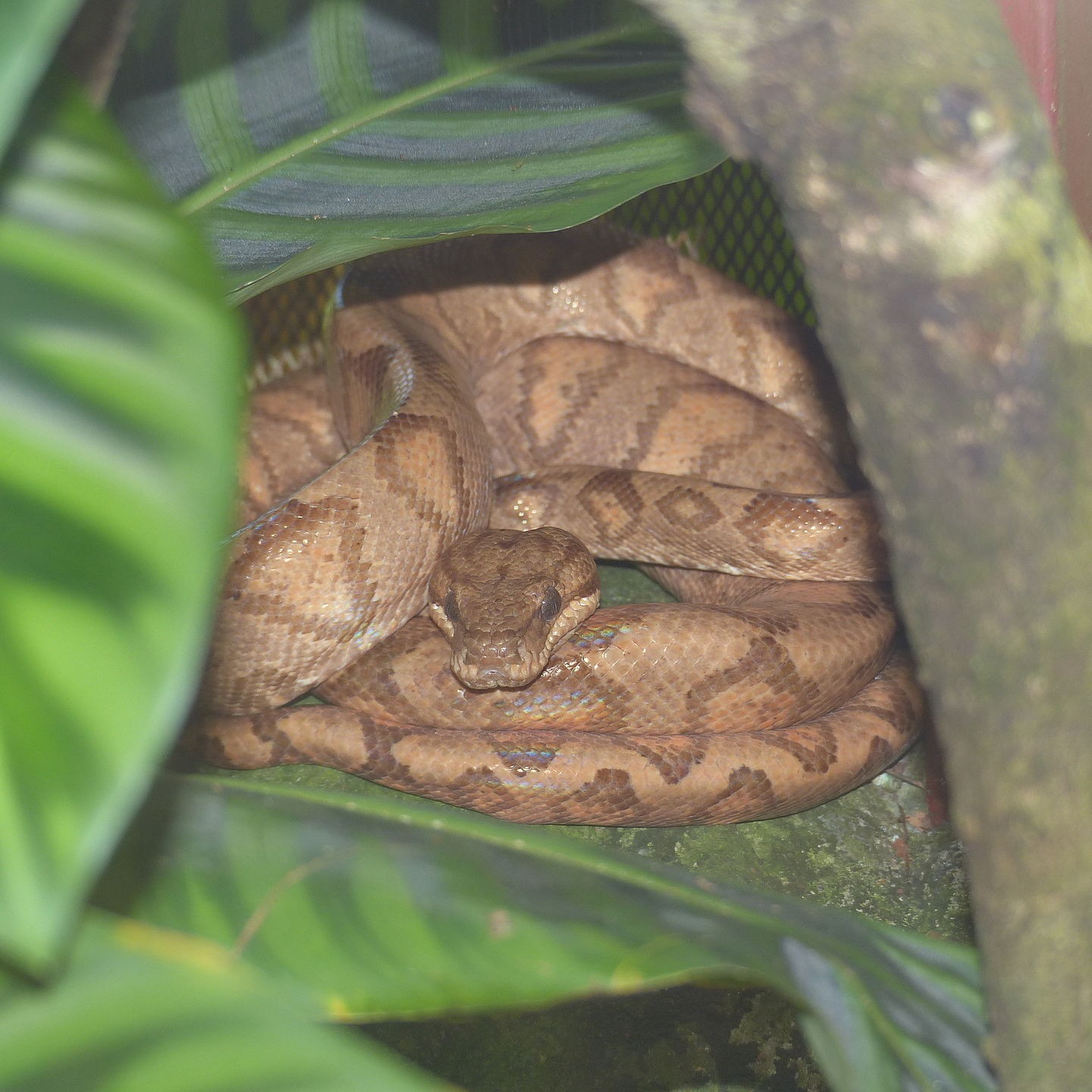
Corallus annulatus
Annulated Tree Boa
(Cope, 1875)
Added by
Anonymous Curator
Reviewed by
Under Review
Last modified by
Julia Trouin
TaxonomyBiological classification ranks placing this species within the tree of life, from Kingdom down to Genus.
Ecology & StatusHow this species lives: habitat preferences, diet, behavior, population status, and role in its ecosystem.
OriginWhether the species is native (evolved here), endemic (found only here), or introduced by human activity.
Native
Population TrendDirection of change in population size over time: increasing, stable, decreasing, or unknown.
Stable
Breeding SeasonTime of year when this species typically reproduces or flowers.
--
Trophic RolePosition in the food chain: producer, herbivore, carnivore, omnivore, decomposer, or parasite.
Carnivore
Recent SightingsWhether this species has been observed in the wild in Costa Rica within recent years.
Yes
Habitat SummaryOverview of the specific ecosystems and environments where this species is found in Costa Rica. Multi-lang
It inhabits exclusively tropical lowland rainforests and premontane wet forests of the Neotropics, ranging from eastern Guatemala and Honduras, through Nicaragua, Costa Rica, and Panama, to northwestern Colombia and Ecuador. It is a species primarily associated with densely forested and mature primary forest, where it spends most of its time in the canopy or suspended among dense arboreal vegetation, lianas, and riparian epiphytes, from sea level up to 1,000 meters in altitude.BehaviourDaily activity patterns, movement, territory use, foraging style, and seasonal behavioral changes. Multi-lang
It is a nocturnal, solitary reptile with strictly arboreal habits. It spends daylight hours compactly coiled in the fork of vegetation-covered branches or inside large epiphytic bromeliads. At dusk, it uncoils and adopts an active ambush position, hanging from vines near watercourses or forest clearings. Its movements are slow and calculated, but its strike speed is incredibly fast when it detects prey.Social ActivitySocial structure: whether the species is solitary, paired, or colonial; hierarchy and communication. Multi-lang
It is a completely asocial and solitary animal during most of its life cycle. They do not tolerate the proximity of other individuals outside of chance sexual encounters triggered by pheromones. They do not form winter congregations nor assist in flocks or defensive groups, relying strictly on their cryptic individual mimicry to evade threats.Feeding GuildWhat the species eats, how it forages or hunts, and its role as a consumer in the food web. Multi-lang
Specialized carnivore with arboreal habits. It stealthily captures a wide variety of small warm-blooded vertebrates, including bats, lizards of the genus Anolis, large tree frogs, and small passerine birds while they rest at night within the foliage.Trophic Chain DetailsSpecific interactions in local food webs: prey species, predators, competitors, and scavengers. Multi-lang
It acts as a secondary consumer and apex predator within the micro-ecosystem of the forest's middle and lower strata. By hunting roosting birds, phyllostomid bats, and small arboreal rodents, it exerts direct selective pressure on these populations. In turn, young individuals of this species are occasional prey for large nocturnal raptors (such as Pulsatrix perspicillata), coaties, and large ophiophagous snakes.Reproductive BehaviourMating strategies, courtship displays, nesting or spawning behavior, and parental care. Multi-lang
It is a viviparous (ovoviviparous) species. Courtship and mating occur on high branches during the dry season. The female retains the embryos internally for an extended period, regulating her temperature through subtle movements toward patches of filtered sun in the canopy. She gives birth directly to 6 to 12 fully formed and independent young, born wrapped in a thin transparent membrane from which they break free immediately. The neonates often possess a brighter or more contrasting coloration than adults to optimize mimicry on slender twigs.Physical Measures
Length (cm)
120.0 - 160.0 cm
Weight (Grams)
500 g - 800 g
Lifespan
Sexual MaturityAge at which the individual becomes capable of reproducing for the first time.
3 - 4 Years
Gestation / IncubationDuration from fertilization to birth (mammals) or to hatching (egg-laying species).
5 - 7