
Costa Rica Species
Hemileia vastatrix
FungiHighest rank in taxonomy. Groups all life into domains: Animalia, Plantae, Fungi, etc.IUCN NEInternational Union for Conservation of Nature — the world authority on species extinction risk, using standardized criteria. — Not Evaluated — not yet assessed against the IUCN Red List criteria.In ProgressCurrent stage of this record in the editorial review workflow. Recent Sighting

Hemileia vastatrix

Coffee Leaf Rust

Berk. & Broome, 1869

Detailed Texts Multi-lang
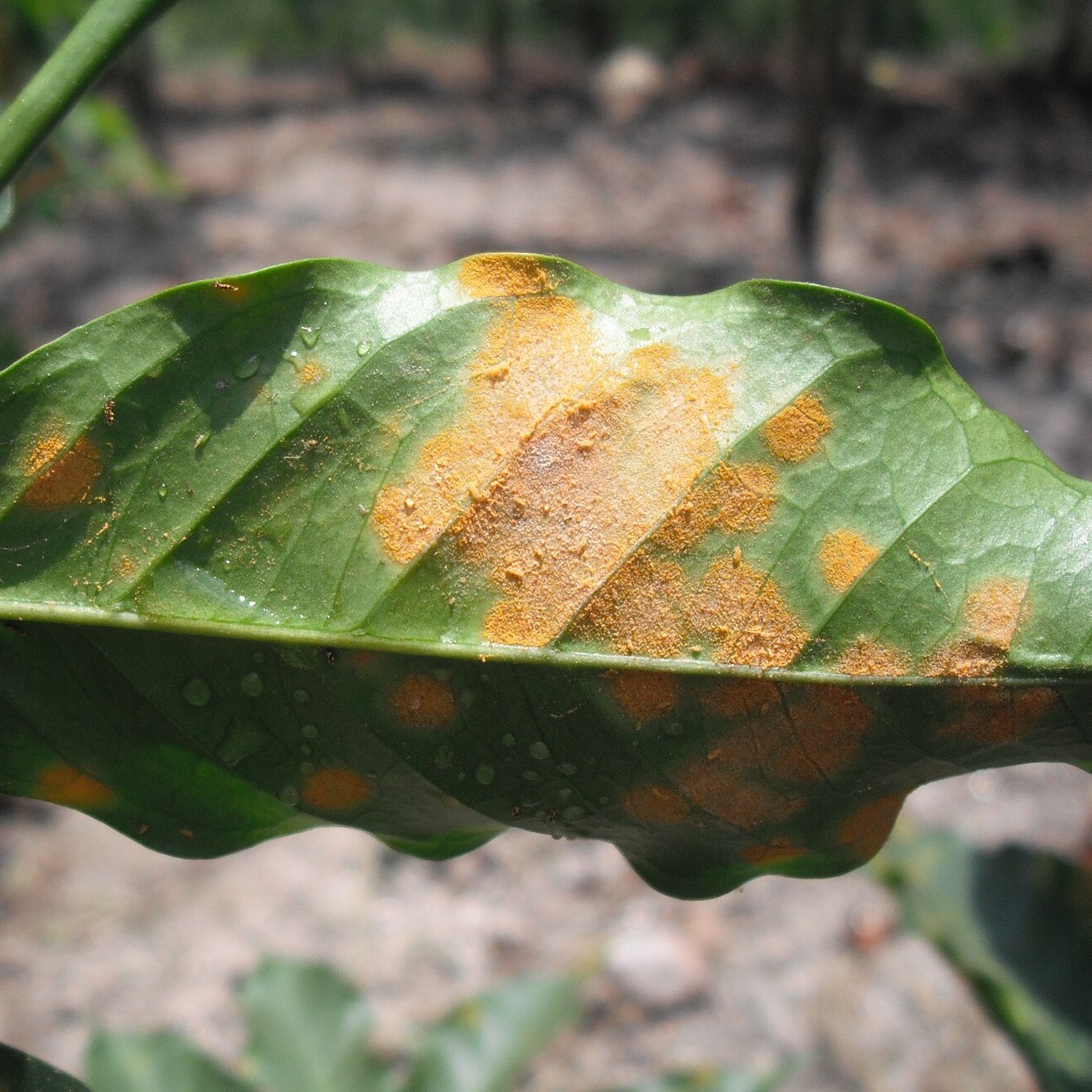
Hemileia vastatrix is an obligate parasitic basidiomycete fungus, responsible for the most destructive disease of the coffee plant worldwide. It does not produce a visible mushroom; instead, it manifests as a fine, powdery, bright orange or yellowish dust on the underside of the leaves. These spots correspond to the urediniospores emerging through the plant's stomata. On the upper side of the leaf, the initial symptom is a yellowish chlorotic spot that expands and eventually becomes necrotic (brown). The fungus actively penetrates leaf tissues to extract nutrients, weakening the shrub, causing premature leaf drop, and drastically reducing bean yield and quality.

Added by

Anonymous Curator

Reviewed by

Under Review

Last modified by

Julia Trouin

TaxonomyBiological classification ranks placing this species within the tree of life, from Kingdom down to Genus.

PhylumRank below Kingdom. Groups organisms sharing a fundamental body plan (e.g., Chordata = vertebrates and some invertebrates).Basidiomycota
ClassRank below Phylum. Subdivides by structural traits (e.g., Mammalia, Aves, Reptilia, Insecta).Pucciniomycetes
OrderRank below Class. Groups related families sharing common ancestry (e.g., Carnivora, Primates).Pucciniales
FamilyRank below Order. Groups closely related genera (e.g., Felidae = cats, Canidae = dogs).Zaghouaniaceae
GenusRank just above Species. The first word in the two-part binomial scientific name.Hemileia
Taxonomic AuthorityThe scientist who first formally described and published this species, followed by the year of publication.Berk. & Broome, 1869
Record Completeness
93%
Coming soon

Ecology & StatusHow this species lives: habitat preferences, diet, behavior, population status, and role in its ecosystem.

OriginWhether the species is native (evolved here), endemic (found only here), or introduced by human activity.

Introduced

Population TrendDirection of change in population size over time: increasing, stable, decreasing, or unknown.

Stable

Trophic RolePosition in the food chain: producer, herbivore, carnivore, omnivore, decomposer, or parasite.

--

EdibilityWhether this mushroom is edible, toxic, hallucinogenic, or of unknown safety. Never eat based solely on this data.

--

Cap ShapeShape of the mushroom cap (pileus): convex, flat, umbonate, funnel-shaped, bell-shaped, etc.

--

Hymenium TypeThe spore-bearing surface of a fungus: gills, pores, teeth, ridges, smooth, or wrinkled.

--

Fruiting SeasonTime of year when this species typically reproduces or flowers.

Year Round

Recent SightingsWhether this species has been observed in the wild in Costa Rica within recent years.

Yes

Habitat SummaryOverview of the specific ecosystems and environments where this species is found in Costa Rica. Multi-lang

It thrives in all coffee-growing regions of the world, particularly at medium and low altitudes (though it has adapted to high zones). It prefers temperatures between 15°C and 28°C and requires a film of liquid water on the leaf (dew or rain) for spores to germinate. It is especially prevalent in coffee plantations with high planting density and poor air circulation. In Costa Rica, it is a constant inhabitant of all producing regions, with severe epidemic outbreaks associated with high-rainfall years.

SubstrateThe organic material or host organism this fungus colonizes and decomposes. Multi-lang

Information not available in English. Help us expand this record!

BehaviourDaily activity patterns, movement, territory use, foraging style, and seasonal behavioral changes. Multi-lang

It is a biotrophic parasite, meaning it needs living plant tissue to survive and reproduce. Its life cycle is rapid under optimal conditions, producing new spore generations every 15 to 30 days. Its dispersal is massive: wind can carry urediniospores across oceans, which facilitated its spread from Africa to America.

Physical Measures

Length (cm)

0.0 - 0.1 cm

Hymenium StructuresMacro photographs of the spore-bearing surfaces used for mushroom identification.

No hymenium surface images available.

Evolutionary AdaptationsInherited traits and behaviors that improve the species' survival and reproduction in its specific environment. Multi-lang

Hydrophobic and Heavy Spores: Its urediniospores have a thick, warty wall allowing them to resist drought periods and adhere firmly to insects or be transported by water splashes, ensuring they reach the underside of leaves where the stomata are located.
Stomatal Specialization: The fungus has evolved to recognize and penetrate exclusively through the coffee plant's stomata, bypassing the harder leaf cuticle barriers on the upper side.

Main ThreatsDocumented pressures reducing the population: habitat loss, hunting, disease, climate change, and invasive species. Multi-lang

Chemical Control and Resistant Varieties: Massive use of systemic fungicides and the development of resistant coffee hybrids (such as Catimor or Obatá) are the main threats to the survival of specific fungal strains.

Interesting FactsSurprising or notable facts that highlight what makes this species unique or ecologically important. Multi-lang

The Fall of Ceylon: In the 19th century, Sri Lanka (then Ceylon) was one of the world's largest coffee producers. Rust devastated coffee plantations so deeply that the country had to abandon coffee cultivation and completely shift its economy to tea production.