
AnimaliaIUCN LCIn Progress Recent Sighting
Ameiva festiva
Middle American Ameiva
Lichtenstein & Martens, 1856
Detailed Texts Multi-lang
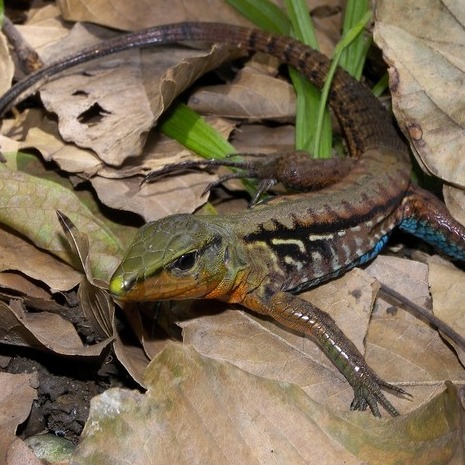
An elegant and slender reptile with a characteristic dorsal coloration: a light vertebral band that contrasts with dark flanks often adorned with bluish spots or stripes. Its head is pointed and aerodynamic, ideal for navigating at high speed through the dense tropical leaf litter.
Added by
Anonymous Curator
Reviewed by
Under Review
Last modified by
Julia Trouin
Taxonomy
PhylumChordata
ClassReptilia
OrderSquamata
FamilyTeiidae
GenusAmeiva
Taxonomic AuthorityLichtenstein & Martens, 1856
Ecology & Status
Origin
Native
Population Trend
Stable
Breeding Season
--
Trophic Role
Insectivore
Recent Sightings
Yes
Habitat Summary Multi-lang
Inhabits the understory of humid forests, gallery forests, and disturbed areas with vegetation cover. It prefers areas with filtered sunlight reaching the ground for thermoregulation before beginning its foraging activity.Behaviour Multi-lang
Active during the day, the *Ameiva festiva* spends almost all its time on the ground searching for prey. It is highly territorial during the mating season, where males perform color displays and chases to defend their domains.Social Activity Multi-lang
Solitary, except during the breeding season. It does not interact socially in a complex way, its encounters being limited to territory defense or mating rituals.Feeding Guild Multi-lang
Active forager. Uses smell to track prey in leaf litter and then digs with its forelimbs to extract hidden insects.Trophic Chain Details Multi-lang
Generalist secondary consumer. Feeds on a wide variety of invertebrates, including grasshoppers, larvae, spiders, and termites. It plays a fundamental role in regulating arthropod populations on the forest floor.Reproductive Behaviour Multi-lang
Oviparous species. The female lays its eggs in nests excavated in humid and protected places under the ground or logs. There is no parental care.Physical Measures
Length (cm)
15.0 - 25.0 cm
Weight (Grams)
15 g - 45 g
Offspring per cycle3 - 8
Sexual DimorphismYes
Lifespan
Sexual Maturity
1 - 2 Years
Gestation / Incubation
2 - 3
Lifespan Estimated
Males4 - 7 Years
Females4 - 7 Years
Sexual Dimorphism
Males Multi-lang
The male is remarkably more colorful, featuring lateral bands of intense electric blue and a belly often with bluish tones. Its head is more robust compared to the female.
Females Multi-lang
The female has more muted colors, with brown and ocher tones predominating, which provides better camouflage among the forest floor while carrying out its activities of searching for nesting sites.
Evolutionary Adaptations Multi-lang
Escape Speed: The *Ameiva festiva* is famous for its ability to run in extremely fast bursts using its strong hind limbs, making it a difficult target for most terrestrial predators.
Sensory Bifid Tongue: Like other teiids, it uses its deeply bifid tongue to collect chemical particles from the air and soil, processing them in the vomeronasal organ to locate prey hidden in the leaf litter.
Main Threats Multi-lang
Habitat Loss: Massive deforestation in the Central American corridor reduces the forest patches necessary for their thermoregulation and foraging.
Interesting Facts Multi-lang
Despite their restless nature during the day, they are experts at finding crevices and tunnels in the ground where they spend the night in a state of deep lethargy.