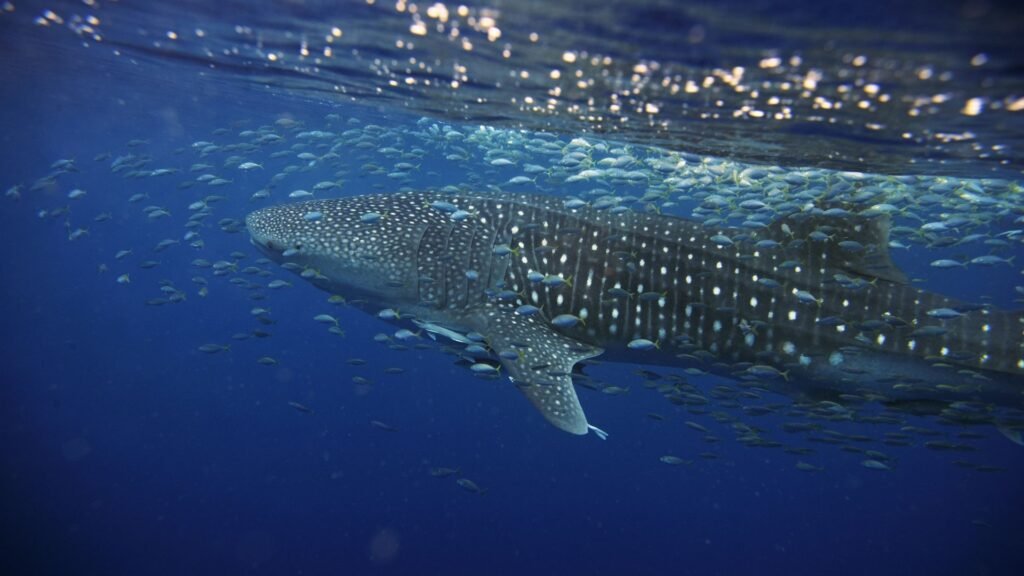
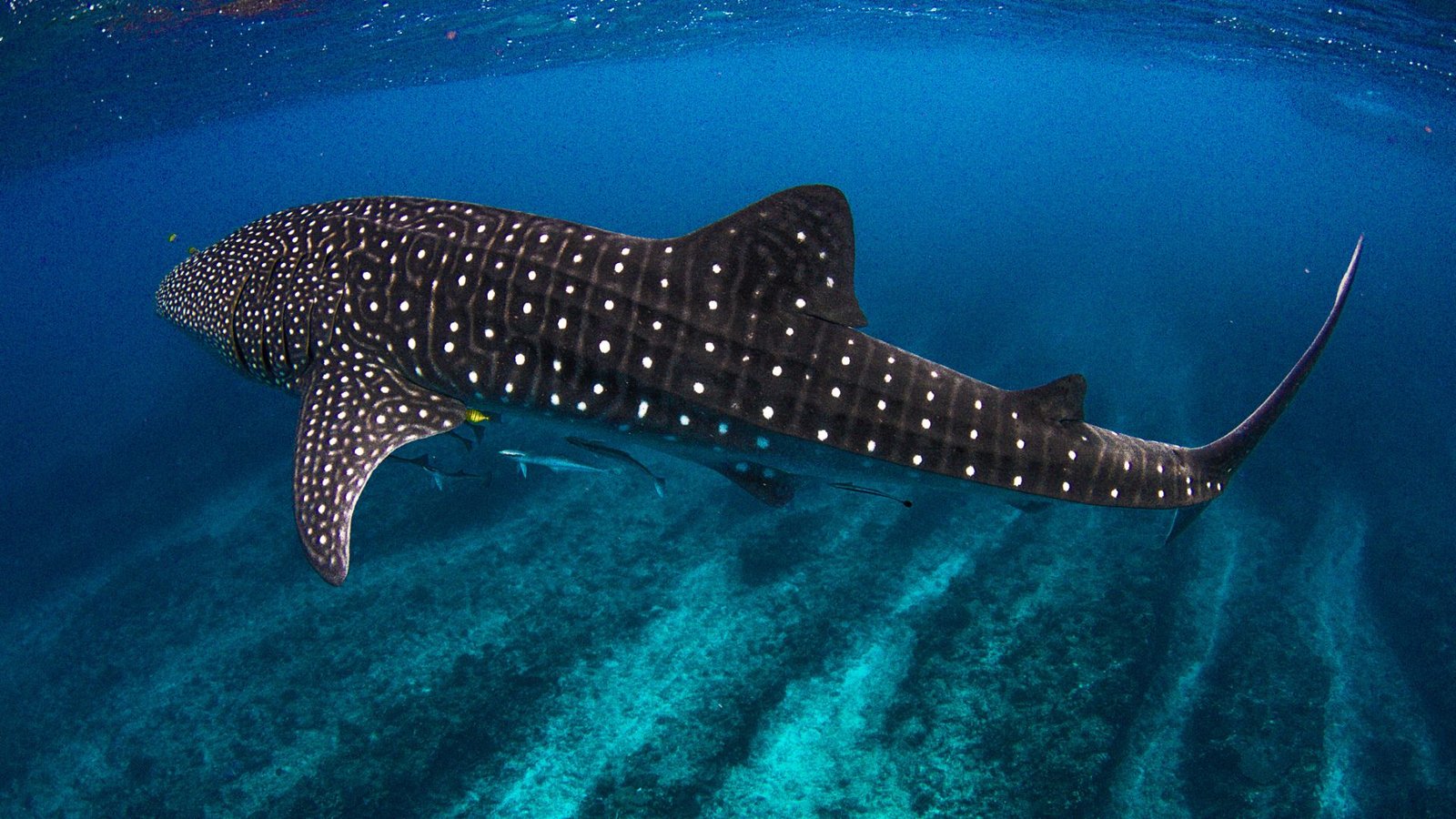
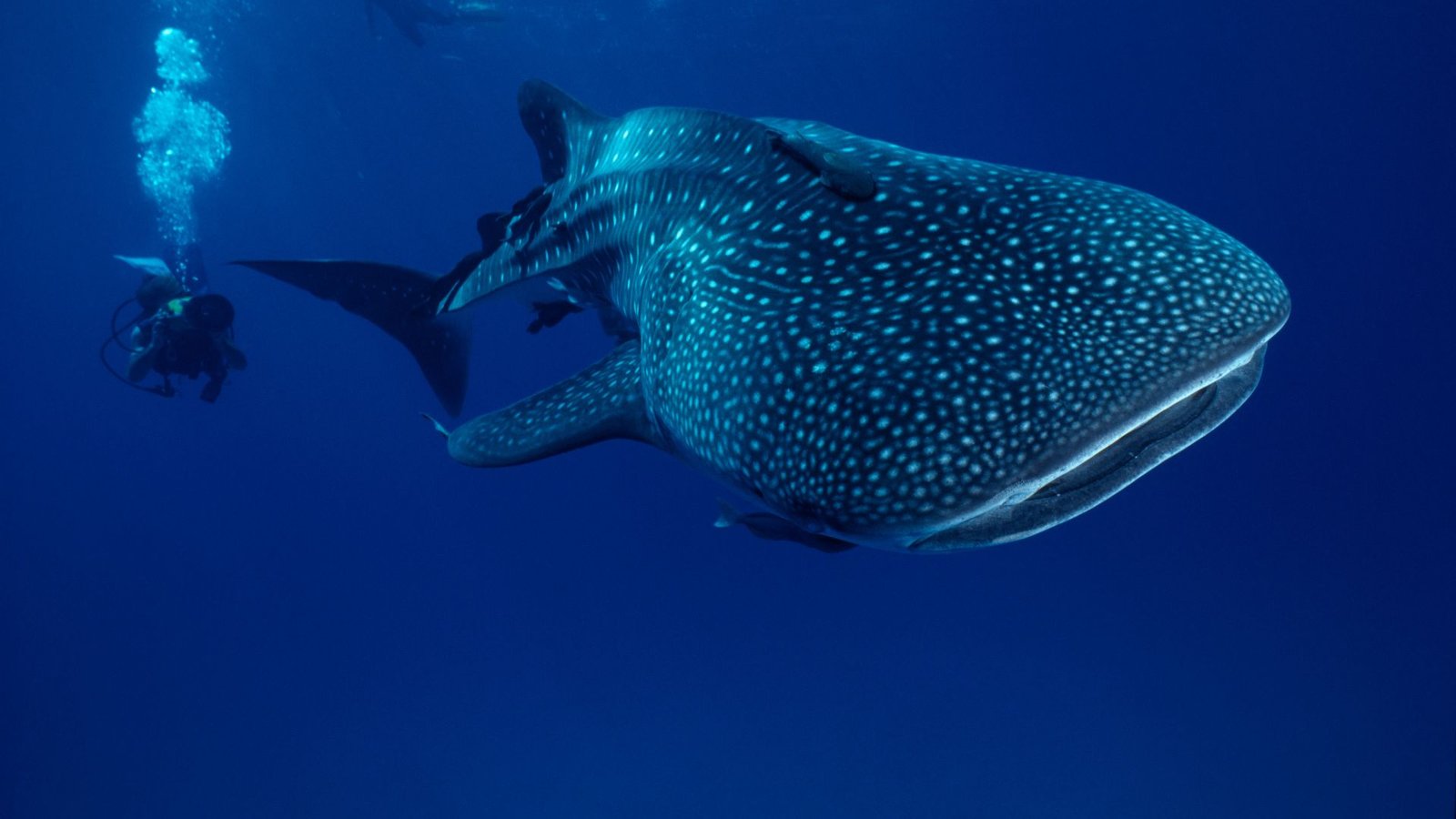
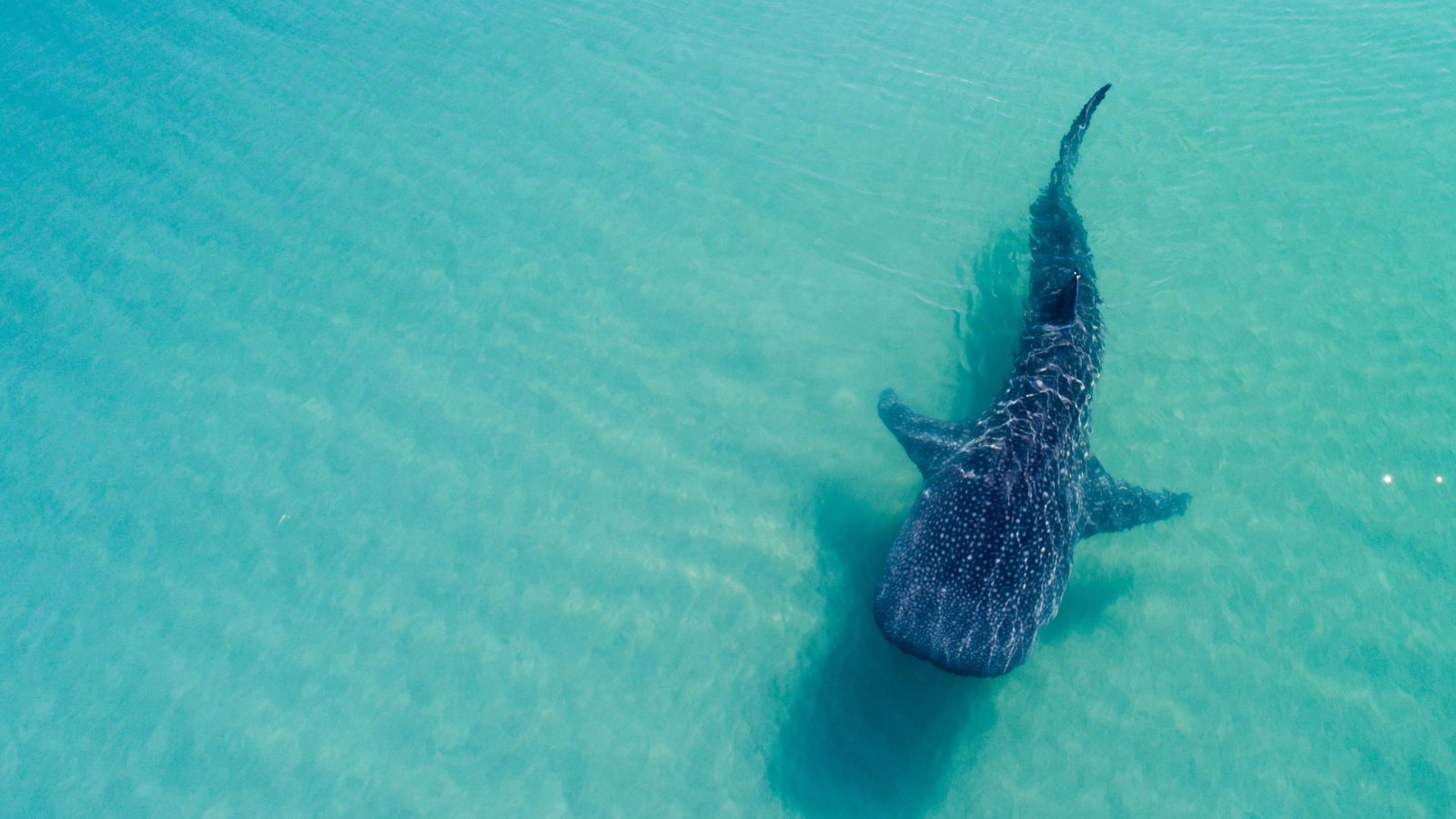
The largest extant fish: adults typically 8–12 m TL but verified records exceed 18 m and 30 t. Body fusiform and massive, head broad and flattened with a terminal mouth up to 1.5 m wide containing ≈ 3 000 minute teeth arranged in 300 rows. Five large gill slits house filtering pads. Dorsal surface dark bluish‑grey to chocolate brown patterned by hundreds of white/yellow spots and transverse stripes unique to each individual; ventrum white. Two dorsal fins, first triangular and set posterior to pectorals; caudal fin semilunate with longer upper lobe in juveniles. Skin up to 10 cm thick, covered in large denticles. Sexes similar; males possess paired claspers.
Sexual dimorphism refers to the physical differences between males and females of the same species that go beyond reproductive organs. For example, size, colour or form.
The largest extant fish: adults typically 8–12 m TL but verified records exceed 18 m and 30 t. Body fusiform and massive, head broad and flattened with a terminal mouth up to 1.5 m wide containing ≈ 3 000 minute teeth arranged in 300 rows. Five large gill slits house filtering pads. Dorsal surface dark bluish‑grey to chocolate brown patterned by hundreds of white/yellow spots and transverse stripes unique to each individual; ventrum white. Two dorsal fins, first triangular and set posterior to pectorals; caudal fin semilunate with longer upper lobe in juveniles. Skin up to 10 cm thick, covered in large denticles. Sexes similar; males possess paired claspers.
Epipelagic and mesopelagic of warm seas (18–30 °C), surface to ≥ 1 900 m; in Costa Rica observed offshore of Nicoya & Dulce gulfs, Cocos Ridge seamounts, occasionally Caribbean slope. Aggregations coincide with up‑welling, fish‑spawn slicks and tuna purse‑seine sets.
Planktivorous megafauna; filter‑feeds on zooplankton, fish/squid larvae, coral spawn, pelagic eggs; occasionally surface‑ram feeds on small schooling fishes
Social Structure & Behaviour
Activity pattern: primarily surface‑oriented feeding dawn/dusk; deep dives midday.
Grouping: generally solitary; seasonal feeding aggregations of 5–30 around plankton blooms or fish‑spawn slicks.
Movements: long‑distance migrations along Costa Rica Dome–Cocos–Galápagos ridge; site fidelity to thermal fronts with high zooplankton fluorescence.
Communication: no documented acoustic signals; tactile cues with trailing fishes/conspecifics observed.
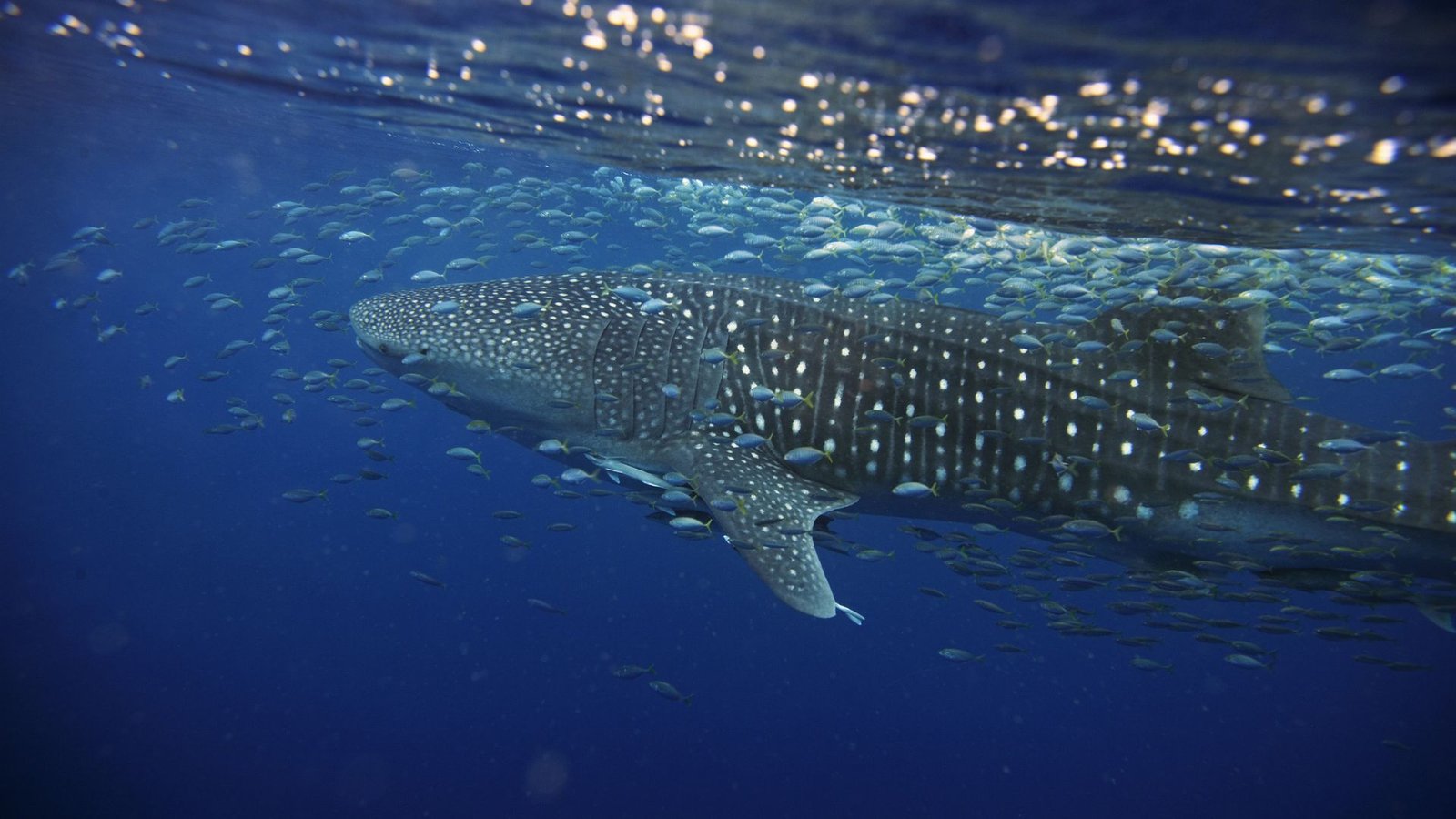
Special behaviours: vertical “corkscrew” feeding spirals and passive suction at fish‑egg slicks; tolerates close approach by remoras and pilot fish.
Taxonomic classification is a hierarchical system used in biology to organize and name living organisms. It arranges species into nested groups based on shared characteristics and evolutionary relationships.
🌍 The IUCN status refers to the conservation category assigned to a species by the International Union for Conservation of Nature, based on its risk of extinction
Each spot pattern is unique—photo‑ID uses algorithm adapted from NASA star‑field software.
Can filter ~6 000 L h⁻¹ of seawater while swimming 1.2 m s⁻¹.
Performs diel vertical migrations: surface feeding at dusk, dives > 1 200 m likely for foraging or thermoregulation.
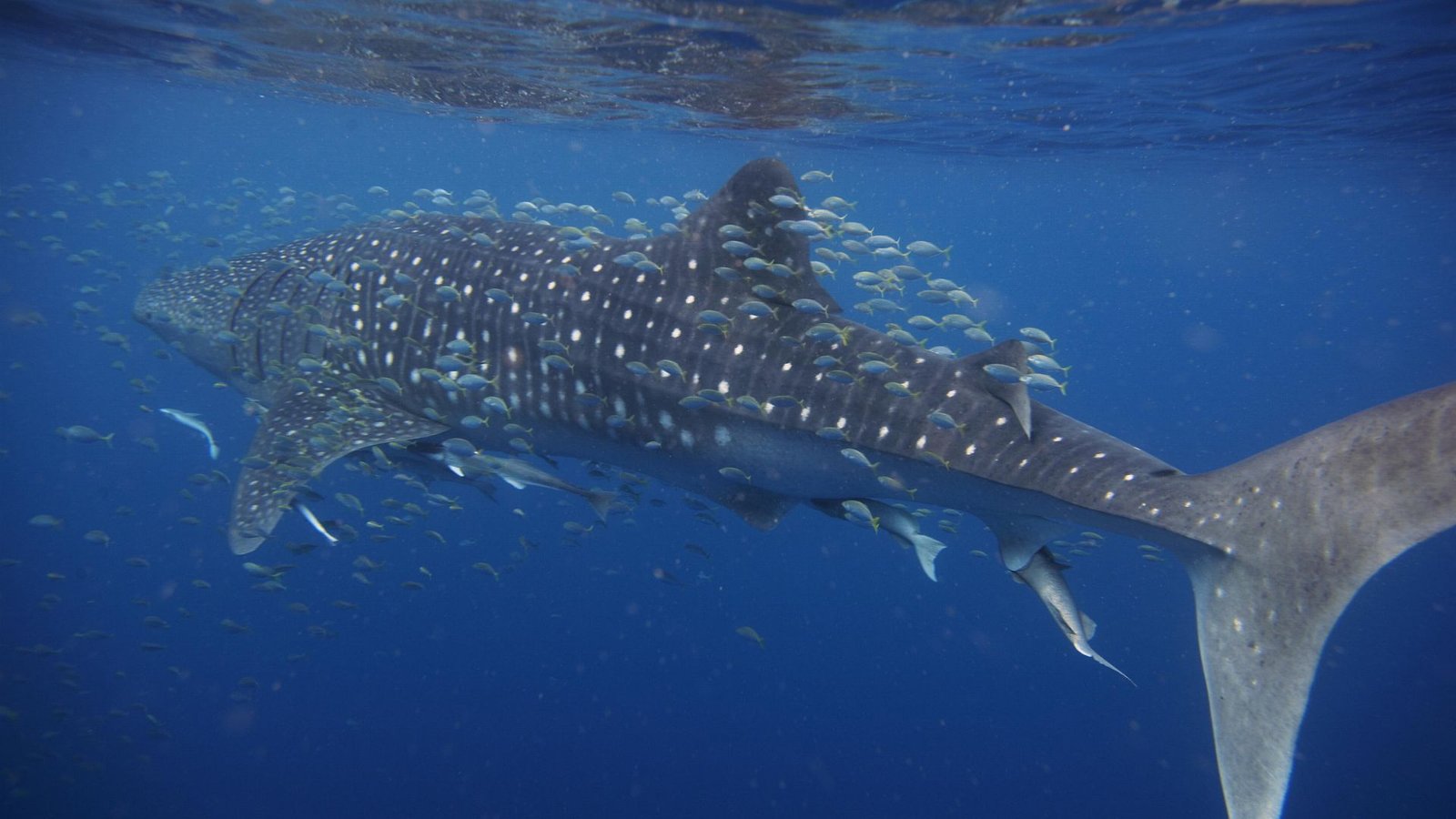
Documented hosting up to 50 remoras and juvenile trevallies sheltering within gill slits.
In 2023, a 12.5 m female tagged off Cocos travelled > 4 800 km to Galápagos and back in 7 mo.
Native
Decreasing