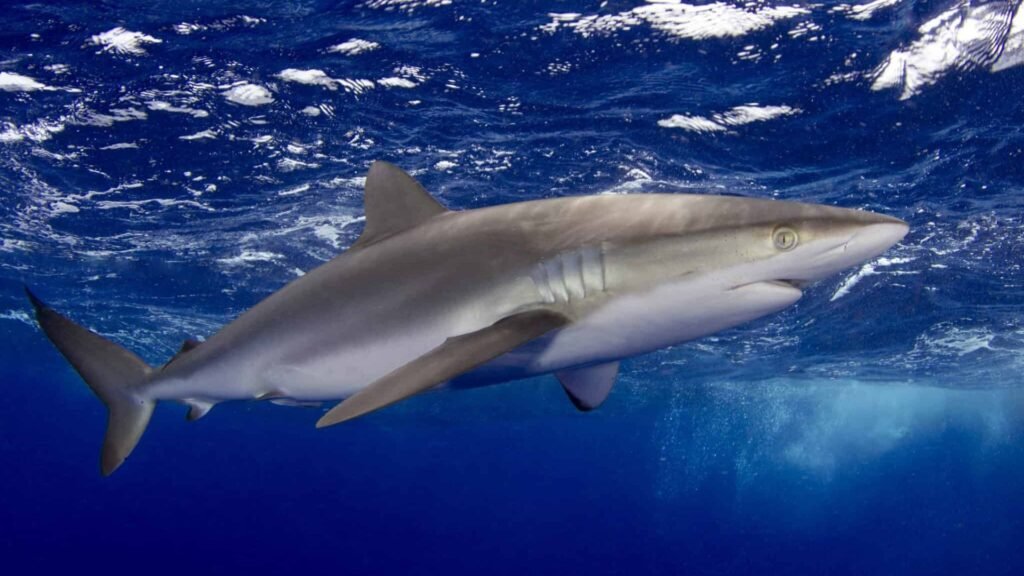
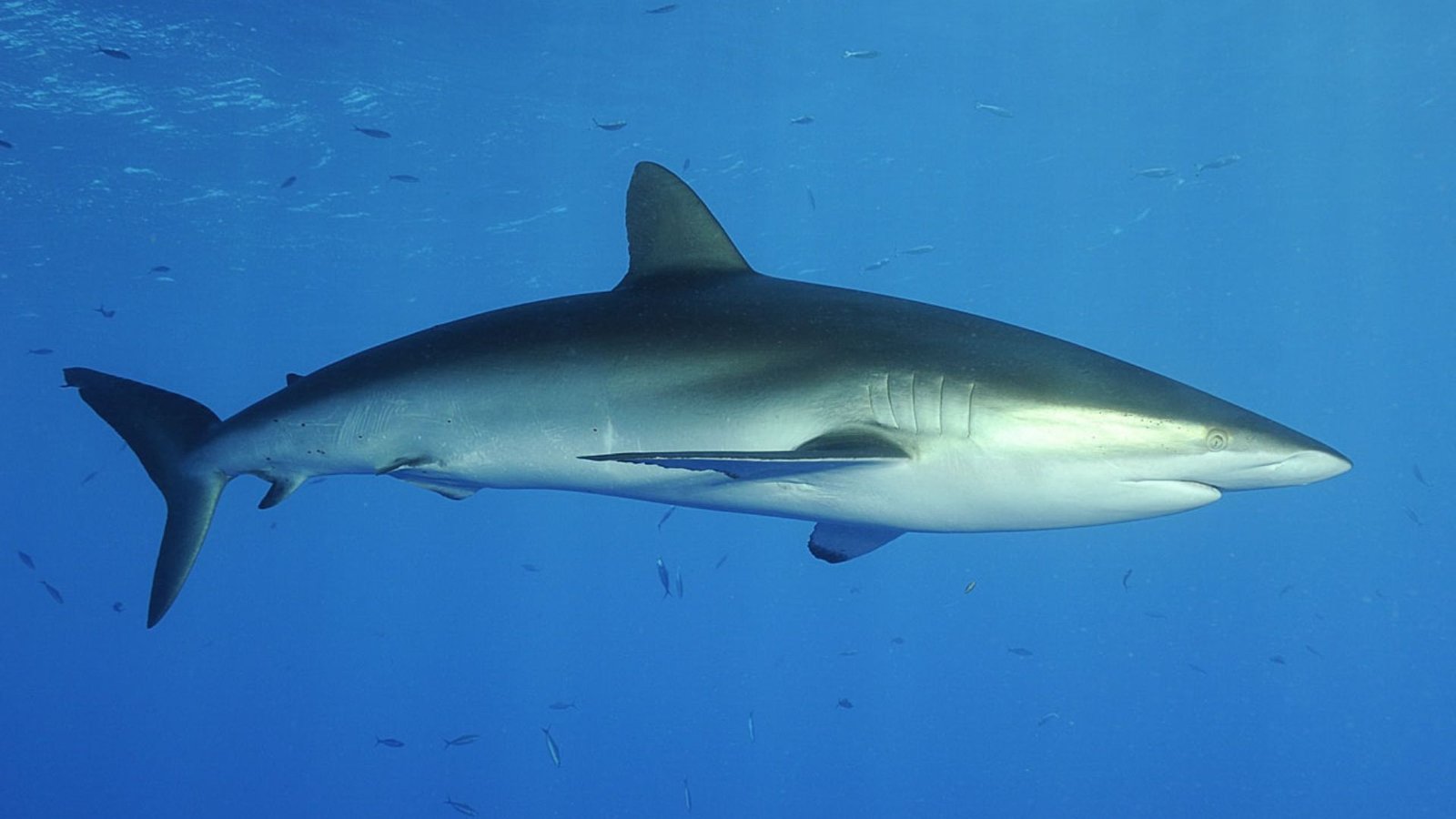
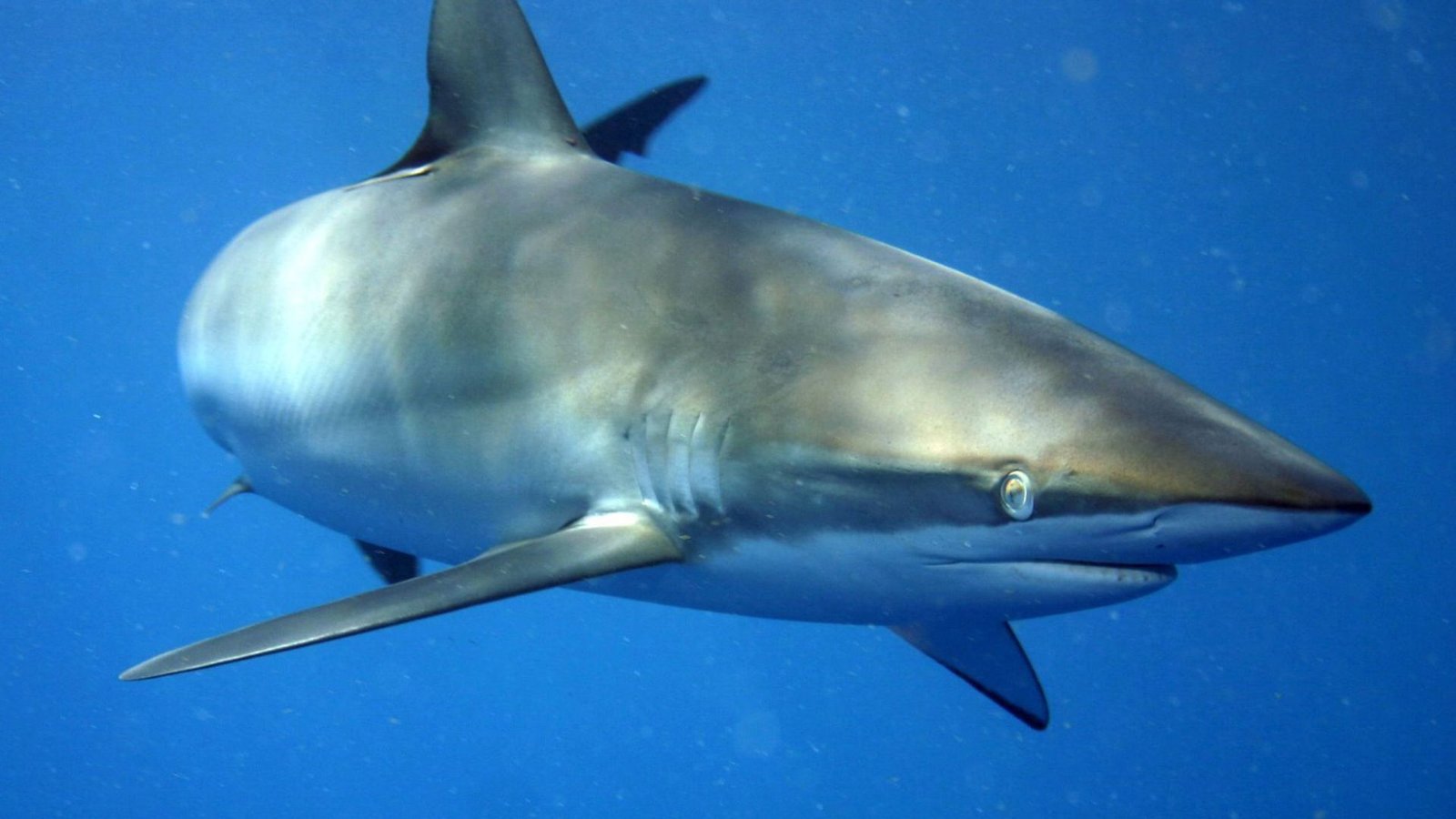
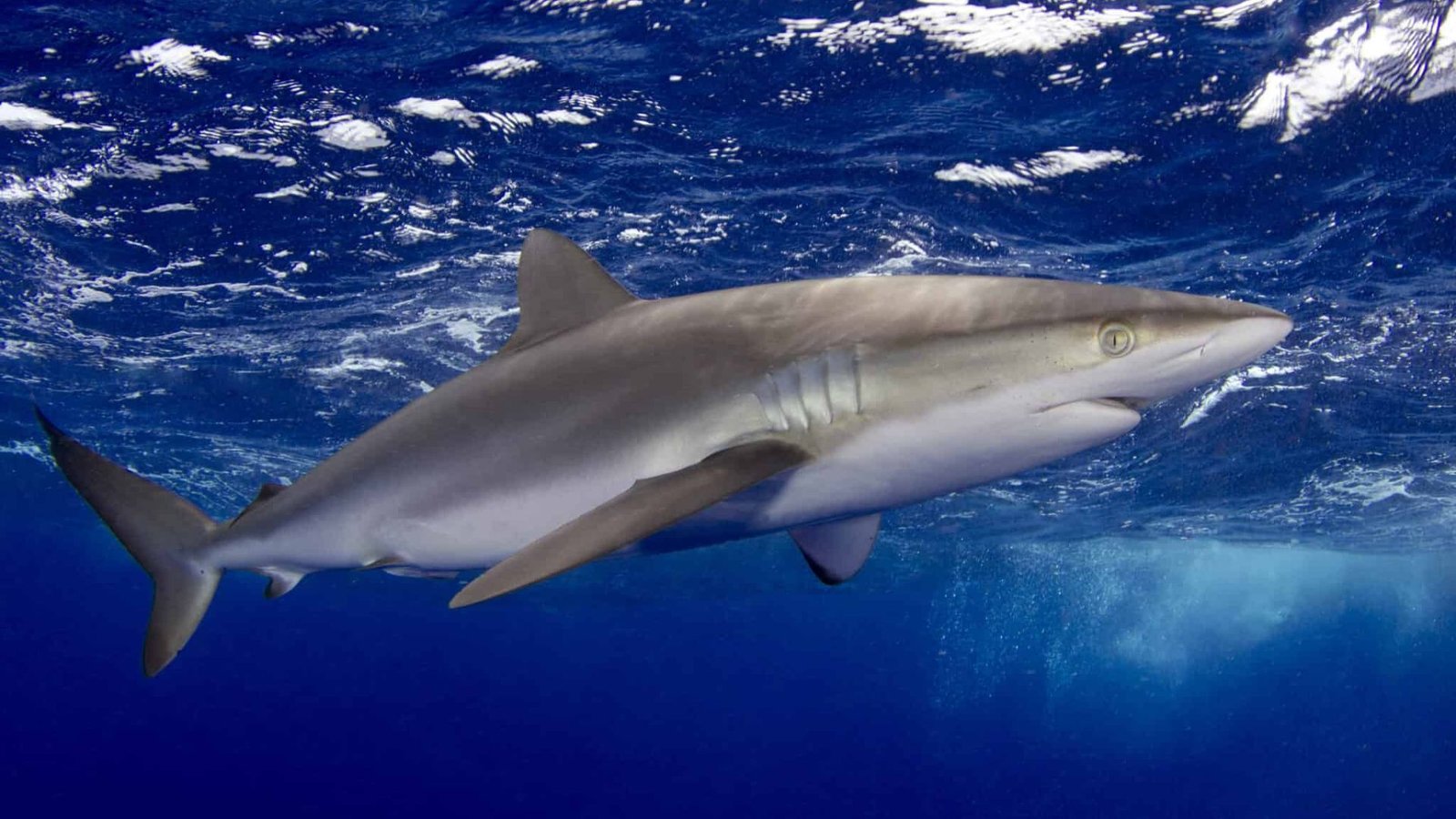
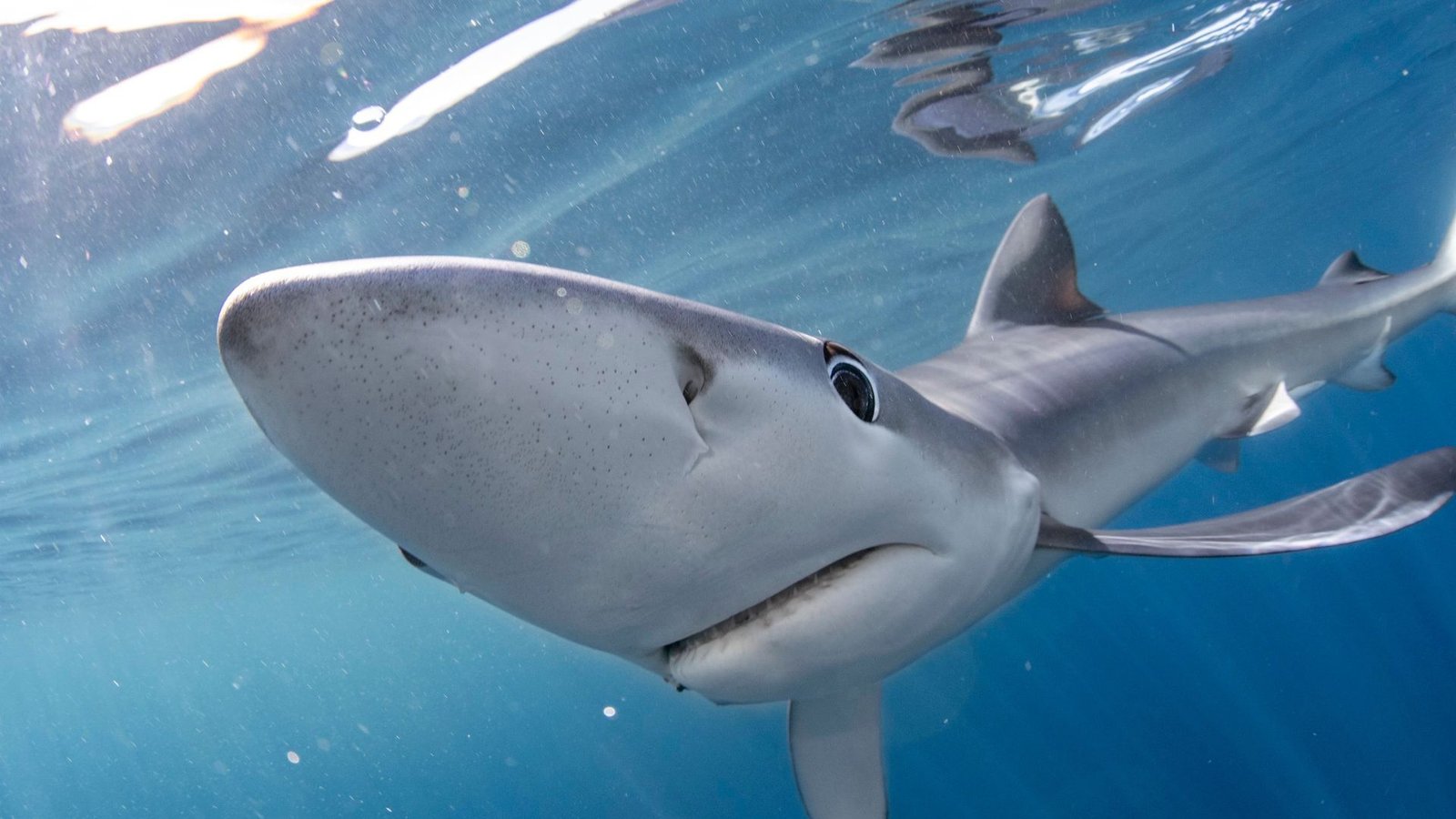
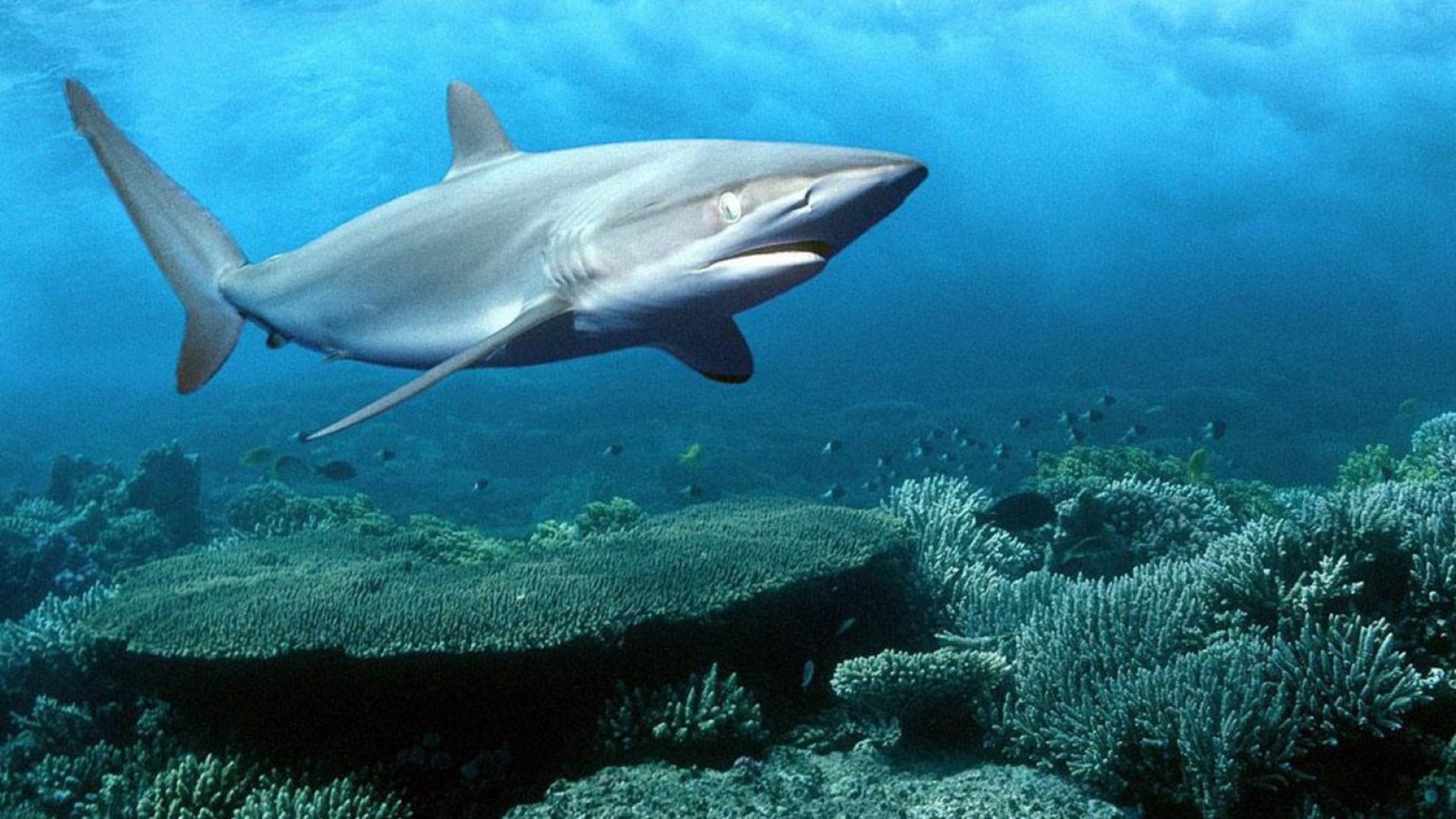
Slender, oceanic requiem shark with a notably silky‑smooth skin created by densely packed dermal denticles. First dorsal fin moderately tall, origin behind pectoral free tips; second dorsal possesses a long free rear tip. Pectorals long, narrow, falcate. Snout long and rounded; eyes large with nictitating membranes. Colour uniform dark bronzy‑grey above, white below; no distinct fin markings except faint dusky tips in juveniles. Adults average 2.2–2.6 m TL (maximum 3.5 m) and 150‑170 kg. Teeth: upper narrow, serrated; lower slender, semi‑erect. Sexual dimorphism minimal—females slightly larger, males with claspers.
Has Sexual Diamorphism?
Yes
Sexual dimorphism refers to the physical differences between males and females of the same species that go beyond reproductive organs. For example, size, colour or form.
Females larger/heavier; males with claspers.
LIFE‑HISTORY & VITAL STATISTICS OF THE Silky Shark(S)
Average Height / Length / Diameter
Males 2.1 m; females 2.4 m (max 3.5 m)
Average Adult Weight / Mass
60–170 kg
Typical Lifespan / Longevity
≈ 22 yr (vertebral ageing)
Typical Lifespan / Longevity for males
Data deficient
Typical Lifespan / Longevity for Females
Data deficient
Age at Sexual Maturity
Males 6–7 yr (≈ 210 cm TL); females 7–9 yr (≈ 230 cm TL)
Breading Season
Parturition in coastal shelf waters May–July; mating inferred preceding dry season offshore
Gestation
Reproductive Outcome
4 – 16 pups (mean 8) every 1–2 yr
Ecology and Behaviour for Silky Shark(s)
Slender, oceanic requiem shark with a notably silky‑smooth skin created by densely packed dermal denticles. First dorsal fin moderately tall, origin behind pectoral free tips; second dorsal possesses a long free rear tip. Pectorals long, narrow, falcate. Snout long and rounded; eyes large with nictitating membranes. Colour uniform dark bronzy‑grey above, white below; no distinct fin markings except faint dusky tips in juveniles. Adults average 2.2–2.6 m TL (maximum 3.5 m) and 150‑170 kg. Teeth: upper narrow, serrated; lower slender, semi‑erect. Sexual dimorphism minimal—females slightly larger, males with claspers.
Habitat
Offshore epipelagic (surface – 400 m) of warm oceans; abundant around Costa‑Rica Dome, Cocos Ridge seamounts, FAD arrays and tuna purse‑seine sets; juveniles utilise outer continental‑shelf and insular shelf breaks (30–100 m).
Trophic Chain
Apex / upper‑mesopredator feeding on skipjack and yellowfin tuna, mackerels, flyingfish, squid; opportunistically scavenges cetacean and whale‑shark carcasses.
Interespecies relationships noted for Silky Shark
Mutualism + / +
Barberfish at seamounts remove parasites; gain food while shark health improves.
Symbiosis + / +
Gut microbiota recycle urea & assist protein digestion.
Commensalism + / 0
Pilot fish shelter under shark, feeding on scraps; shark unaffected.
Inquilinism + / 0
Juvenile dolphinfish school beneath large silky sharks for predator cover.
Phoresy + / 0
Remoras (Echeneis naucrates) ride on flanks, dispersing across ocean basins.
Tanatocresis + / 0
Dead silky carcasses serve as substrate for deep‑sea invertebrate blooms.
Parasitism + / –
Copepods (Kroeyerina) and cestodes (Gymnorhynchus) on gills/intestine.
Predation + / –
Preys on tuna, squid, flyingfish; juveniles preyed upon by blue marlin & larger sharks.
Amensalism 0 / –
Herding bait schools reduces foraging success of seabirds without benefit to shark.
Competition – / –
Overlaps with Galapagos and blue sharks for tuna prey around FADs.
Social behaviour of Silky Shark
Social Structure & Behaviour
Activity pattern: cathemeral; follows prey‑rich thermocline (50–150 m) by day, surfaces at night.
Group size: solitary or loose schools (5–50) around FADs, seamount plateaus and tuna schools.
Site fidelity: seasonal return to Cocos–Galápagos corridor seamounts documented.
Communication: body‑arching and pectoral drop threat postures toward divers/competitors.
Distribution and Sighthings ofSilky Shark(s) in Costa Rica
General Regions of Costa Rica where to find Silky Sharks
Pacific Ocean
National Parks and Reserves of Costa Rica where to find Silky Sharks
Parque Nacional Isla del Coco
Best Time to seeSilky Shark(s) in Costa Rica
Dry Season
January
February
March
April
June
July
August
September
October
November
December
Media
Videos
Sounds and calls
This entry needs further information with:
Male and female photos
This sheet is marked as: Revision required
Taxonomy
Taxonomic classification is a hierarchical system used in biology to organize and name living organisms. It arranges species into nested groups based on shared characteristics and evolutionary relationships.
Kingdom Animalia
Phylum Chordata
Class Chondrichthyes
Order Carcharhiniformes
Genus Carcharhinus
Conservation Status
Status IUCN
🌍 The IUCN status refers to the conservation category assigned to a species by the International Union for Conservation of Nature, based on its risk of extinction
Vulnerable
Threats
⚠️Heavy by‑catch and targeted capture in Eastern Tropical Pacific purse‑seine and long‑line fisheries (valued fins).
⚠️High post‑release mortality due to capture stress and shark‑handling practices.
⚠️Aggregation around fish‑aggregating devices (FADs) increases exposure to gear.
⚠️Declining tuna biomass may reduce key prey availability.
⚠️Plastic debris ingestion recorded in stomachs from Costa‑Rica Dome gyre.
Fun Facts
Named for the silky texture of skin—denticles reduce drag, enabling efficient cruising.
Can sustain burst speeds > 3 m s⁻¹ when corralling tuna.
Satellite tags show diel vertical migrations: surface at night, 200–400 m by day following prey.
Juveniles exhibit counter‑shading with faint white fin edges that fade in adults.
Costa Rica banned finning (2006), yet silky accounts for > 40 % of shark by‑catch at national tuna fleet.