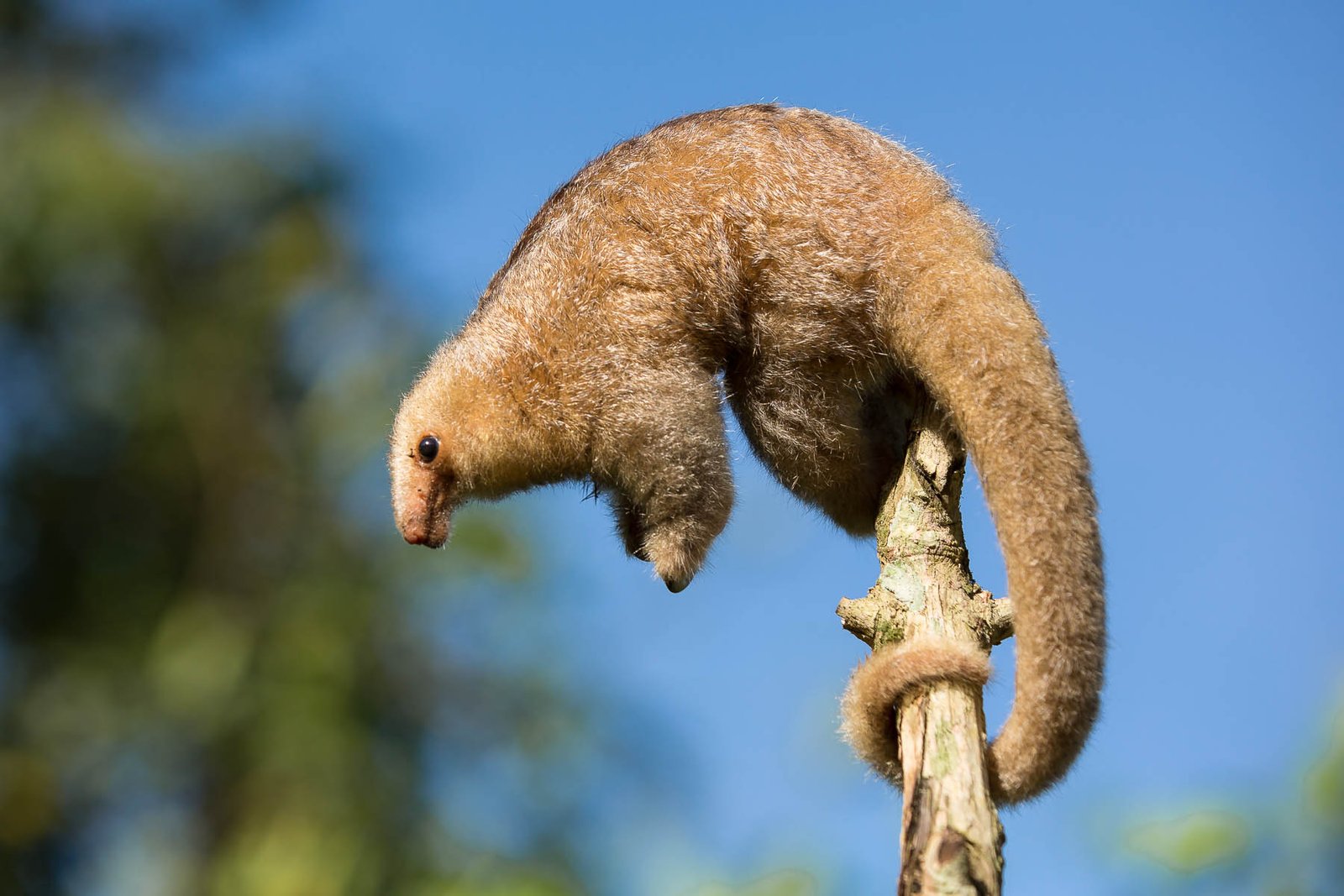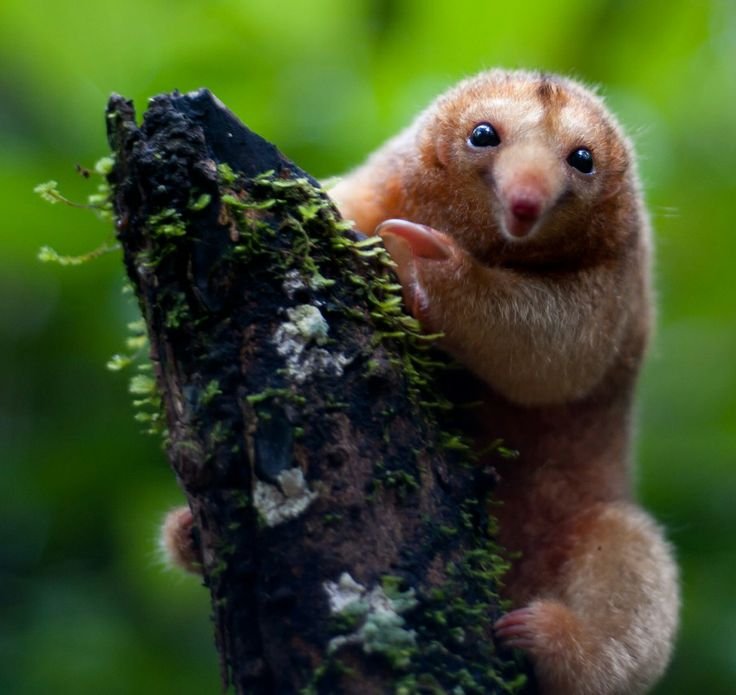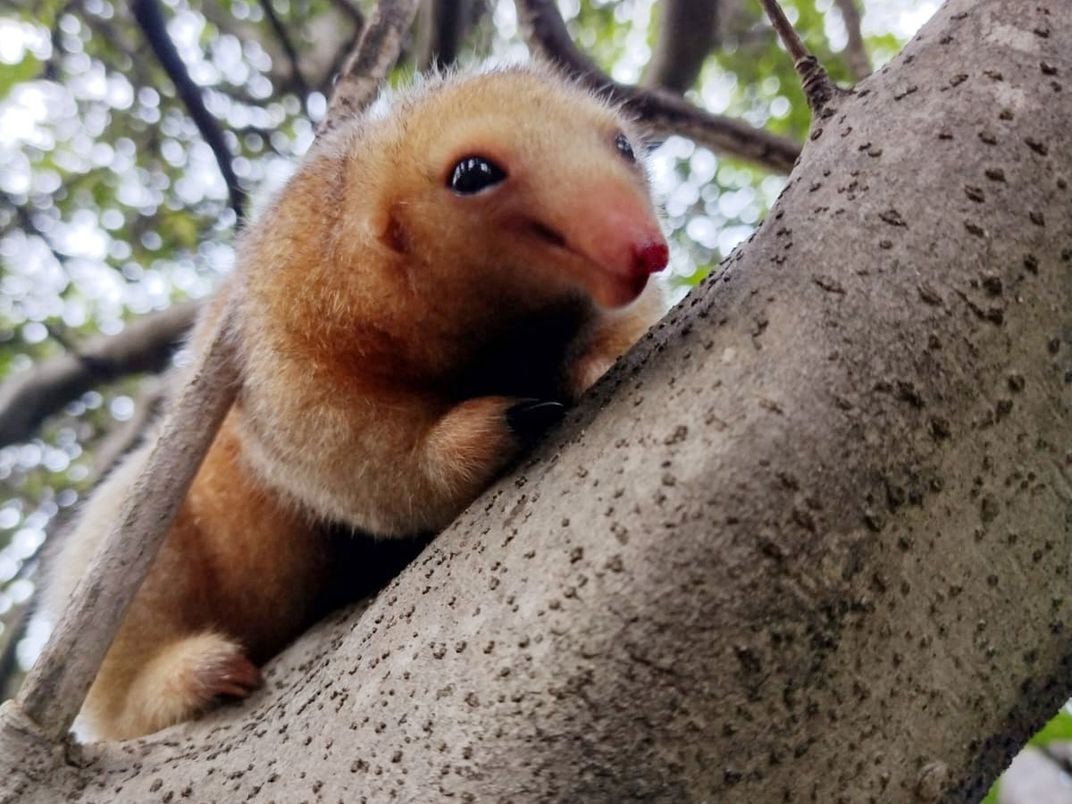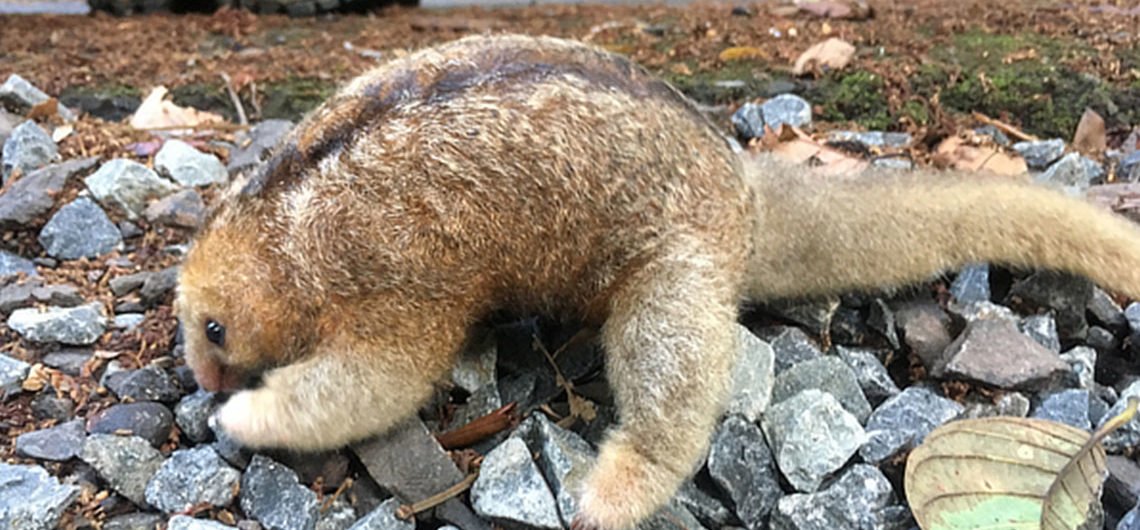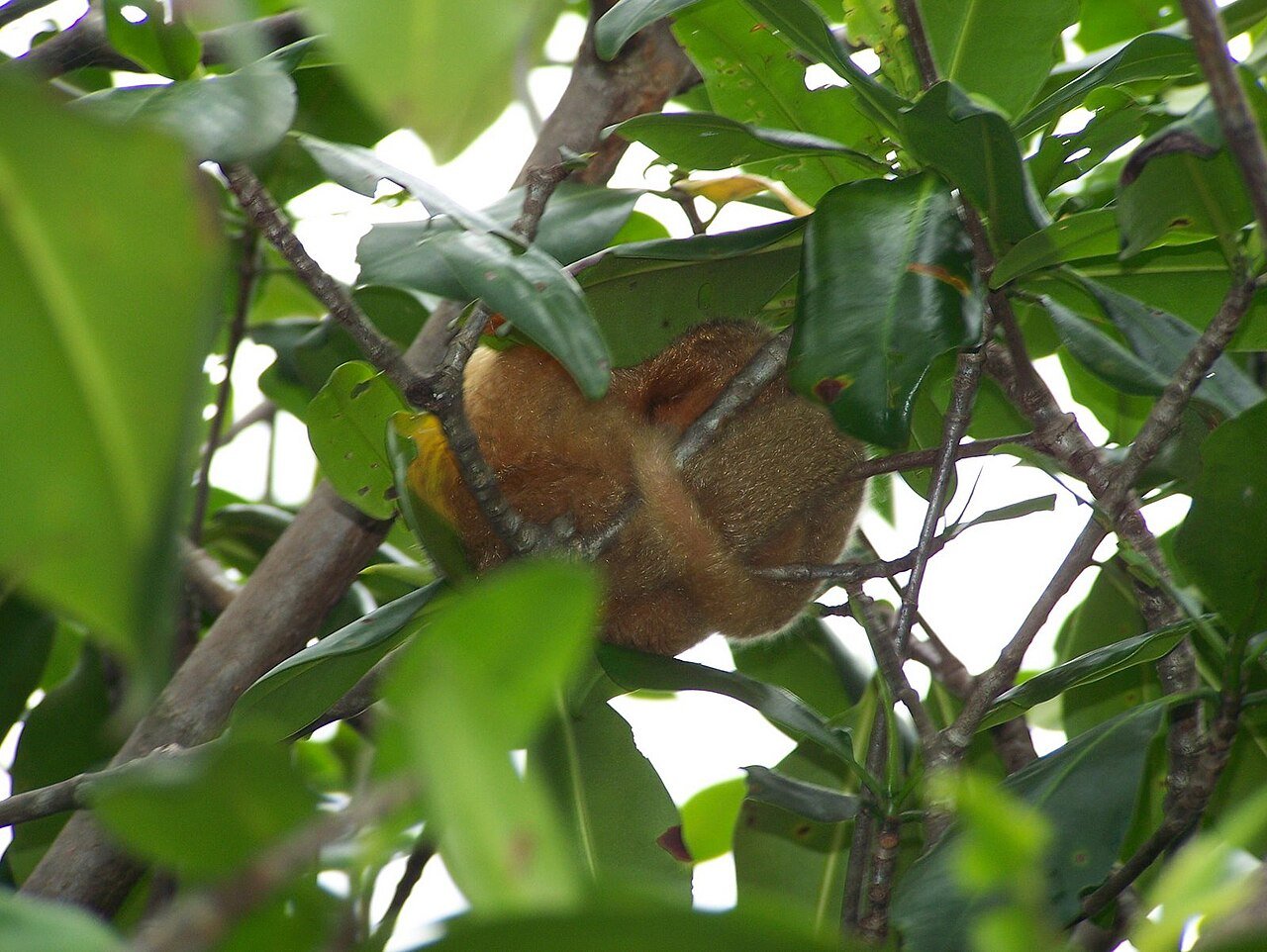
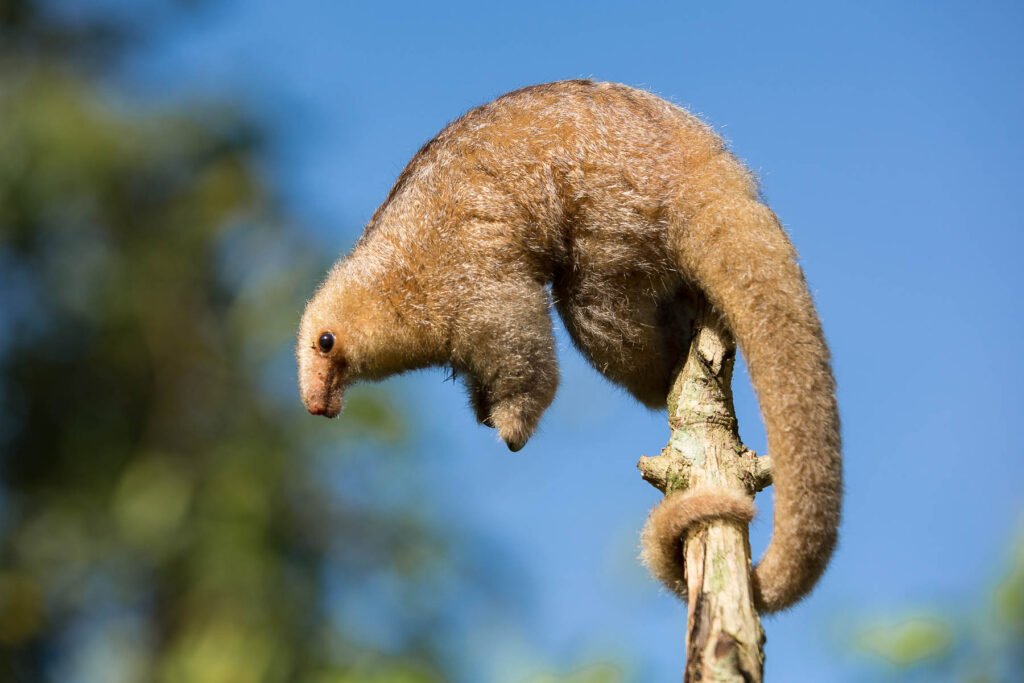



The silky anteater is the smallest living xenarthran, bearing a dense, wool‑silky coat ranging from pale silver‑grey to golden buff that camouflages among Cecropia seed tufts. Head–body length 17–27 cm with a 17–24 cm fully prehensile tail; mass 200–450 g. The head is short with a tapered, toothless muzzle and a 15‑cm extensile tongue. Forefeet have two greatly enlarged, recurved claws used to tear open ant nests; hind feet have four diminutive claws. Eyes are large and forward‑set, reflecting its strictly arboreal, nocturnal habits. Limbs rotate nearly 180° at the ankle, facilitating upside‑down locomotion along vines and thin branches. Neonates are born pink and nearly naked, gaining adult pelage within four weeks.
Sexual dimorphism refers to the physical differences between males and females of the same species that go beyond reproductive organs. For example, size, colour or form.
Head–body 17–27 cm; tail 17–24 cm
0.2–0.45 kg
≈ 9–12 yr wild; up to 16 yr captivity
Data deficient
Data deficient
≈ 12–15 mo
Aseasonal in Costa Rica; births cluster May–July (early wet season)
Number of Offspring per Event: 1; litters ≈ once every 12–16 mo
The silky anteater is the smallest living xenarthran, bearing a dense, wool‑silky coat ranging from pale silver‑grey to golden buff that camouflages among Cecropia seed tufts. Head–body length 17–27 cm with a 17–24 cm fully prehensile tail; mass 200–450 g. The head is short with a tapered, toothless muzzle and a 15‑cm extensile tongue. Forefeet have two greatly enlarged, recurved claws used to tear open ant nests; hind feet have four diminutive claws. Eyes are large and forward‑set, reflecting its strictly arboreal, nocturnal habits. Limbs rotate nearly 180° at the ankle, facilitating upside‑down locomotion along vines and thin branches. Neonates are born pink and nearly naked, gaining adult pelage within four weeks.
Specialized myrmecophage consuming 5 000–8 000 arboreal Camponotus and Azteca ants per night; minor intake of termites and stingless‑bee honey.
Taxonomic classification is a hierarchical system used in biology to organize and name living organisms. It arranges species into nested groups based on shared characteristics and evolutionary relationships.
🌍 The IUCN status refers to the conservation category assigned to a species by the International Union for Conservation of Nature, based on its risk of extinction
Possesses only two functional fingers per forefoot—the fewest of any mammal.
Each night travels < 200 m, spending 80 % of activity time stationary while foraging ant trails.
Fur contains air pockets, making individuals exceptionally buoyant when branches fall into water.
Emits a faint musky odor thought to deter arboreal predators such as arboreal boas.
Shares mutualistic “ant gardening” with Azteca ants: ants hollow Cecropia internodes that anteaters later exploit as day nests.


Shallow coral and rocky reefs, sand flats, seagrass beds and mangrove channels from intertidal pools to ≈ 70 m; in Costa Rica abundant around Isla del Caño, Golfo Dulce, Bahía Culebra, and Caribbean patch reefs of Cahuita.

Slender, oceanic requiem shark with a notably silky‑smooth skin created by densely packed dermal denticles. First dorsal fin moderately tall, origin behind pectoral free tips; second dorsal possesses a long free rear tip. Pectorals long, narrow, falcate. Snout long and rounded; eyes large with nictitating membranes. Colour uniform dark bronzy‑grey above, white below; no distinct fin markings except faint dusky tips in juveniles. Adults average 2.2–2.6 m TL (maximum 3.5 m) and 150‑170 kg. Teeth: upper narrow, serrated; lower slender, semi‑erect. Sexual dimorphism minimal—females slightly larger, males with claspers.