Also known / common namesSpanish – Hongo de láminas hendidas, Hongo oreja, Hongo abanico; Bribri – Wachä́r; Cabécar – Rãchiʼ
Hongo de láminas hendidas / Split‑gill(s) General Description
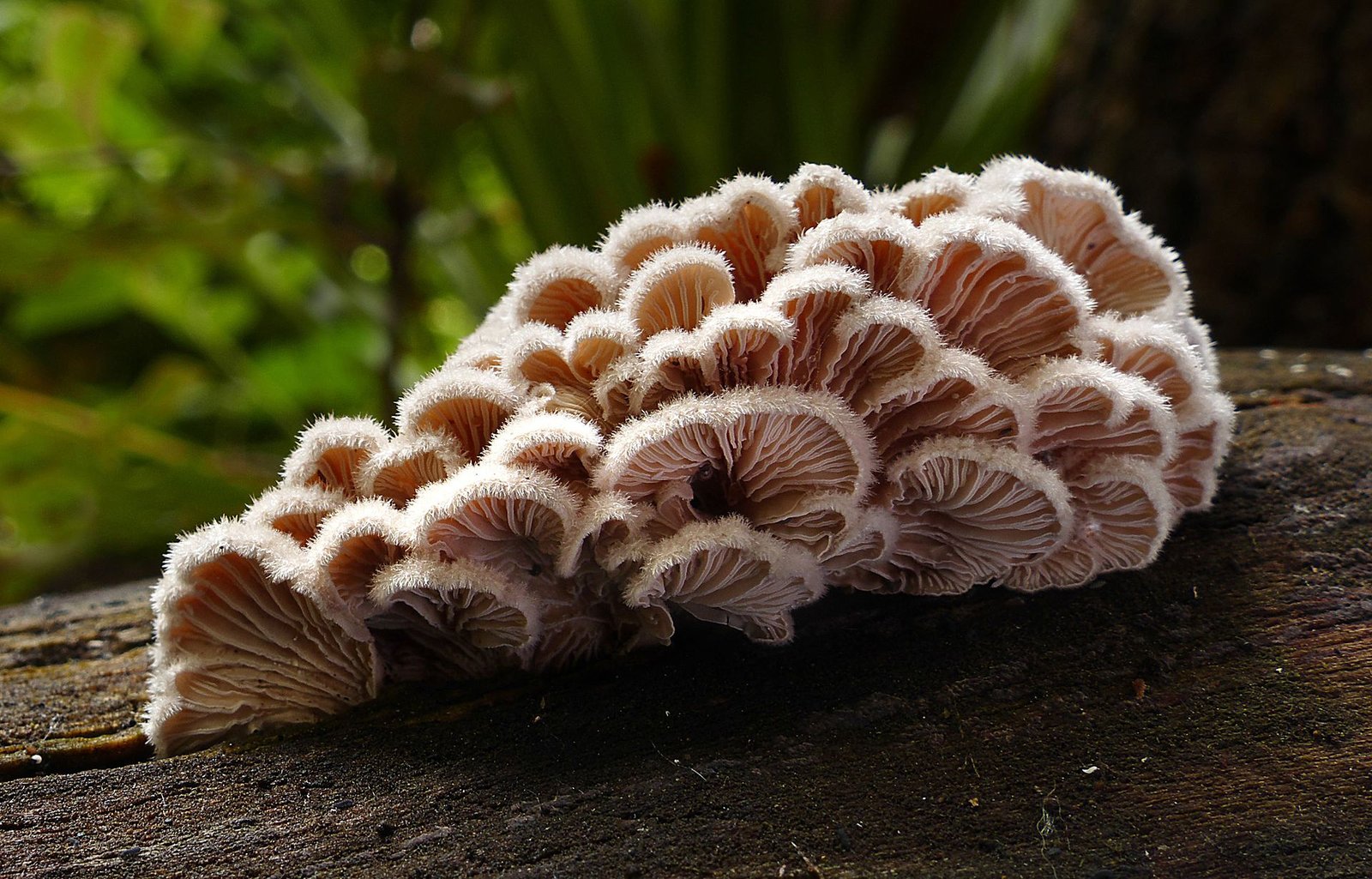
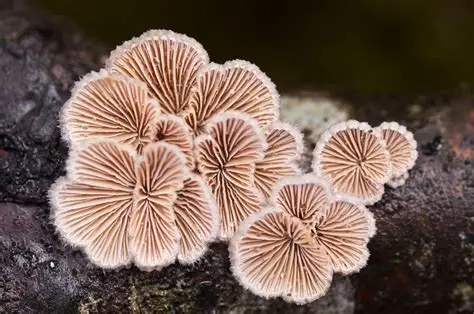
Small, fan‑ to shell‑shaped basidiocarps form layered brackets 1–4 cm across and ≤ 5 mm thick. Upper surface is grey‑white to tan, densely tomentose, often zoned; the underside bears 2–6 radiating folds whose halves split longitudinally and close in dry weather, reopening when re‑hydrated. Margin frequently wavy or lobed. Stalk absent; attachment lateral or central. Flesh tough, cartilaginous. Spore print white. Microscopic features include hyaline, cylindrical basidiospores (3–4 × 1–1.5 µm) and clamp connections. Fruiting bodies develop singly or in imbricate tiers on decaying hardwood; they can desiccate for months and revive repeatedly.
Has Sexual Diamorphism?
No
Sexual dimorphism refers to the physical differences between males and females of the same species that go beyond reproductive organs. For example, size, colour or form.
LIFE‑HISTORY & VITAL STATISTICS OF THE Hongo de láminas hendidas / Split‑gill(S)
Average Height / Length / Diameter
Cap 1–4 cm wide; thickness ≤ 5 mm
Average Adult Weight / Mass
Data deficient (Several grams)
Typical Lifespan / Longevity
Individual fruit body may persist 1–3 yr via repeated desiccation cycles; mycelium potentially decades
Typical Lifespan / Longevity for males
Data deficient (tens‑of‑thousands mating types rather than sexes)
Typical Lifespan / Longevity for Females
Data deficient (tens‑of‑thousands mating types rather than sexes)
Age at Sexual Maturity
Mycelium can fruit within 2–4 wk after colonising suitable wood under tropical humidity
Breading Season
Year‑round; peaks soon after heavy rains followed by drying spells
Gestation
Spore to mature fruit body ≈ 14–21 d under optimal conditions
Reproductive Outcome
Ecology and Behaviour for Hongo de láminas hendidas / Split‑gill(s)
Small, fan‑ to shell‑shaped basidiocarps form layered brackets 1–4 cm across and ≤ 5 mm thick. Upper surface is grey‑white to tan, densely tomentose, often zoned; the underside bears 2–6 radiating folds whose halves split longitudinally and close in dry weather, reopening when re‑hydrated. Margin frequently wavy or lobed. Stalk absent; attachment lateral or central. Flesh tough, cartilaginous. Spore print white. Microscopic features include hyaline, cylindrical basidiospores (3–4 × 1–1.5 µm) and clamp connections. Fruiting bodies develop singly or in imbricate tiers on decaying hardwood; they can desiccate for months and revive repeatedly.
Habitat
Predominantly active during
Saprobe (occasionally weak parasite) on dead or dying hardwood branches, logs and fence posts from sea level to ~1 900 m; thrives in humid lowland and montane forests, plantations and urban parks.
Trophic Chain
Decomposer (saprotroph) that breaks down lignocellulose, accelerating nutrient cycling in woodland ecosystems
Interespecies relationships noted for Hongo de láminas hendidas / Split‑gill
No data was found
Social behaviour of Hongo de láminas hendidas / Split‑gill
Distribution and Sighthings ofHongo de láminas hendidas / Split‑gill(s) in Costa Rica
General Regions of Costa Rica where to find Hongo de láminas hendidas / Split‑gills
Tropical
Mangroves
Wetlands and swamps
Seasonal dry forest (Guanacaste)
Tropical rainforest (Caribbean and North Pacific slopes)
National Parks and Reserves of Costa Rica where to find Hongo de láminas hendidas / Split‑gills
Parque Nacional Volcán Arenal
Parque Nacional Barbilla
Parque Nacional Braulio Carrillo
Parque Nacional Cahuita
Parque Nacional Carara
Parque Nacional Corcovado
Parque Nacional Guanacaste
Parque Nacional Juan Castro Blanco
Parque Internacional La Amistad
Parque Nacional Manuel Antonio
Parque Nacional Piedras Blancas
Parque Nacional Rincón de la Vieja
Parque Nacional Santa Rosa
Parque Nacional Tapantí – Macizo Cerro de la Muerte
Parque Nacional Tenorio
Parque Nacional Tortuguero
Reserva Biológica Islas Negritos
Refugio Nacional de Vida Silvestre Barra del Colorado
Refugio Nacional de Fauna Silvestre Caño Negro
Refugio Nacional de Vida Silvestre Curú
Refugio Nacional de Vida Silvestre Gandoca-Manzanillo
Refugio Nacional de Fauna Silvestre Golfito
Best Time to seeHongo de láminas hendidas / Split‑gill(s) in Costa Rica
Dry Season
January
February
March
April
June
July
August
September
October
November
December
Media
Videos
Sounds and calls
log in to help us with this an other posts.
Taxonomy
Taxonomic classification is a hierarchical system used in biology to organize and name living organisms. It arranges species into nested groups based on shared characteristics and evolutionary relationships.
Kingdom Fungi
Phylum Basidiomycota
Class Agaricomycetes
Order Agaricales
Genus Schizophyllum
Conservation Status
Status IUCN
🌍 The IUCN status refers to the conservation category assigned to a species by the International Union for Conservation of Nature, based on its risk of extinction
Least Concern
Threats
⚠️Removal of deadwood and “clean‑up” practices in managed forests and urban parks.
⚠️Logging and conversion of lowland forest reducing substrate availability.
⚠️Air pollution and smoke that inhibit basidiocarp formation.
⚠️Climate‑driven shifts altering humidity cycles crucial for fruiting.