Also known / common namesSpanish – Arasarí collarejo, Tucancillo collarejo; Bribri – Bríkwa‑íyik; Cabécar – Tsá‑suʼ
Collared Aracari(s) General Description
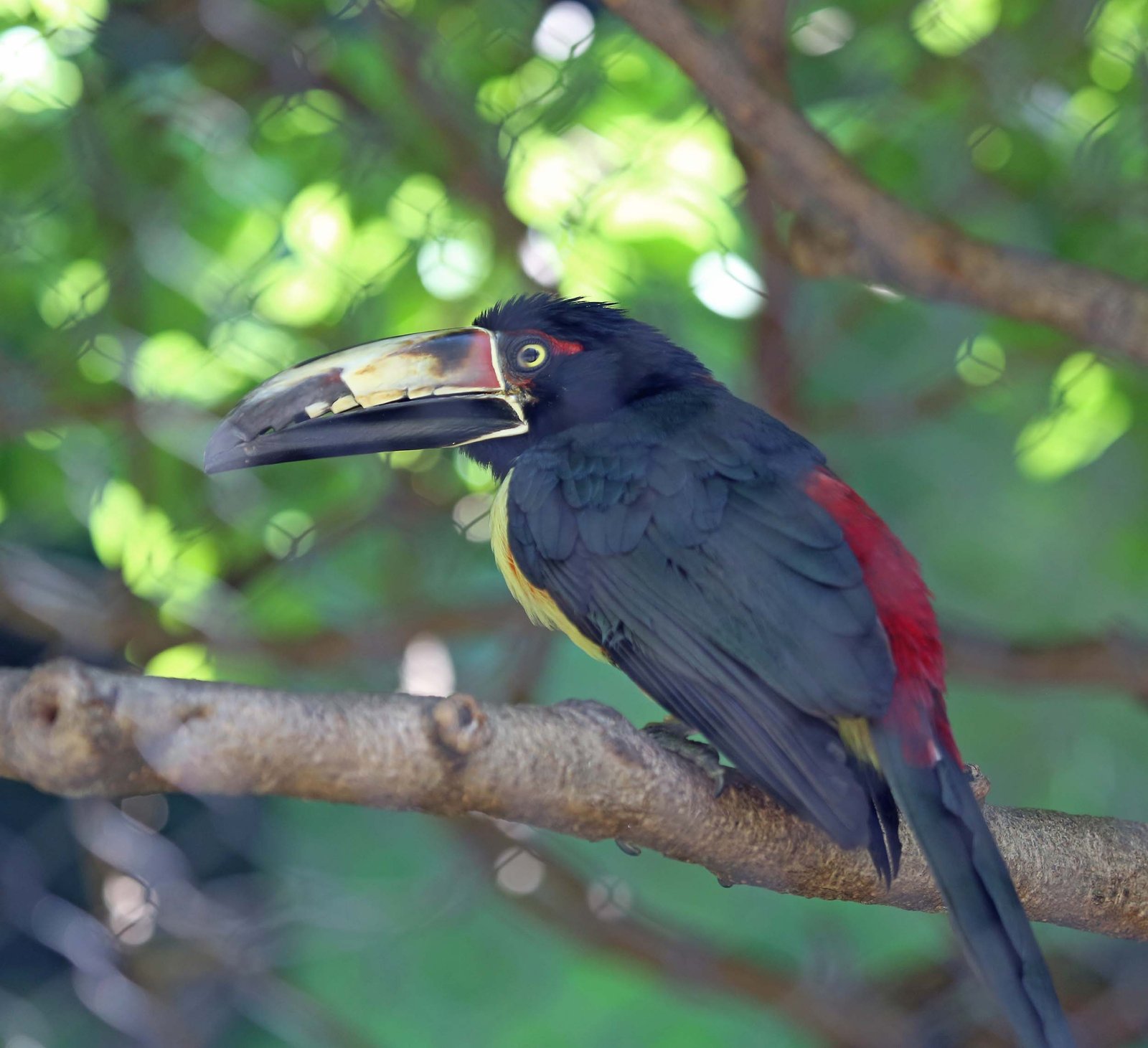
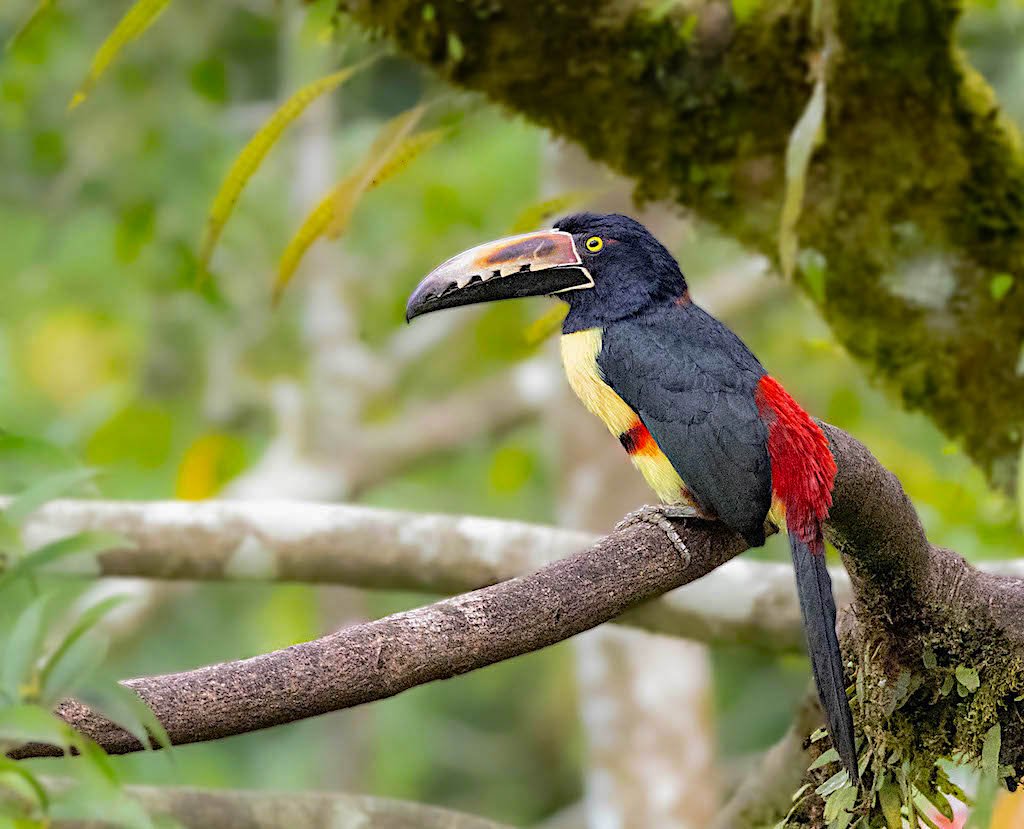
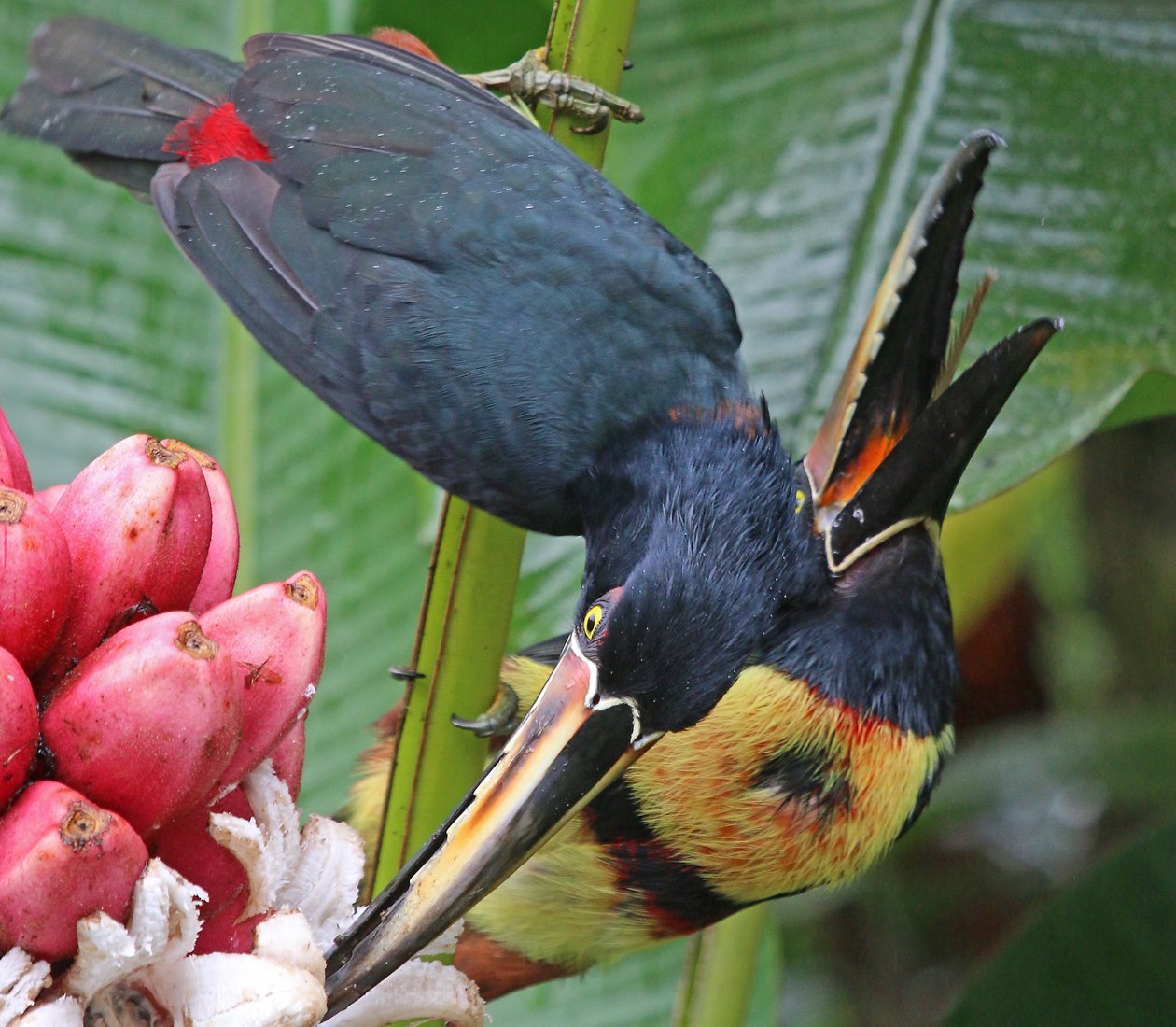
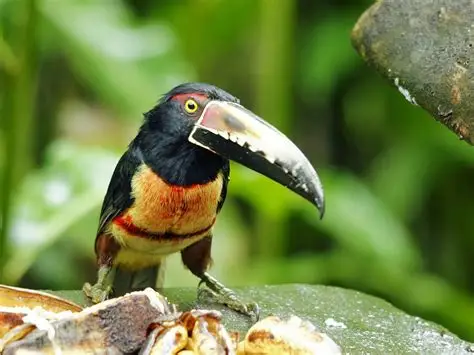
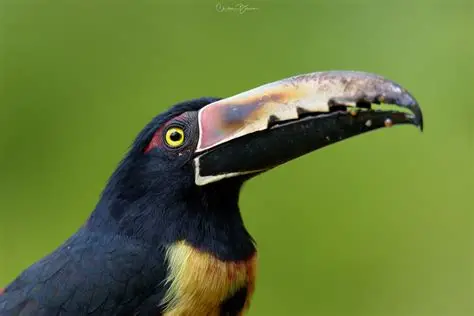
Slender, small‑bodied toucan (total length 38–43 cm) with glossy black head, throat and upper breast, separated from the yellow belly by a conspicuous red‑brown “collar” band across the mantle. Belly sports a dark central spot and red crissum; upperparts olive‑green. Long, narrow bill (8–10 cm) is black with an ivory culmen line and yellow‑white subterminal blotches forming a “zig‑zag” pattern. Bare facial skin is dull green. Sexes appear alike; juveniles have sooty underparts and a shorter, duller bill. Average mass 175–230 g.
Has Sexual Diamorphism?
No
Sexual dimorphism refers to the physical differences between males and females of the same species that go beyond reproductive organs. For example, size, colour or form.
LIFE‑HISTORY & VITAL STATISTICS OF THE Collared Aracari(S)
Average Height / Length / Diameter
Total length 38–43 cm; wingspan 55–60 cm
Average Adult Weight / Mass
175–230 g
Typical Lifespan / Longevity
12–15 yr wild; 20 + yr captivity
Typical Lifespan / Longevity for males
Data deficient
Typical Lifespan / Longevity for Females
Data deficient
Age at Sexual Maturity
≈ 2–3 yr
Breading Season
February – June (dry‑to‑wet transition)
Gestation
3–5 white eggs; one clutch yr⁻¹
Reproductive Outcome
Ecology and Behaviour for Collared Aracari(s)
Slender, small‑bodied toucan (total length 38–43 cm) with glossy black head, throat and upper breast, separated from the yellow belly by a conspicuous red‑brown “collar” band across the mantle. Belly sports a dark central spot and red crissum; upperparts olive‑green. Long, narrow bill (8–10 cm) is black with an ivory culmen line and yellow‑white subterminal blotches forming a “zig‑zag” pattern. Bare facial skin is dull green. Sexes appear alike; juveniles have sooty underparts and a shorter, duller bill. Average mass 175–230 g.
Habitat
Common in lowland and premontane evergreen forest, semi‑deciduous woodland, shaded cacao plantations and tall second‑growth to ~1 500 m on both Caribbean and Pacific slopes; uses edge and interior habitats.
Trophic Chain
Omnivorous but strongly frugivorous (~75 %) on Cecropia, Ficus, Virola; gleans insects, small lizards and bird eggs; effective seed disperser for small‑/medium‑seed trees.
Interespecies relationships noted for Collared Aracari
Mutualism + / +
Disperses Cecropia peltata seeds > 200 m; gains sugary drupes.
Symbiosis + / +
Gut microbes ferment complex fruit sugars, enhancing nutrient uptake.
Commensalism + / 0
Double‑toothed kites capture insects flushed by aracari flock.
Stingless bees colonise old cavities post‑breeding.
Parasitism + / –
Feather mites (Ramphasticola spp.) and botflies (Philornis) infest plumage/nestlings.
Predation + / –
Preyed upon by ornate hawk‑eagle; aracari preys on other birds’ eggs/chicks.
Amensalism 0 / –
Heavy fruit removal limits resources for small tanagers.
Competition – / –
Competes with keel‑billed toucan for figs and nesting sites during fruit shortages.
Social behaviour of Collared Aracari
Activity pattern: diurnal; foraging peaks at 07:00–11:00 & 15:00–17:00.
Group size: cohesive family bands of 6–12; non‑breeders often remain as helpers.
Breeding system: cooperative; breeding pair plus 1–4 helpers share incubation and chick feeding.
Territoriality: group defends ~3–5 ha core around nest with harsh “kyeek” calls and physical chases.
Communication: rapid series of high‑pitched “pik‑pik‑pik,” bill clattering, tail flicks.
Special behaviours: communal roosting; food‑sharing among group; use of “throwing” motion to pass fruit bill‑to‑bill.
Distribution and Sighthings ofCollared Aracari(s) in Costa Rica
General Regions of Costa Rica where to find Collared Aracaris
Tropical
Caribbean Sea
Tropical Rain Forest
National Parks and Reserves of Costa Rica where to find Collared Aracaris
Parque Nacional Volcán Arenal
Parque Nacional Braulio Carrillo
Parque Nacional Carara
Parque Nacional Corcovado
Parque Nacional Tenorio
Parque Nacional Tortuguero
Best Time to seeCollared Aracari(s) in Costa Rica
Dry Season
January
February
March
April
June
July
August
September
October
November
December
Media
Videos
Sounds and calls
log in to help us with this an other posts.
This sheet is marked as: Revision required
Taxonomy
Taxonomic classification is a hierarchical system used in biology to organize and name living organisms. It arranges species into nested groups based on shared characteristics and evolutionary relationships.
Kingdom Animalia
Phylum Chordata
Class Aves
Order Piciformes
Genus Pteroglossus
Conservation Status
Status IUCN
🌍 The IUCN status refers to the conservation category assigned to a species by the International Union for Conservation of Nature, based on its risk of extinction
Least Concern
Threats
⚠️Removal of old trees reduces nest cavity availability.
⚠️Pesticide use in cacao and banana zones contaminates fruit resources.
⚠️Local capture for pet trade, though less prized than larger toucans.
⚠️Predation by invasive rats at nest cavities near plantations.
Fun Facts
Forms dormitory groups of 5–15 birds roosting side‑by‑side in single tree cavity.
Performs “bill fencing” play displays among group members at sunrise.
Flight muscles have high oxidative capacity, enabling rapid zig‑zag sallying for insects.
Known to remove ectoparasites from capuchin monkeys during mixed‑species foraging.