
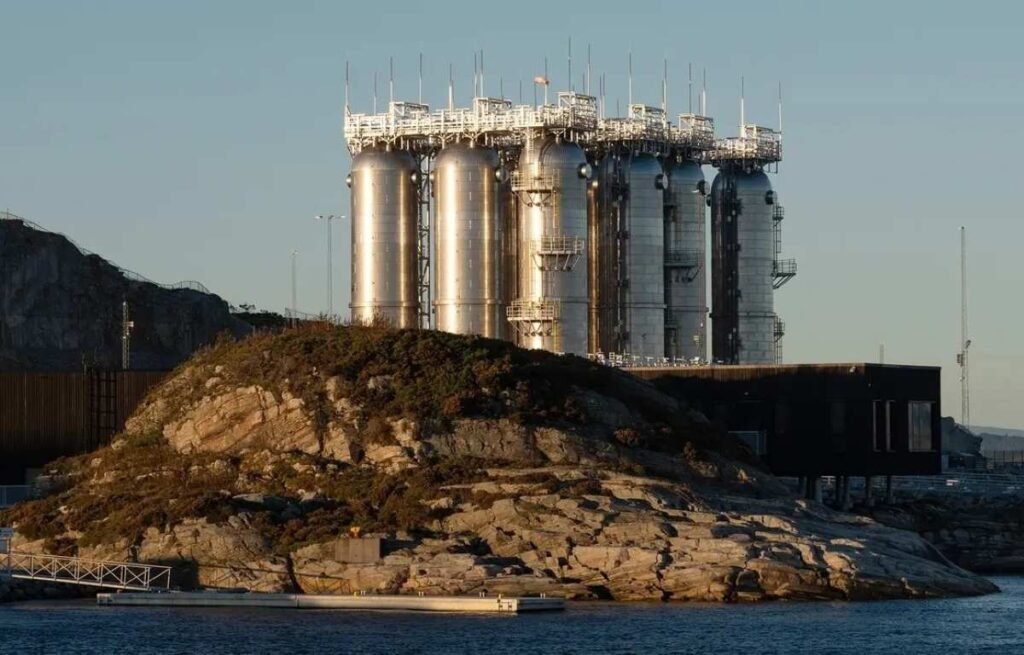
In a pioneering move to combat climate change, Norway has officially inaugurated the world’s first commercial site designed to permanently store carbon dioxide (CO₂) beneath the seabed. The project, named “Northern Lights,” marks a crucial step in developing Carbon Capture and Storage (CCS) technologies on an industrial scale.
This milestone not only represents a significant technological advancement but also establishes a viable business model for managing emissions from industries that are difficult to decarbonize, opening a new era in global climate strategy.



How Does Geological Carbon Storage Work?
Carbon Capture and Storage technology is a multi-step process. First, CO₂ is captured directly from industrial sources, such as cement plants or waste-to-energy facilities, before it can be released into the atmosphere.
Once captured, the gas is compressed until it becomes a liquid. It is then transported—in this case, by custom-designed ships—to a coastal terminal. From there, it is injected via a pipeline into a porous geological formation, approximately 2,600 meters below the North Sea floor. A layer of dense, impermeable rock acts as a seal, ensuring the CO₂ remains permanently trapped.
The “Northern Lights” project has an initial capacity to store 1.5 million metric tons of CO₂ per year, which is equivalent to the emissions from over 300,000 cars.


A Solution for “Hard-to-Abate” Industries
While the transition to renewable energy sources like solar and wind is essential for reducing future emissions, it does not solve the problem of CO₂ generated by heavy industries crucial to the modern economy. The production of cement, steel, and chemicals, for example, inevitably releases large amounts of carbon as part of their chemical processes.
This is where CCS becomes a strategic tool. It offers a solution to decarbonize these “hard-to-abate” sectors, allowing them to operate while mitigating their climate impact. The “Northern Lights” project is the first to offer this service across borders, inviting companies from all over Europe to send their captured CO₂ for permanent storage.
Global Implications and the Future of CCS
The success of “Northern Lights” could accelerate the adoption of CCS technology worldwide. By demonstrating that it is logistically possible and commercially viable, Norway is creating a model that other countries with suitable geological formations could replicate.
Although the technology faces debates over its cost and scalability, it is considered by the Intergovernmental Panel on Climate Change (IPCC) to be one of the necessary tools in the portfolio of solutions for achieving the goals of the Paris Agreement.
In summary, the inauguration of this undersea storage facility is not a silver bullet for climate change, but it is a pragmatic and powerful step forward. It represents a vital new piece of infrastructure in the global effort to build a low-carbon economy, addressing the emissions of today while continuing the work on the clean energies of tomorrow.