
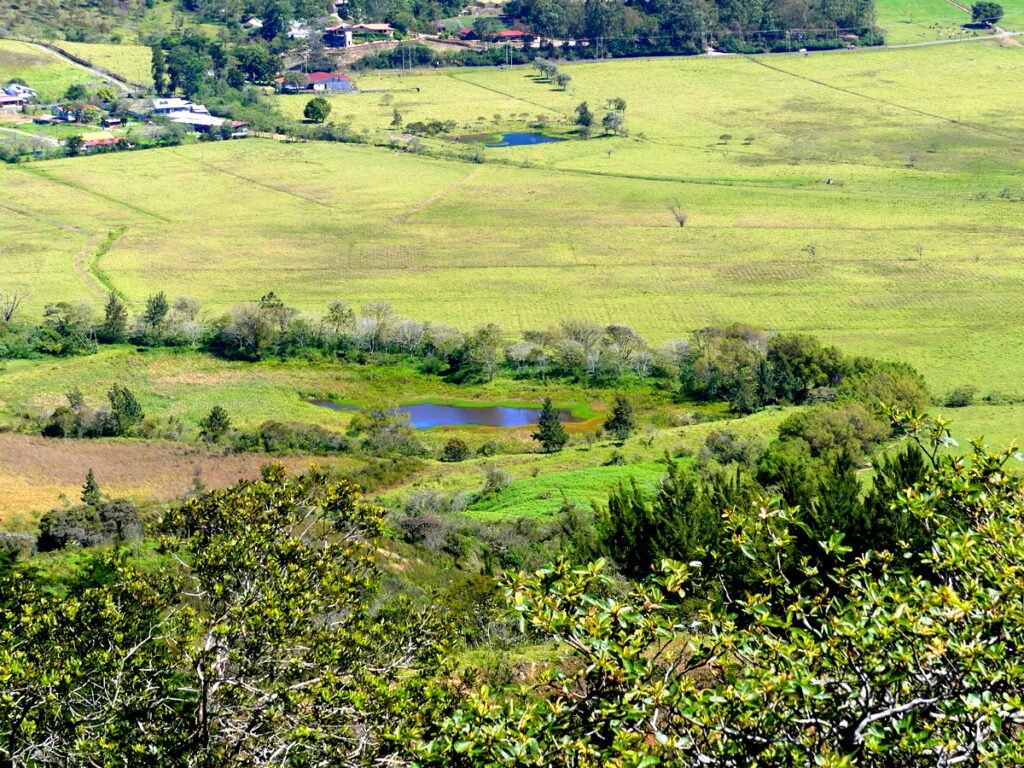
In a significant move for applied conservation, Costa Rica’s National System of Conservation Areas (SINAC) has issued a technical resolution (ACC-SINAC-P-RES-050-2025) officially delimiting 130 hectares of vital wetland in the Coris Valley, Cartago. This declaration provides long-overdue legal recognition to an ecosystem whose immense value lies in its dual function: ensuring water security for the Greater Metropolitan Area (GAM) and providing a critical refuge for biodiversity.
For years, this wetland complex existed in a state of “cartographic invisibility,” leaving it highly vulnerable to anthropogenic pressures. This new technical delimitation is not the creation of a new protected area, but rather a scientific confirmation of its existence, based on rigorous analysis of its hydric soils, hydrophytic vegetation, and hydrological regime.



The Hydrological Engine of the Coris Aquifer
The primary ecosystem service provided by the Coris wetland is hydrological. The site functions as a critical recharge and filtration zone for the Coris Aquifer, one of the most important subterranean water reserves supplying potable water to the GAM.
This alluvial valley wetland system acts as a natural buffer, performing two key functions:
- Groundwater Recharge: The wetland’s soils and vegetation capture precipitation, slowing its release. This allows for the gradual percolation and filtration of water, purifying it of sediments and potential contaminants before it recharges the aquifer.
- Hydrometeorological Attenuation: The 130-hectare expanse serves as a natural retention basin, absorbing peak water volumes during high-precipitation events. This mitigates flood risks in the lower Reventazón River basin, a service of increasing importance under changing climate scenarios.


A Fragmented Refuge for Avifauna and Aquatic Species
From a biological perspective, the declaration is a critical win for local and migratory wildlife. The Coris wetland represents a significant palustrine and lacustrine habitat fragment within a matrix of increasing urban and industrial development.
Its ecological importance for species includes:
- Avian Refuge: The wetland is a crucial “stopover” site for Neotropical migratory birds using the Central American flyway. It provides essential feeding and resting grounds. Furthermore, it supports a diverse community of resident waterbirds (Ardeidae family, e.g., herons and egrets) and other associated avifauna.
- Aquatic and Amphibian Habitat: The system’s ponds, marshes, and saturated soils provide ideal breeding and foraging grounds for a variety of amphibian, reptile, and macroinvertebrate species, which form the base of the local food web.
Conservation Implications of the Declaration
Prior to this resolution, the area faced imminent threats from land-use change, primarily driven by industrial park and housing development. Such activities, which often involve draining, filling, and soil compaction, would have irreversibly destroyed the wetland’s hydrological function and its value as a habitat.
The technical declaration immediately activates protections under Costa Rica’s Organic Law of the Environment (No. 7554) and Water Law (No. 276). These laws explicitly prohibit the draining, filling, or diversion of water in designated wetlands.
While this technical recognition is the foundational first step, the scientific and conservation community views it as the precursor to a more robust, long-term conservation strategy. The next essential step will be the development of a comprehensive management plan for the 130-hectare area. This plan must aim to restore ecological integrity where possible and ensure that the vital connection between this surface wetland and the subterranean Coris Aquifer—the “blue gold” of Cartago—is protected in perpetuity.