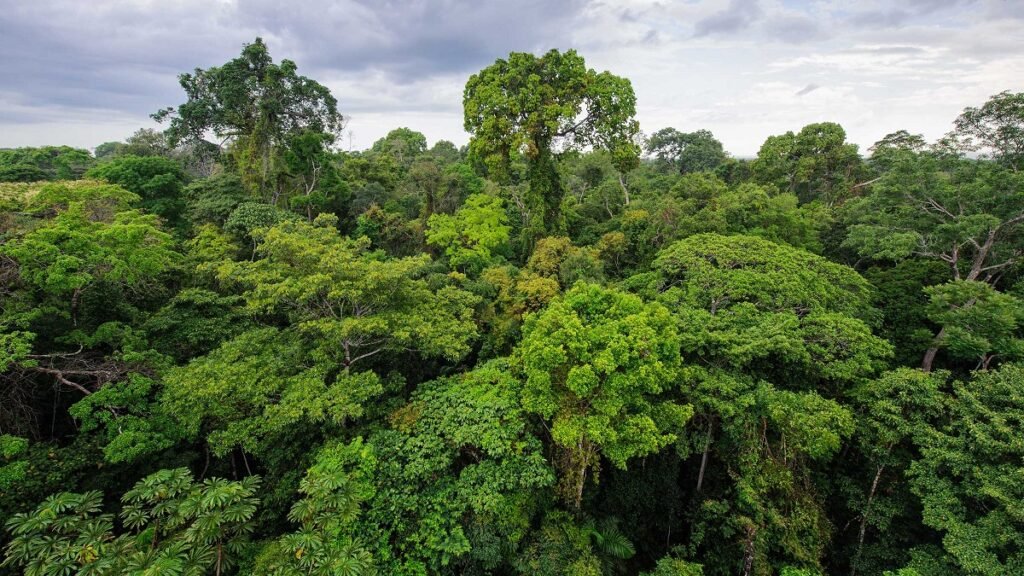
Recent scientific research has revealed a surprising trend in the Amazon rainforest: trees are getting bigger. According to a study published in Nature Plants in 2025, the average size of trees across large portions of the Amazon has increased by approximately 3.2 to 3.3 percent per decade over the past several decades. This growth suggests a structural transformation of the world’s largest tropical forest, with important implications for ecology, climate, and conservation.
Evidence from Long-Term Research
The study analyzed data from 188 permanent forest plots monitored over decades throughout the Amazon Basin. Researchers found that not only are average trees increasing in size, but the largest trees in particular are experiencing even faster growth—up to 5.8 percent per decade. Median-size trees also showed an increase, although at lower rates (~1.9 percent per decade).
These findings confirm that the forest is shifting its structure toward larger individuals, making the Amazon increasingly dominated by big trees that play a disproportionately important role in carbon storage and ecosystem stability.



What Drives the Growth?
Several factors may be behind this increase in tree size:
- CO₂ fertilization effect: Higher atmospheric carbon dioxide levels may enhance photosynthesis and carbon uptake, stimulating tree growth.
- Forest dynamics: Reduced mortality among certain large individuals may allow them to survive longer and continue accumulating biomass.
- Environmental conditions: Availability of nutrients, light, and water likely influences the rate of growth, creating variation across different regions of the forest.
Ecological and Climate Implications
The growth of Amazonian trees has both positive and cautionary aspects. On the positive side, larger trees store significantly more carbon, strengthening the Amazon’s role as a global carbon sink. Their resilience also suggests that intact tropical forests may have a greater capacity to withstand moderate climate stressors than previously thought.
However, this does not mean the Amazon is immune to threats. Climate change continues to bring more frequent and severe droughts, heatwaves, and extreme weather events. Nutrient limitations, particularly phosphorus availability in Amazonian soils, may constrain future growth. Human activities—such as deforestation, fragmentation, and fire—pose even greater risks, potentially negating the benefits observed in intact forest areas.


Important Caveats
It is crucial to interpret the results accurately. The study reports an increase of around 3.2 percent per decade, not “32 percent per decade” as some media mistakenly stated. The observed growth was documented primarily in intact forest plots, meaning the trend may not apply to degraded or heavily impacted areas of the Amazon. Moreover, while the CO₂ fertilization effect is a likely driver, researchers caution that its influence may be temporary and limited by other environmental stressors.
The Global Role of the Amazon
As the largest tropical forest on Earth, the Amazon plays an irreplaceable role in regulating climate and maintaining biodiversity. The discovery that its trees are getting bigger reinforces its significance as a global carbon reservoir, while also reminding us of its fragility. Protecting the Amazon is not just about preserving wildlife—it is about safeguarding one of the planet’s most essential systems for life.
Conclusion
The finding that Amazonian trees are increasing in size provides a rare glimpse of resilience in the face of climate change. Yet it also underscores the urgency of conservation. The Amazon’s future will depend on our ability to protect intact forests, limit deforestation, and reduce global carbon emissions. Larger trees may buy us time, but they cannot by themselves secure the stability of the forest. Science makes it clear: conserving the Amazon is critical not only for South America, but for the world.