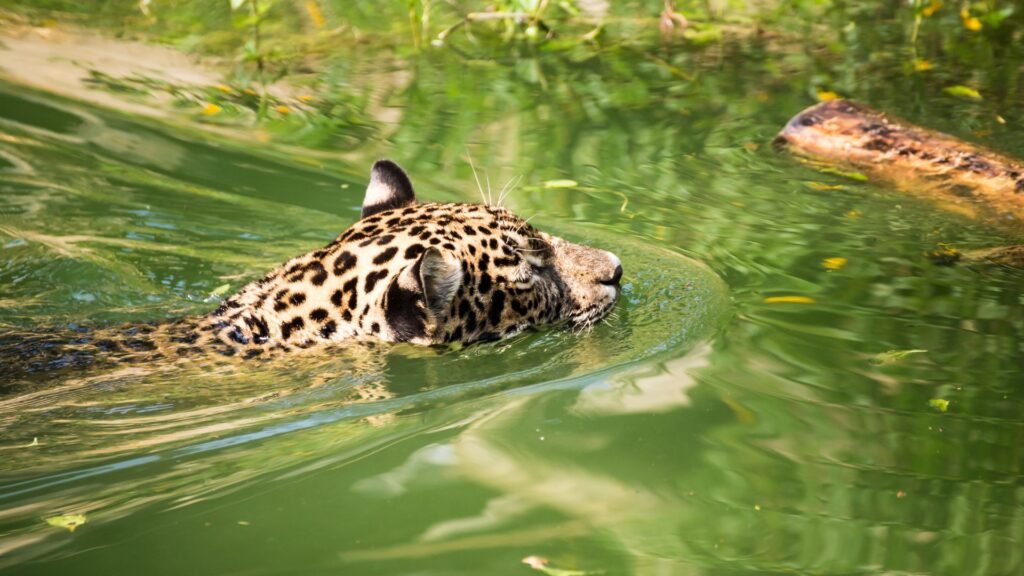



A male jaguar (Panthera onca) in Brazil has been documented making the longest recorded swim ever observed for the species, covering an estimated 2.30 kilometers (2,300 meters) across a reservoir. This feat shatters the previous record of ~200 meters and expands our understanding of how jaguars interact with aquatic landscapes. news.mongabay.com+2Live Science+2
Observation and Identification
The jaguar was first captured by camera traps in May 2020 on the mainland near the Serra da Mesa hydroelectric reservoir in Goiás state. Four years later, in August 2024, the same individual was photographed on a forested island within that reservoir. Researchers matched the coat pattern to confirm it was the same animal.
Possible Swimming Routes and Distances
Based on mapping of the reservoir, scientists propose two primary scenarios:
- A two-leg swim: first ~1.07 km (1,070 m) to a small islet, followed by ~1.23 km (1,230 m) to the main island;
- Or, a direct swim covering the full ~2.30 km (2,300 m) in a single stretch.
In either scenario, this swim is more than six times longer than the previously documented maximum of ~200 m (~0.2 km).
What Makes This Significant
- It challenges the assumption that large water bodies are complete barriers to jaguar movement.
- It suggests jaguars may sometimes exploit aquatic routes to reach otherwise isolated habitat patches.
- For conservation planning, understanding how animals traverse or circumvent reservoirs is vital, especially when designing or managing infrastructure like dams.
Caveats and Considerations
- This study is currently shared as a preprint (i.e., not yet peer-reviewed), so conclusions should be considered provisional.
- The actual route may include resting points (islets) which reduce the distance swum in one go.
- Environmental conditions (water temperature, current, obstacles) likely influence what is feasible for individual jaguars.
- Not every jaguar might be capable of replicating such a crossing—this may be an exceptional case.
Broader Implications for Conservation
This discovery underscores the adaptability of jaguars and indicates that hydroelectric reservoirs, often viewed as barriers, may not always completely prevent movement of strong-swimming individuals. For designing wildlife corridors, island stepping-stones or buffer zones may assist jaguar dispersal in human-modified landscapes.
It also calls for more research into how often such long-distance swims happen, under what conditions, and how infrastructure could be modified to reduce habitat isolation for large carnivores.