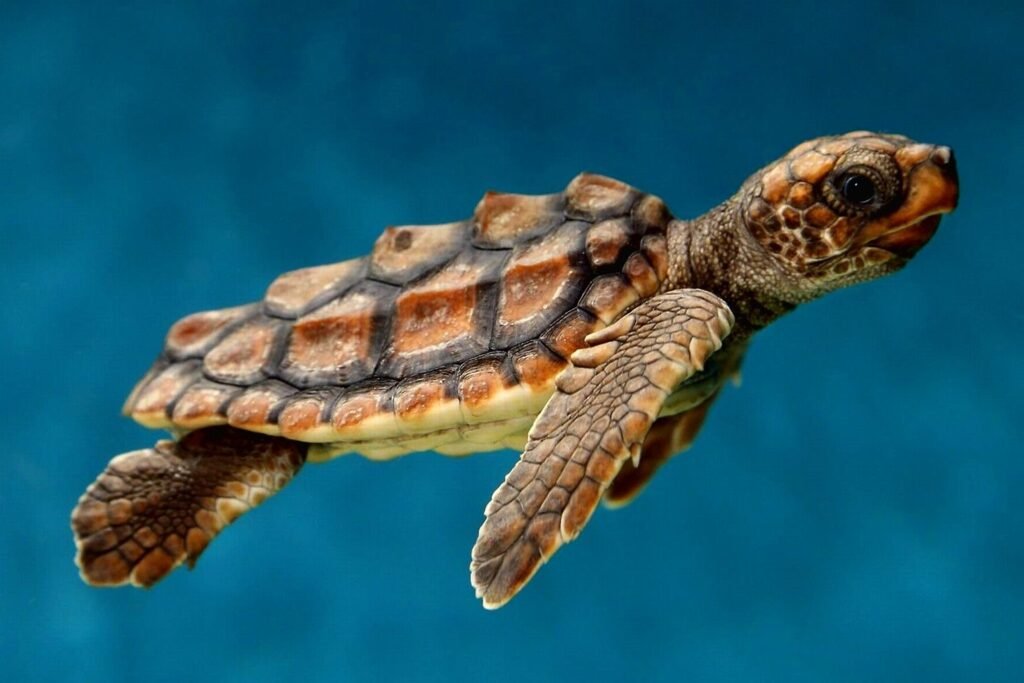
On the barrier islands of Georgia, newly hatched loggerhead sea turtles (Caretta caretta) are struggling to reach the ocean. Instead of following the natural glow of moonlight reflected on the water, many are disoriented by the powerful lights from nearby highways and commercial centers. This growing threat adds another layer of stress to a species already listed as threatened under the U.S. Endangered Species Act.



The Lighting Problem
In July 2025, the largest Buc-ee’s travel center opened near Exit 42 on Interstate 95 in Glynn County. Its massive overhead lights, combined with existing highway lighting, have created an unnatural beacon visible from kilometers away. Hatchlings, which instinctively crawl toward the brightest horizon, are now drawn inland toward the artificial glare instead of the ocean. Conservationists warn that this simple disruption of navigation can have devastating consequences for survival.
Ecological Consequences
The impact is already evident. Instead of reaching the sea within minutes of emerging, many hatchlings wander inland where they face exhaustion, dehydration, predation, or death under vehicle traffic. Adult females are also affected, avoiding beaches with strong light pollution and further reducing the availability of safe nesting sites. According to local monitoring, in 2024 around 11% of observed nests showed significant disorientation, with at least ten hatchlings per nest moving the wrong way. Considering that each nest can hold around 120 eggs, the loss is considerable.

Geographic Spread and Scale
The lights near I-95 are visible up to 19 kilometers away, reaching sensitive nesting grounds on Sapelo and Little St. Simons Islands. What is happening in Georgia is part of a broader regional trend. In North Carolina, female turtles avoid nesting altogether in well-lit areas. In Florida, wildlife agencies recorded over 10,000 disoriented loggerhead hatchlings between 2020 and 2023. On a national level, studies show that artificial nighttime light in the United States grew at an average of 9.6% per year between 2011 and 2022, effectively doubling the brightness of the night sky every eight years.
Responses and Stakeholders
Local organizations such as One Hundred Miles and the conservation staff of Little St. Simons Island have raised alarms about the problem. Community members have requested that county officials dim or switch off the lights during the critical July hatchling season, but no official measures have yet been taken. Glynn County’s public works department and the Georgia Department of Transportation have indicated they are exploring wildlife-friendly alternatives. Conservationists have suggested immediate solutions such as installing shields to direct light downward and using amber lighting less attractive to turtles. As Catherine Ridley of One Hundred Miles put it: “If we’re going to put marine turtles on billboards and magazine covers, we need to play our part.”
The disorientation of Georgia’s hatchling sea turtles underscores the urgent need to balance development with conservation. Highway lighting and large commercial complexes may serve human convenience, but without adjustments they impose deadly consequences on vulnerable wildlife. Simple, science-based solutions exist, but they require swift coordination between local government, infrastructure agencies, and private businesses. Protecting these turtles is not only an ecological responsibility but also an ethical one, ensuring that one of the oldest surviving marine species continues its journey to the sea for generations to come.