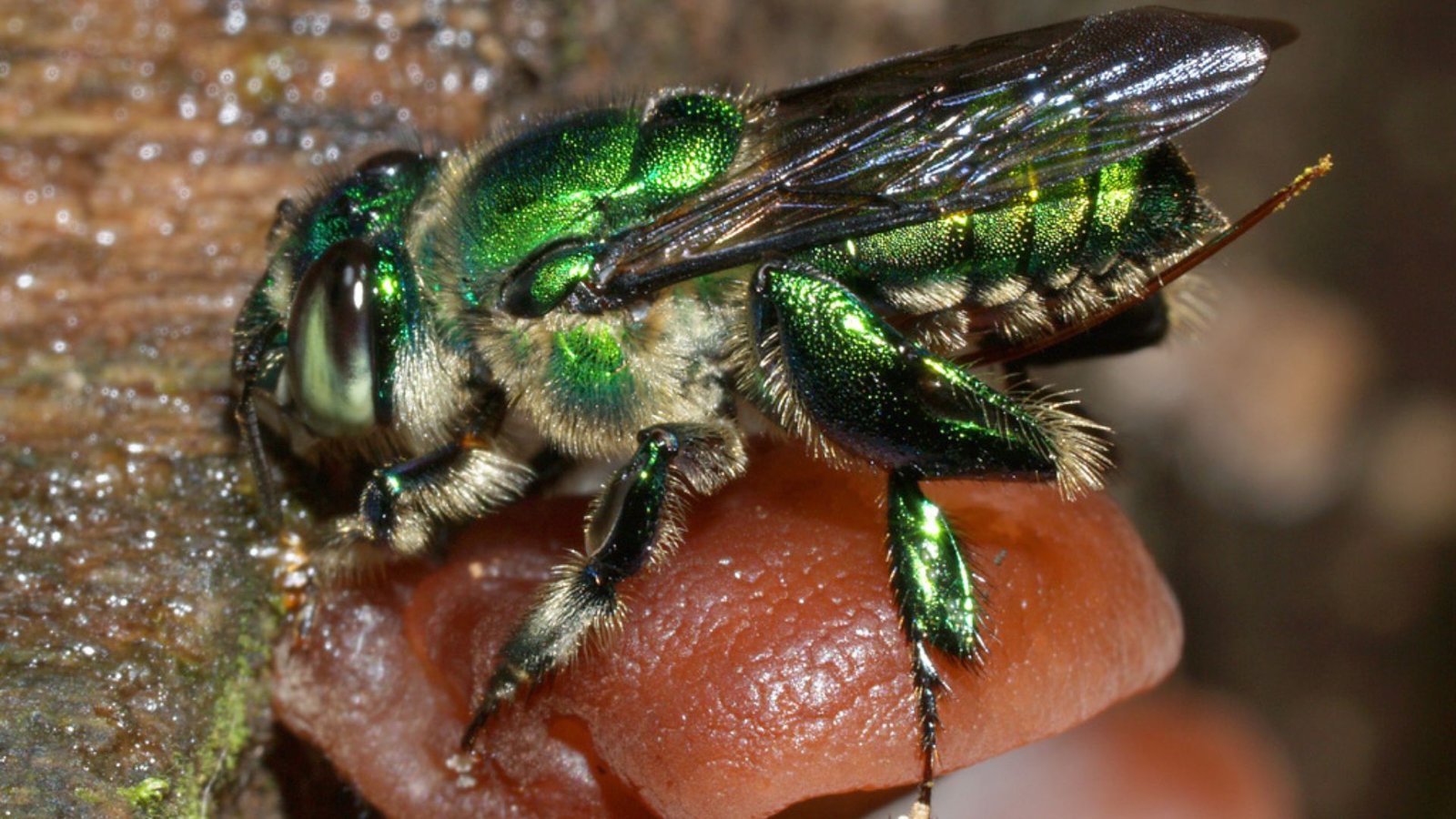
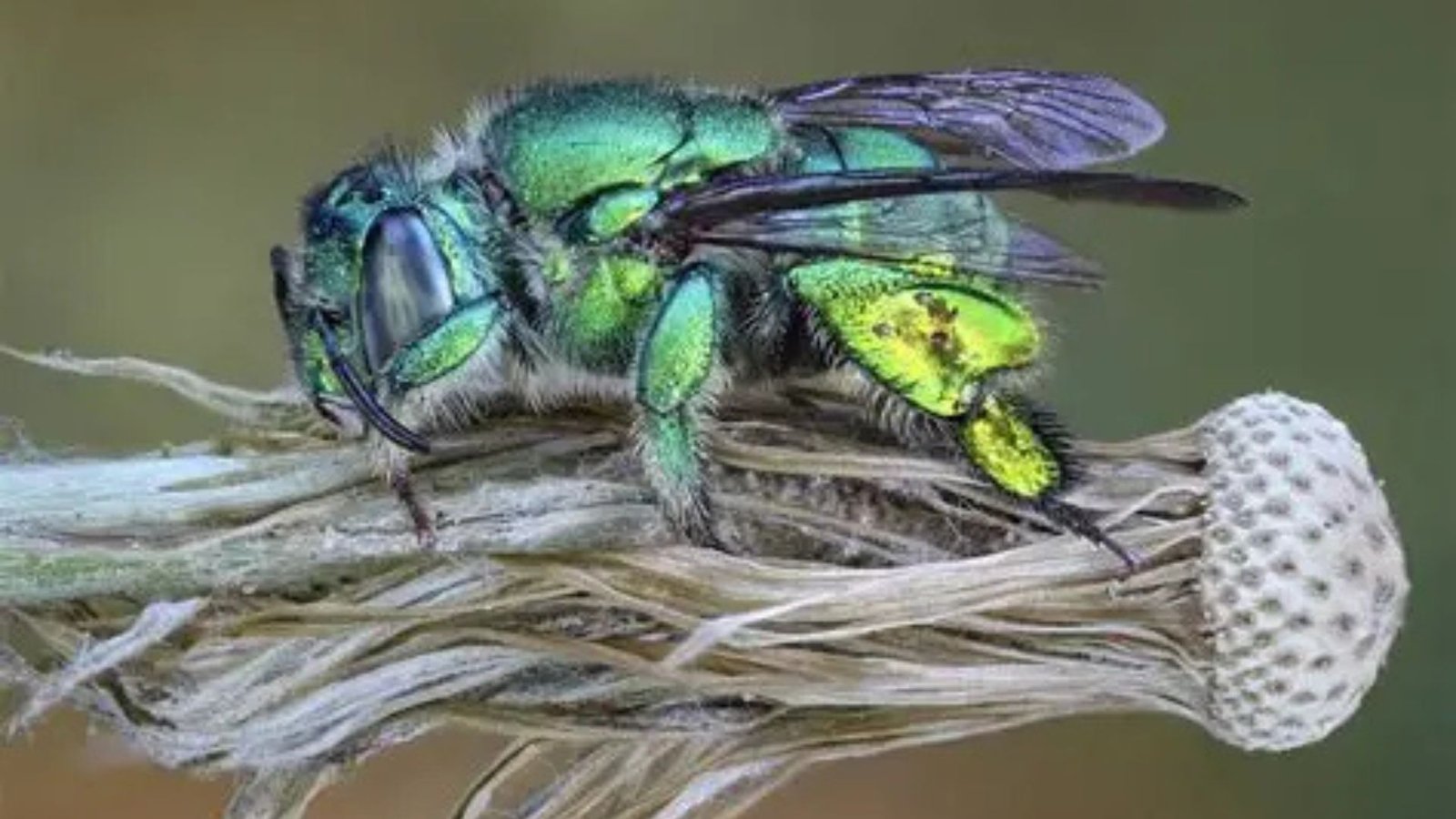
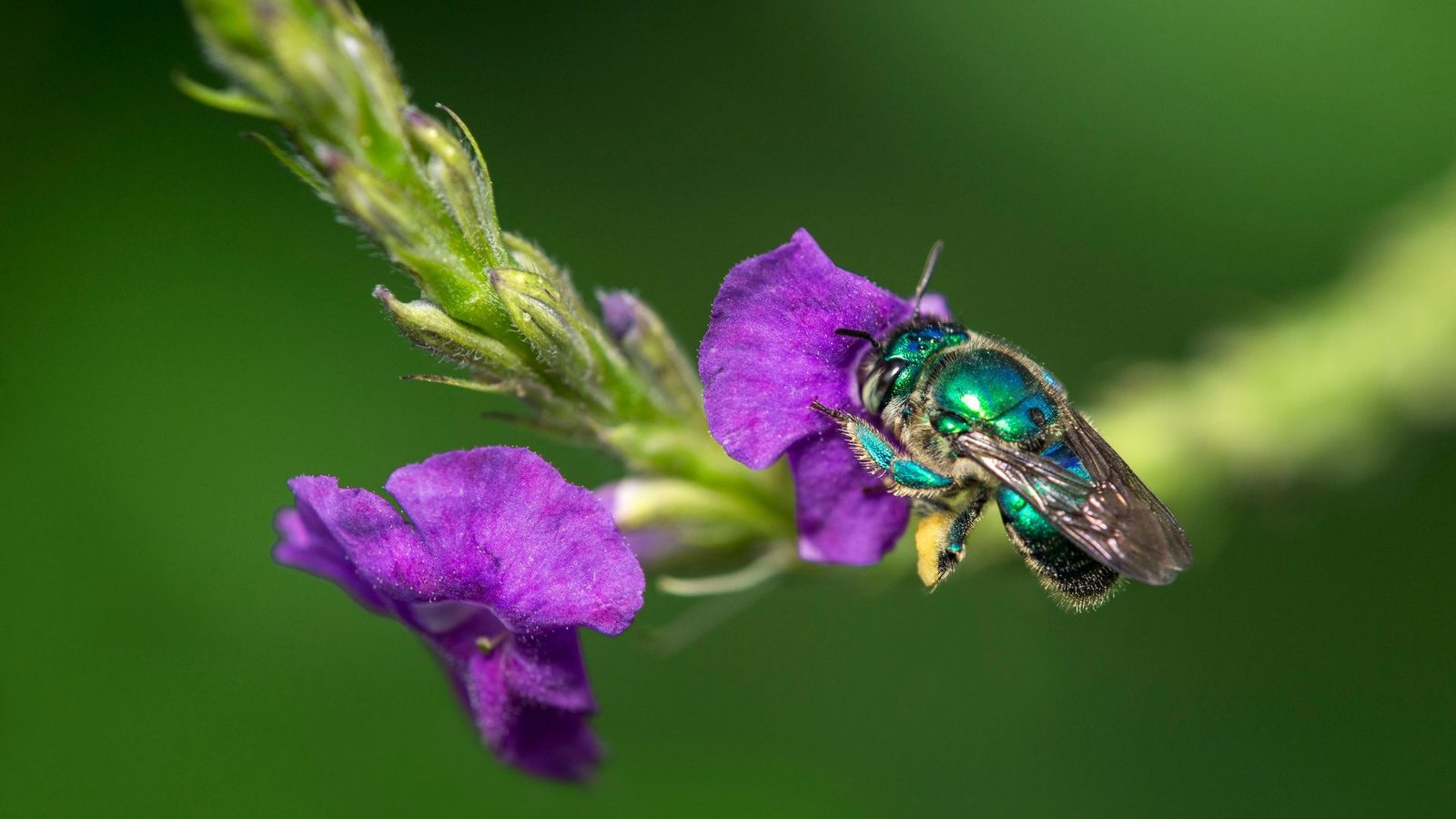




Medium-large metallic green euglossine bee; males bright emerald to bronze with expanded rhomboid hind tibiae that store perfumes, and brush-like fore-tarsal setae used to mop aromatic oils. Females duller, with denser pilosity and pollen-carrying scopae. Body length typically 13–18 mm; individuals around ~15 mm are common in Mesoamerica. Proboscis long for suction feeding; wings clear, rapid hovering flight. Males often perch and display near scented resources; both sexes visit deep-tubed flowers. Distinctive white labial marks in males; no worker caste (non-eusocial).
Sexual dimorphism refers to the physical differences between males and females of the same species that go beyond reproductive organs. For example, size, colour or form.
Yes. Males have enlarged perfume-storage tibiae and engage in display/territorial behavior; females lack perfume organs and provision nests.
~15 mm (range ≈ 13–18 mm)
Data deficient (Euglossa spp. span ~29–302 mg; species-specific means not published)
Adults commonly weeks to ~1–2 months (mark–recapture recoveries up to 6–8 weeks)
Not enough data
Not enough data
At eclosion (adult stage)
Year-round in humid lowlands; activity peaks in wet season (bait studies in Costa Rica show seasonal variation)
Solitary/communal nests; clutch size per cell data deficient for this species
Medium-large metallic green euglossine bee; males bright emerald to bronze with expanded rhomboid hind tibiae that store perfumes, and brush-like fore-tarsal setae used to mop aromatic oils. Females duller, with denser pilosity and pollen-carrying scopae. Body length typically 13–18 mm; individuals around ~15 mm are common in Mesoamerica. Proboscis long for suction feeding; wings clear, rapid hovering flight. Males often perch and display near scented resources; both sexes visit deep-tubed flowers. Distinctive white labial marks in males; no worker caste (non-eusocial).
Humid lowland to premontane forests (often along rivers, second-growth, plantations with floral resources); recorded widely across Costa Rica. Males readily sample at baits (cineole, eugenol, methyl salicylate).
Pollinator & nectar feeder. Males gather volatile perfumes; both sexes take nectar; females collect pollen. This bee pollinates many orchids (esp. Stanhopeinae such as Coryanthes/Stanhopea/Gongora).
Sociality: Solitary to communal nesting documented within the genus; E. imperialis lacks a worker caste (species-specific nesting data scarce).
Activity: Diurnal; males perch/defend display sites and patrol around perfume sources; both sexes hover-feed at deep flowers.
Communication: Males compile and release perfume blends during displays; blends are partly learned and species-typical.
Taxonomic classification is a hierarchical system used in biology to organize and name living organisms. It arranges species into nested groups based on shared characteristics and evolutionary relationships.
🌍 The IUCN status refers to the conservation category assigned to a species by the International Union for Conservation of Nature, based on its risk of extinction
Males build personal perfume blends and can learn/remember specific scents they’ve collected.
Some perfumes come from non-floral sources (rotting wood, fungi, sap, fruit); not just orchids.
Exhibits long-distance movements and genetic connectivity across human-modified landscapes in Costa Rica.
Uses suction feeding rather than lapping—an adaptation to deep flowers; hovering physiology is well studied.