Also known / common namespanish – Oreja de palo laberíntica, Políporo laberinto;
White Maze Polypore(s) General Description
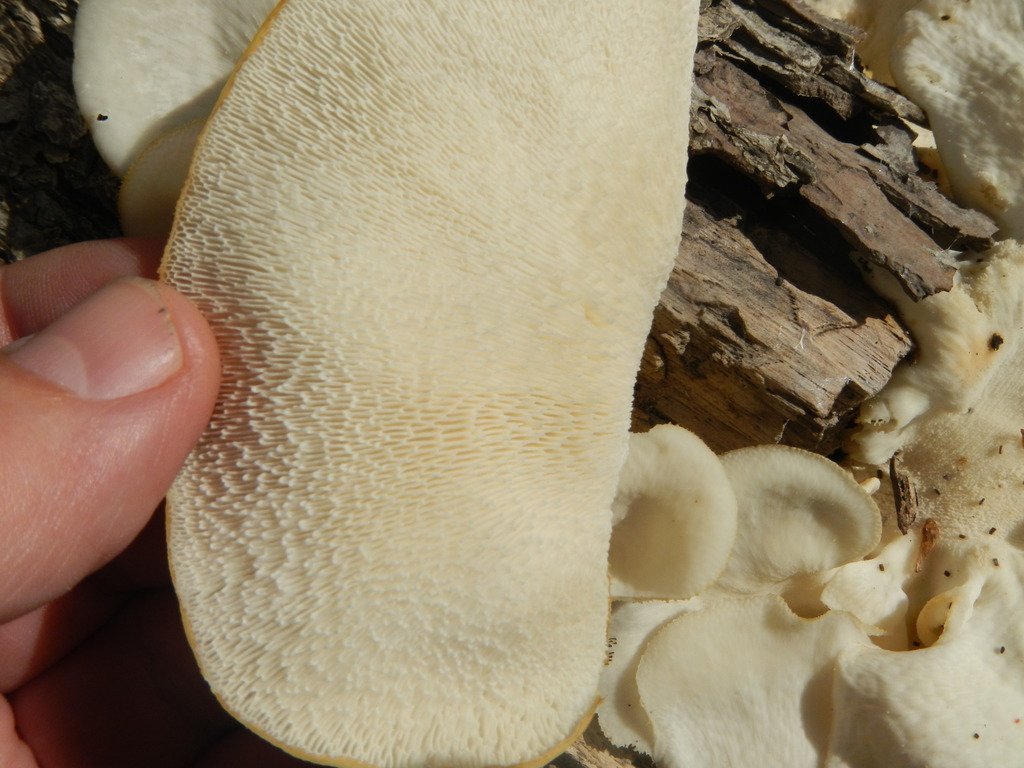
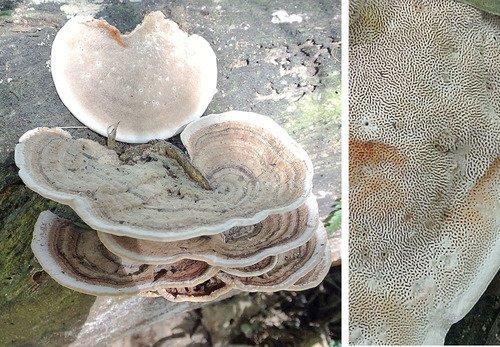
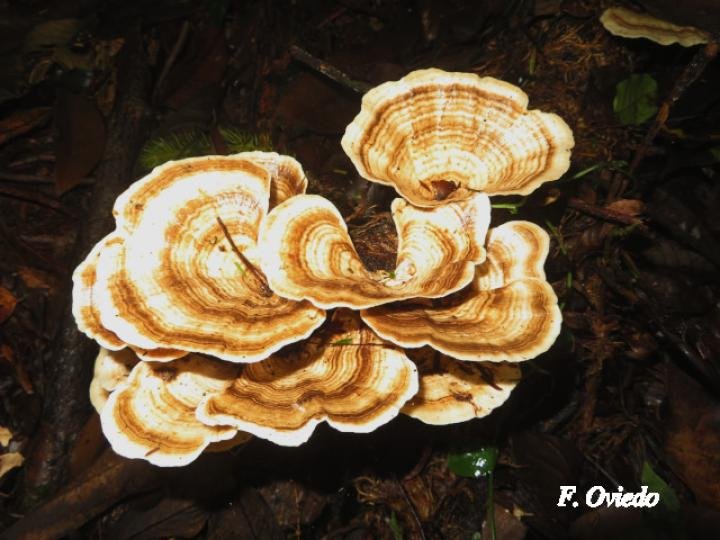
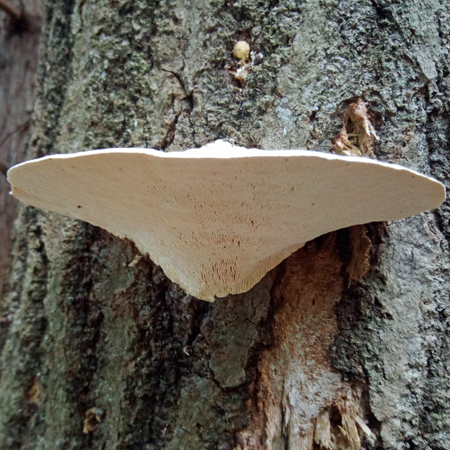
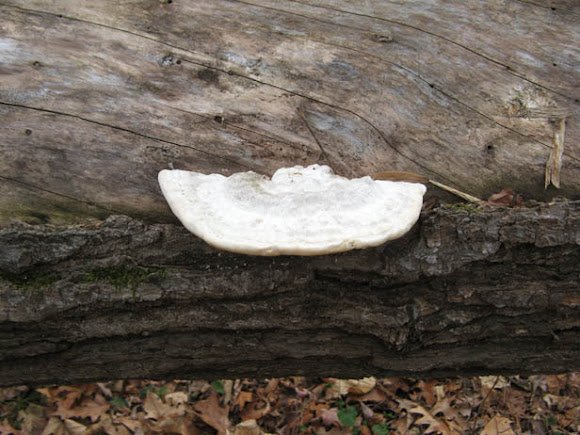
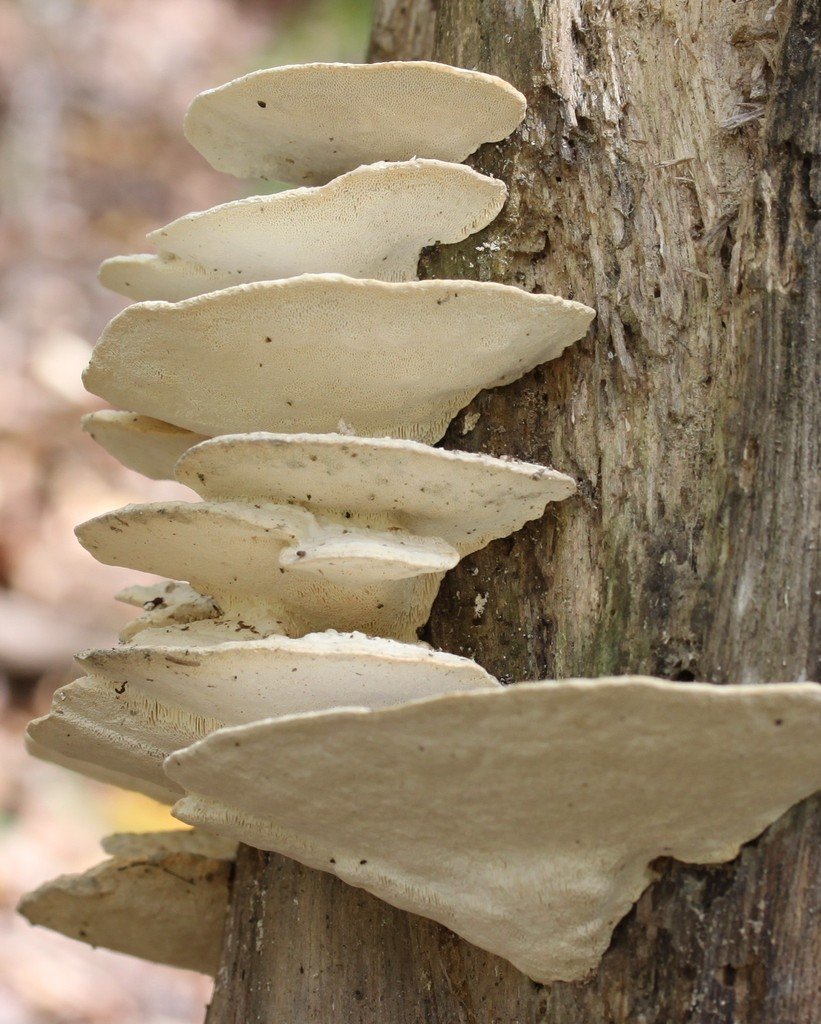
Basidiomes perennial, sessile to applanate brackets 5 – 20 cm wide, stacked in imbricate tiers on dead hardwood. Upper surface zonate cream-white to tan with concentric ridges and velvety tomentum, turning green with algal growth in age. Context corky, 3–8 mm thick, white; no distinct black line. Hymenophore white to pale buff with a maze-like (daedaloid) tube layer—pores elongated, sinuous, 1–3 mm wide, often radially aligned. Margin thin, wavy, sterile. Basidiospores cylindrical, hyaline, smooth, 5–6 × 1.5–2 µm. Emits faint mushroom–sweet odour when fresh; becomes tough and lightweight on drying.
Has Sexual Diamorphism?
No
Sexual dimorphism refers to the physical differences between males and females of the same species that go beyond reproductive organs. For example, size, colour or form.
LIFE‑HISTORY & VITAL STATISTICS OF THE White Maze Polypore(S)
Can produce new growth year-round in humid tropics; peak fruiting late wet season (Sep – Nov)
Gestation
Reproductive Outcome
Ecology and Behaviour for White Maze Polypore(s)
Basidiomes perennial, sessile to applanate brackets 5 – 20 cm wide, stacked in imbricate tiers on dead hardwood. Upper surface zonate cream-white to tan with concentric ridges and velvety tomentum, turning green with algal growth in age. Context corky, 3–8 mm thick, white; no distinct black line. Hymenophore white to pale buff with a maze-like (daedaloid) tube layer—pores elongated, sinuous, 1–3 mm wide, often radially aligned. Margin thin, wavy, sterile. Basidiospores cylindrical, hyaline, smooth, 5–6 × 1.5–2 µm. Emits faint mushroom–sweet odour when fresh; becomes tough and lightweight on drying.
Habitat
Saprotrophic on well-decayed logs, stumps and fallen branches of broad-leaf trees (e.g., Dipteryx, Virola, Inga) in lowland to premontane rain forest (0–1 200 m) on both Pacific and Caribbean slopes; favours humid riparian corridors and old secondary forest.
Trophic Chain
Primary white-rot decomposer, breaking down lignin and cellulose, releasing organic nutrients and creating cavities used by insects.
Interespecies relationships noted for White Maze Polypore
Endohyphal bacteria produce laccase-inducing signals, boosting wood decay efficiency.
Commensalism + / 0
Tree-frogs use bracket undersides as day shelters; fungus unaffected.
Inquilinism + / 0
Pygmy snails (Subulina) live in maze pores, benefitting from constant humidity.
Phoresy+/0
No documented case.
Tanatocresis + / 0
Old, fallen brackets serve as substrate for Xylaria spp. stromata.
Parasitism + / –
Attacked by white-rot competitor Favolus tenuiculus, which overgrows margins, reducing spore output.
Predation + / –
Consumed by larval cerambycid beetles; fruit-body tissue lost.
Amensalism 0 / –
Secretes phenolic acids inhibiting nearby Schizophyllum commune mycelia.
Competition – / –
Competes with Polyporus arcularius for the same decayed log substrates.
Social behaviour of White Maze Polypore
Fruiting Behaviour
Brackets enlarge slowly, adding new pore layer rings each wet season.
Produce aromatic aldehydes that deter wood-boring beetle larvae until sporulation complete.
Distribution and Sighthings ofWhite Maze Polypore(s) in Costa Rica
General Regions of Costa Rica where to find White Maze Polypores
Tropical
Tropical rainforest (Caribbean and North Pacific slopes)
National Parks and Reserves of Costa Rica where to find White Maze Polypores
Parque Nacional Braulio Carrillo
Parque Nacional Corcovado
Parque Nacional Santa Rosa
Parque Nacional Tapantí – Macizo Cerro de la Muerte
Parque Nacional Tortuguero
Reserva Forestal Golfo Dulce
Reserva Forestal Río Macho
Reserva Biológica Hitoy-Cerere
Reserva Biológica Lomas de Barbudal
Refugio Nacional de Vida Silvestre Curú
Refugio Nacional de Vida Silvestre Gandoca-Manzanillo
Best Time to seeWhite Maze Polypore(s) in Costa Rica
Dry Season
January
February
March
April
June
July
August
September
October
November
December
Media
Videos
Sounds and calls
log in to help us with this an other posts.
This sheet is marked as: Revision required
Taxonomy
Taxonomic classification is a hierarchical system used in biology to organize and name living organisms. It arranges species into nested groups based on shared characteristics and evolutionary relationships.
Kingdom Fungi
Phylum Basidiomycota
Class Agaricomycetes
Order Polyporales
Genus Trametes
Conservation Status
Status IUCN
🌍 The IUCN status refers to the conservation category assigned to a species by the International Union for Conservation of Nature, based on its risk of extinction
Not Evaluated (NE)
Threats
⚠️Logging / deforestation reduces supply of sizeable fallen hardwoods.
⚠️Removal of deadwood for firewood in community forests disrupts substrate continuity.
⚠️Prolonged droughts linked to climate change slow ligninolytic activity and fruiting.
⚠️Prolonged droughts linked to climate change slow ligninolytic activity and fruiting.