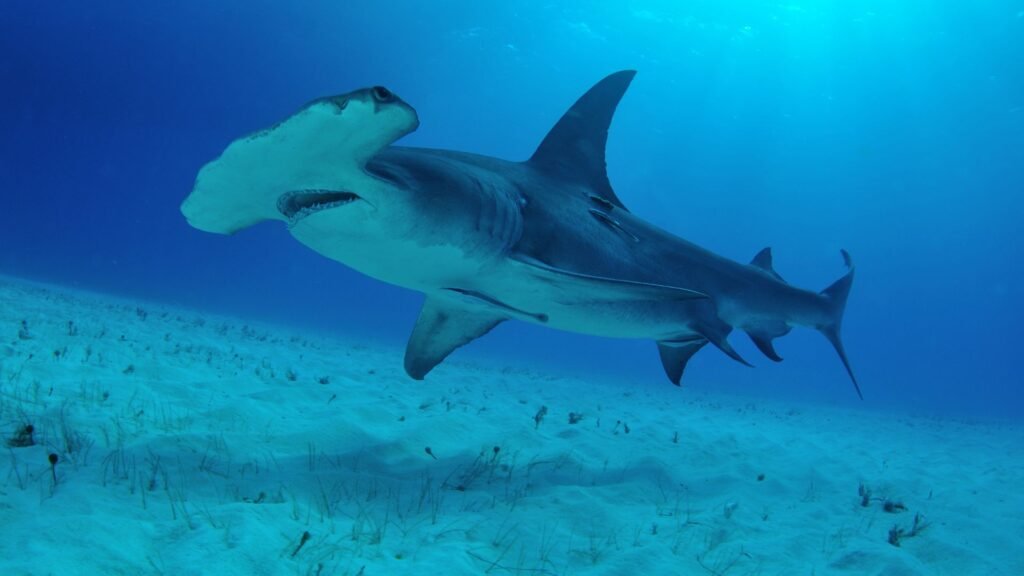
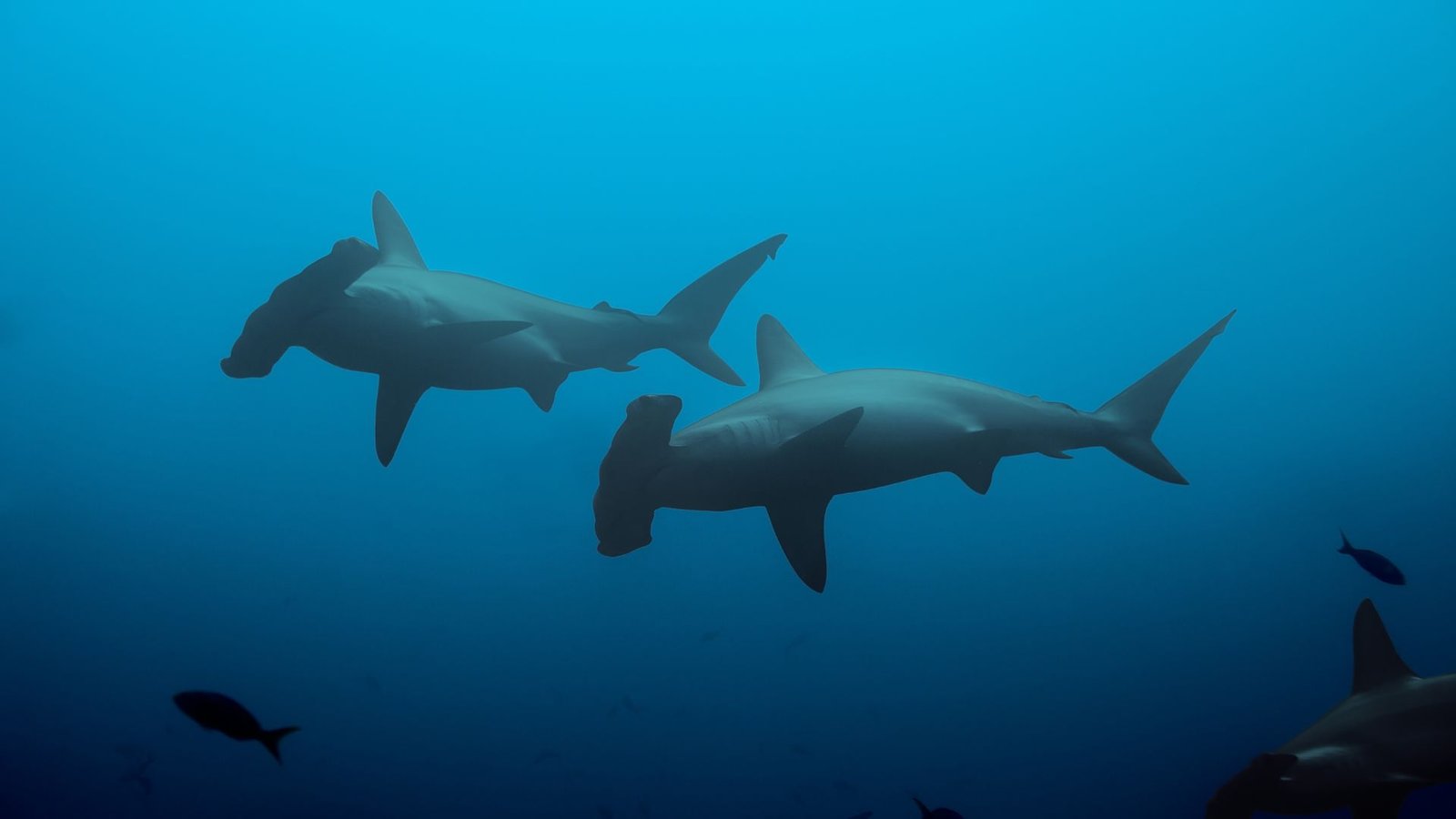
Large, laterally flattened hammerhead shark distinguished by a gently scalloped anterior margin of the cephalofoil bearing three central indentations. Body slender, grey‑bronze dorsally, fading to pale ventrally; pectoral fins long and sickle‑shaped. First dorsal fin tall and falcate, second markedly smaller. Adult total length 2.5–3.4 m (max > 4 m); newborns 45–55 cm. Eyes and nares positioned at foil tips, enhancing binocular vision and olfaction. Gill slits five pairs, lateral; dermal denticles smooth. Sexual dimorphism moderate—mature females slightly larger and broader across the cephalofoil than males.
Sexual dimorphism refers to the physical differences between males and females of the same species that go beyond reproductive organs. For example, size, colour or form.
Yes — females larger; gravid females possess distended abdomen; males have enlarged claspers
Large, laterally flattened hammerhead shark distinguished by a gently scalloped anterior margin of the cephalofoil bearing three central indentations. Body slender, grey‑bronze dorsally, fading to pale ventrally; pectoral fins long and sickle‑shaped. First dorsal fin tall and falcate, second markedly smaller. Adult total length 2.5–3.4 m (max > 4 m); newborns 45–55 cm. Eyes and nares positioned at foil tips, enhancing binocular vision and olfaction. Gill slits five pairs, lateral; dermal denticles smooth. Sexual dimorphism moderate—mature females slightly larger and broader across the cephalofoil than males.
Coastal to epipelagic (0–275 m) over continental shelves, seamounts and oceanic islands; in Costa Rica common at Isla del Coco, Golfo Dulce canyon and Isla Murciélago up‑welling fronts. Juveniles inhabit turbid estuaries and mangrove‑backed bays ≤ 30 m deep.
Apex‑mesopredator feeding on pelagic and demersal bony fishes, cephalopods and smaller sharks; prey includes jacks, rays and squid.
Social Structure & Behaviour
Activity pattern: crepuscular–nocturnal foraging; daytime schooling at seamount cleaning stations 15–40 m depth.
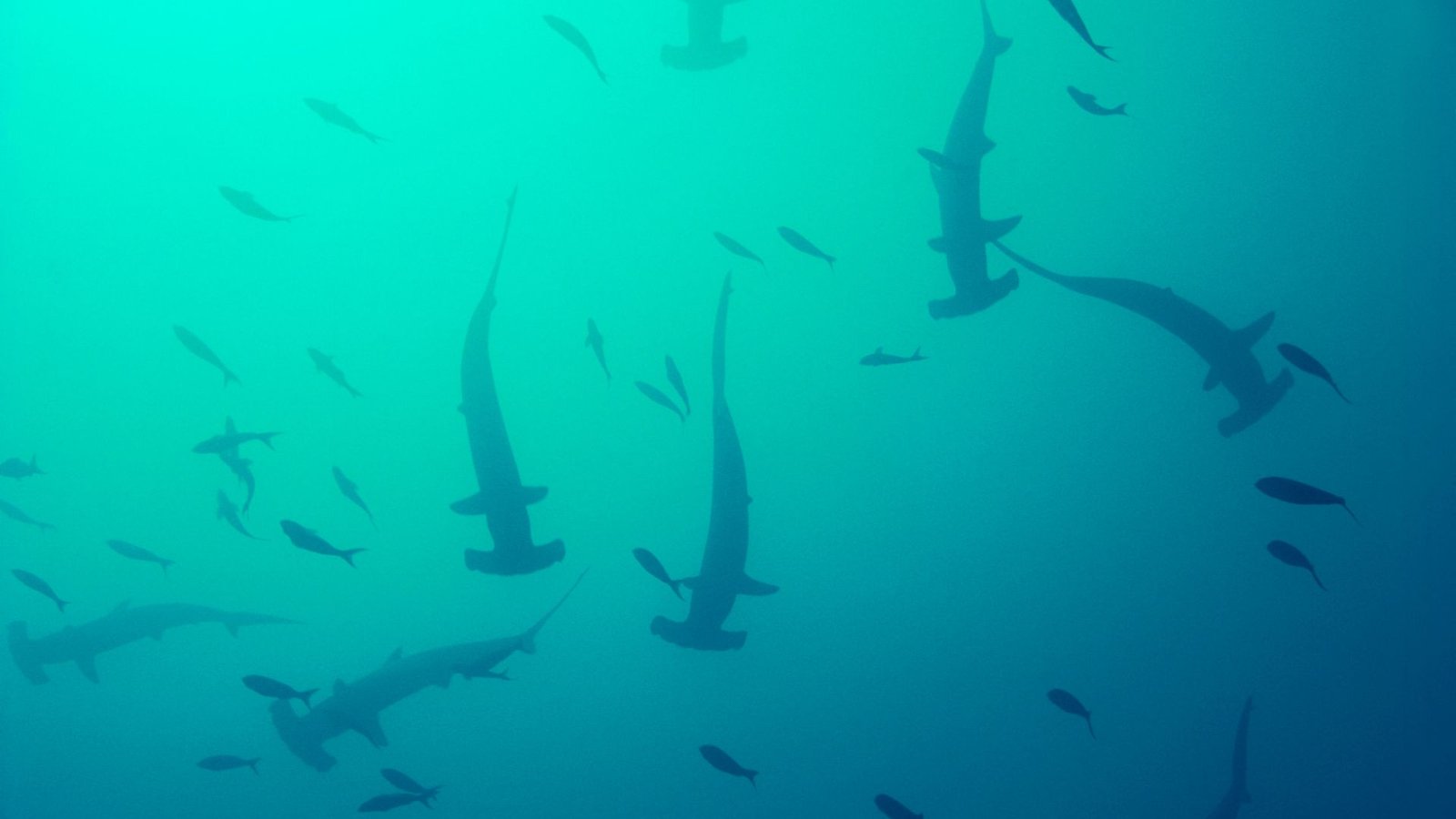
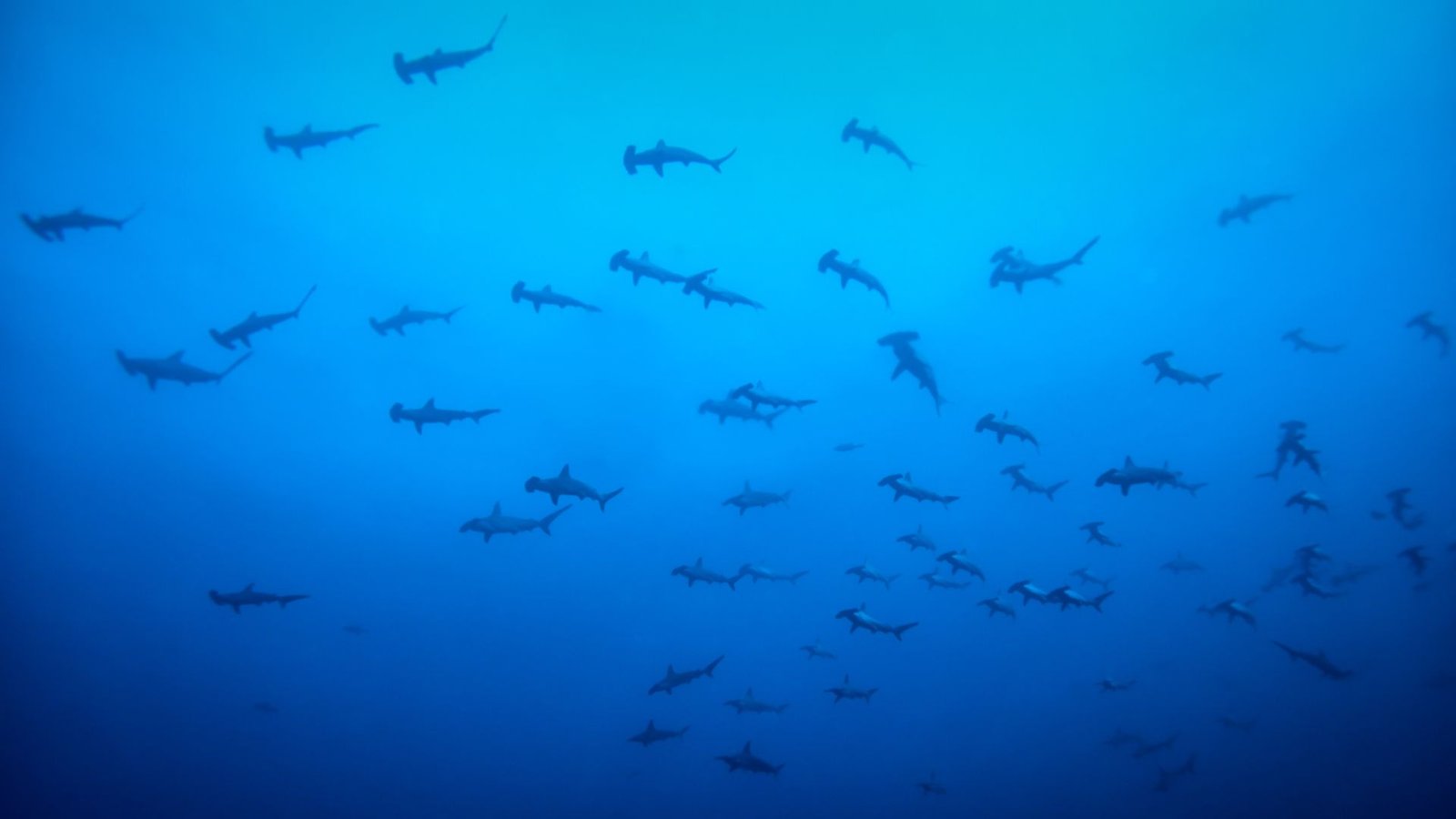
Group size: juveniles solitary or small (< 10) in mangroves; adults form seasonal shoals 50–300 over Cocos Ridge.
Mating system: polygynandrous; courtship chases and nips observed in mid‑water columns May–July.
Territoriality: non‑territorial but show high philopatry to specific seamounts.
Communication: body contacts and parallel swimming alignments maintain school cohesion; electro‑receptive signals possible at close range.
Special behaviours: visits cleaner‑fish stations (king angelfish, barberfish) to remove parasites; “yo‑yo” vertical movements maximise oxygen intake near hypoxic thermocline.
Taxonomic classification is a hierarchical system used in biology to organize and name living organisms. It arranges species into nested groups based on shared characteristics and evolutionary relationships.
🌍 The IUCN status refers to the conservation category assigned to a species by the International Union for Conservation of Nature, based on its risk of extinction
Iconic “wall of sharks”: hundreds form tight daytime schools circling Cocos Island seamounts before dispersing to hunt at night.
Cephalofoil provides 360° stereo‑olfaction—hammerheads sample odour plumes twice as fast as other sharks.
Embryos connected to yolk‑sac placenta; intra‑uterine sibling competition minimal compared with lamniform sharks.
Demonstrated geomagnetic navigation, returning to the same seamount after > 1 000 km migrations along Equatorial Counter Current.
Costa Rica added S. lewini to its Wildlife Conservation Law (2021), banning landing of detached fins.
Native
Decreasing


Robust requiem shark with fusiform body and high, slightly rounded first dorsal fin whose origin lies over (or just anterior to) the free rear tip of the pectorals. Snout long, broad and rounded; eyes circular with nictitating membrane. Dorsum uniform grey‑brown, ventrum white; no prominent flank markings.