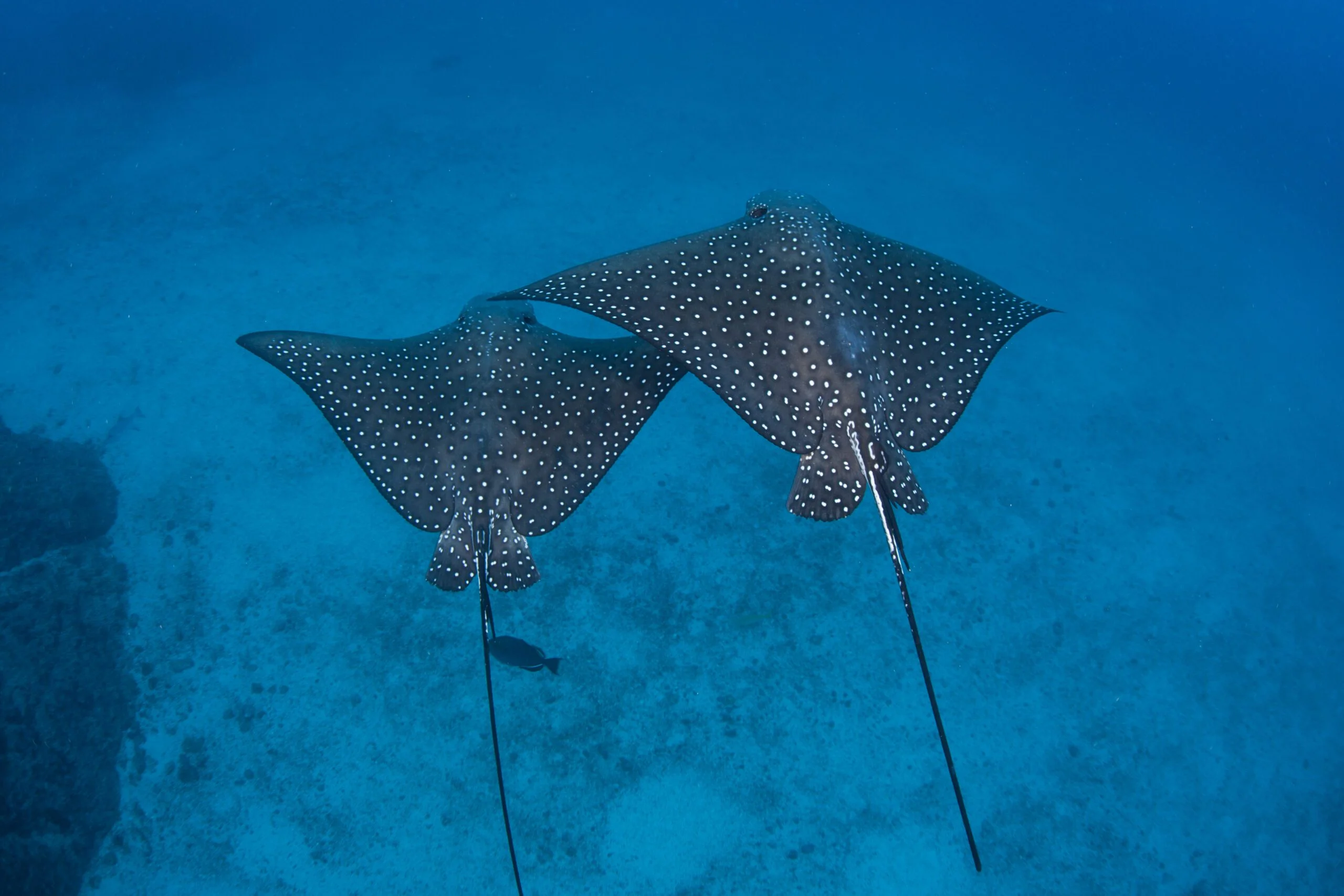
Also known / common namespanish – Mantarraya águila pinta, Chucho pintado; Bribri – Sáre‑kuä; Cabécar – Tsíwe
Spotted Eagle Ray(s) General Description
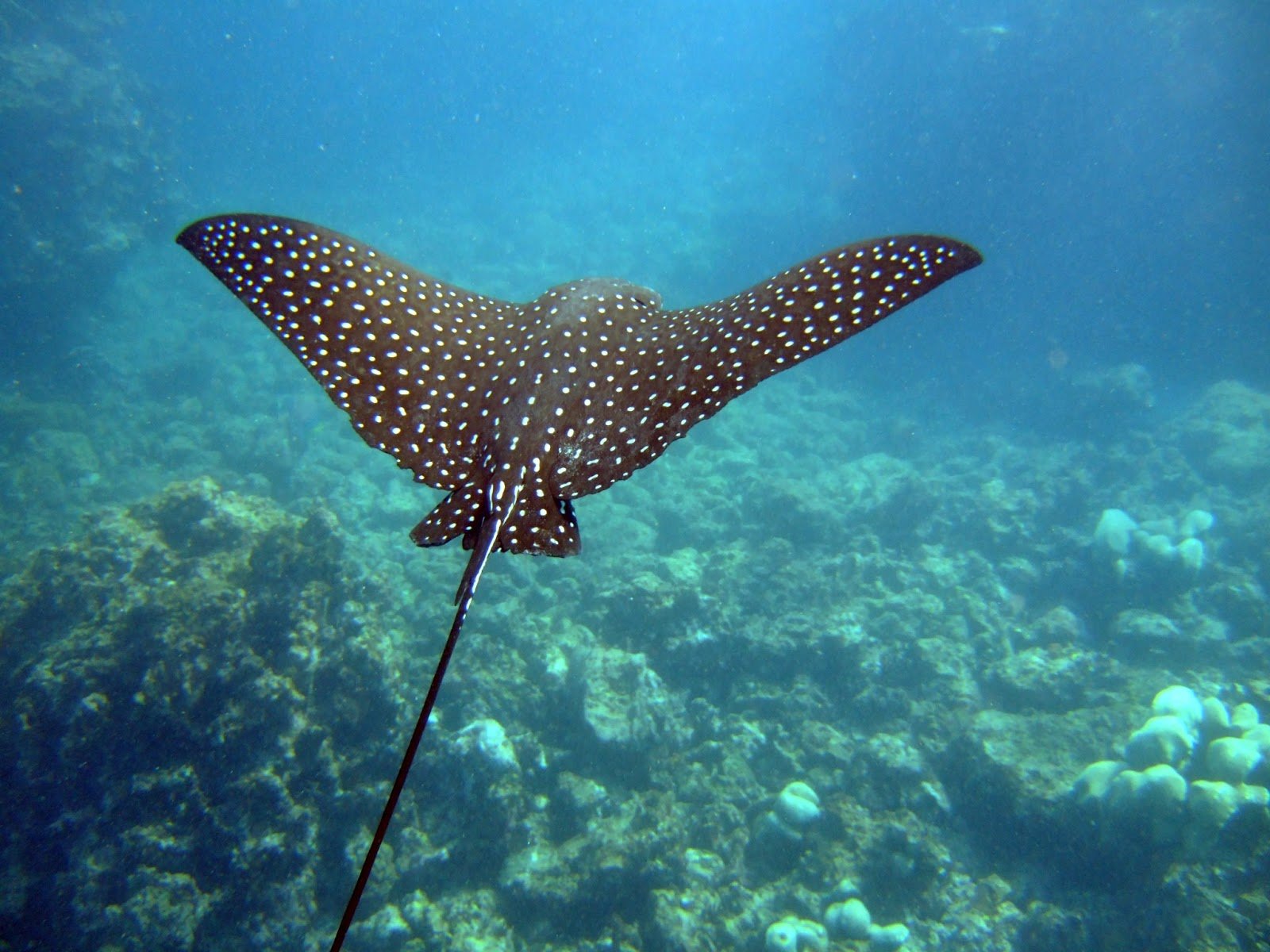
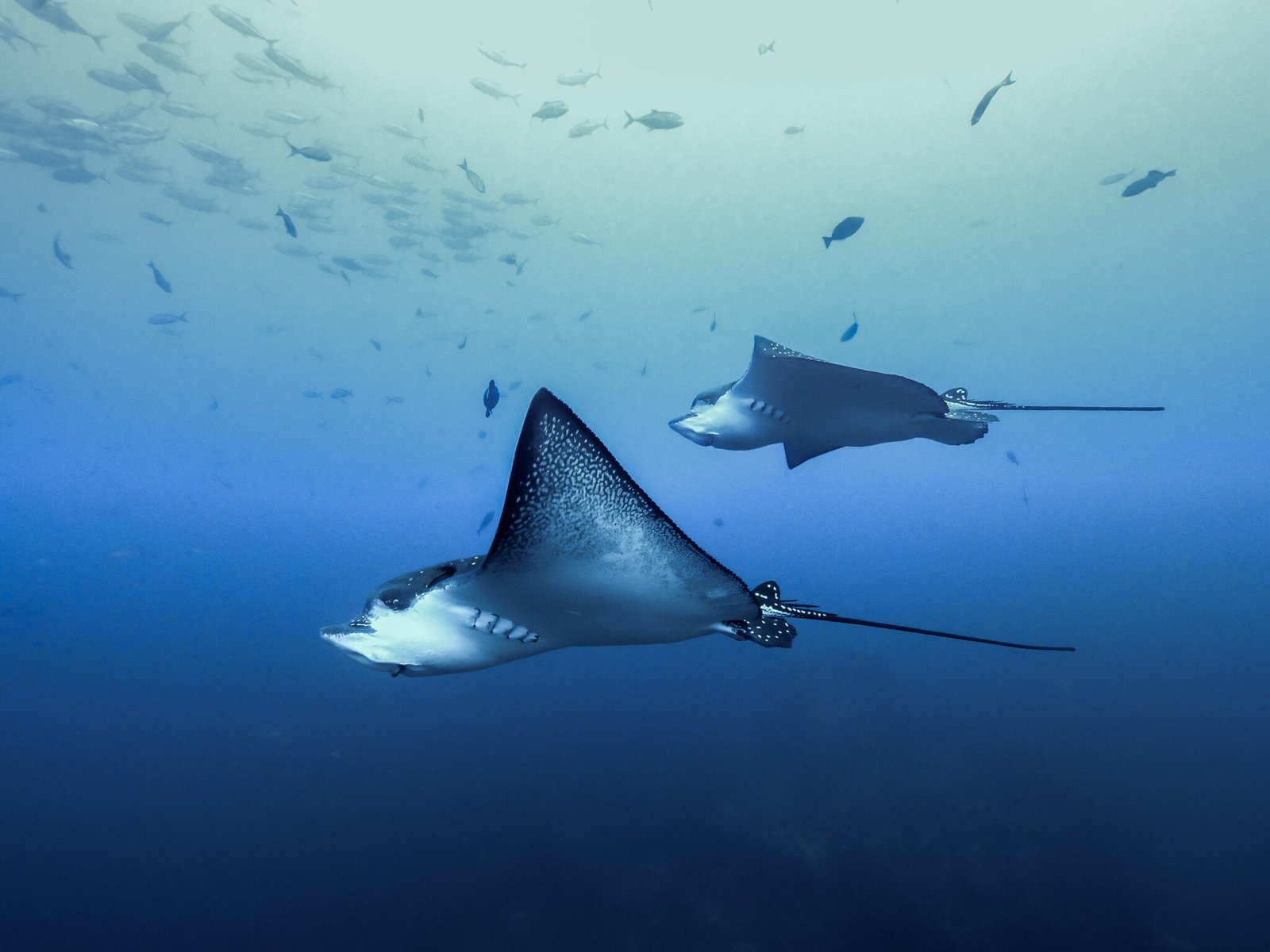
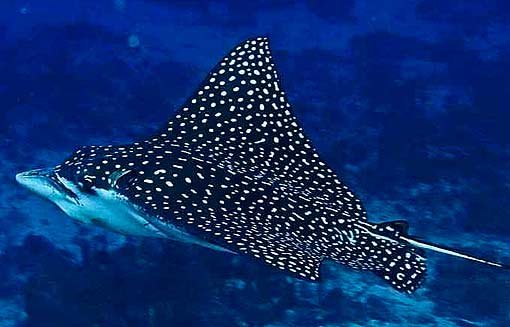
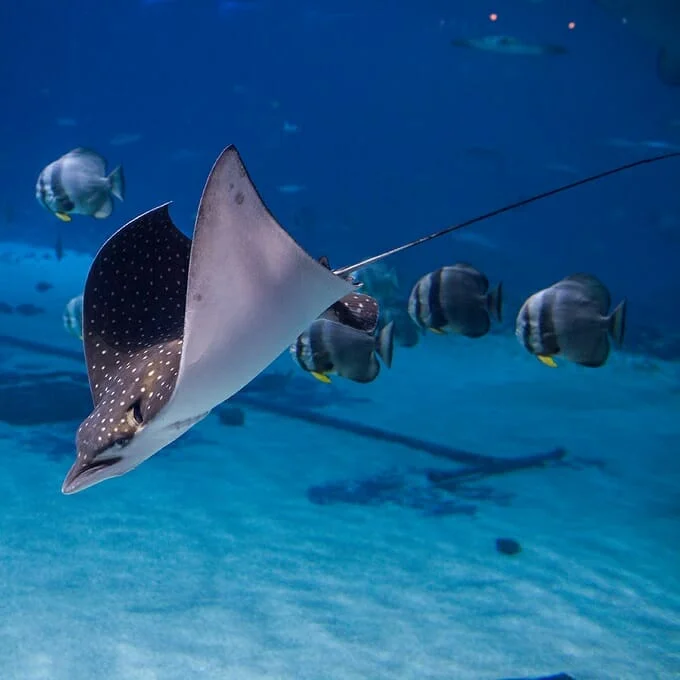
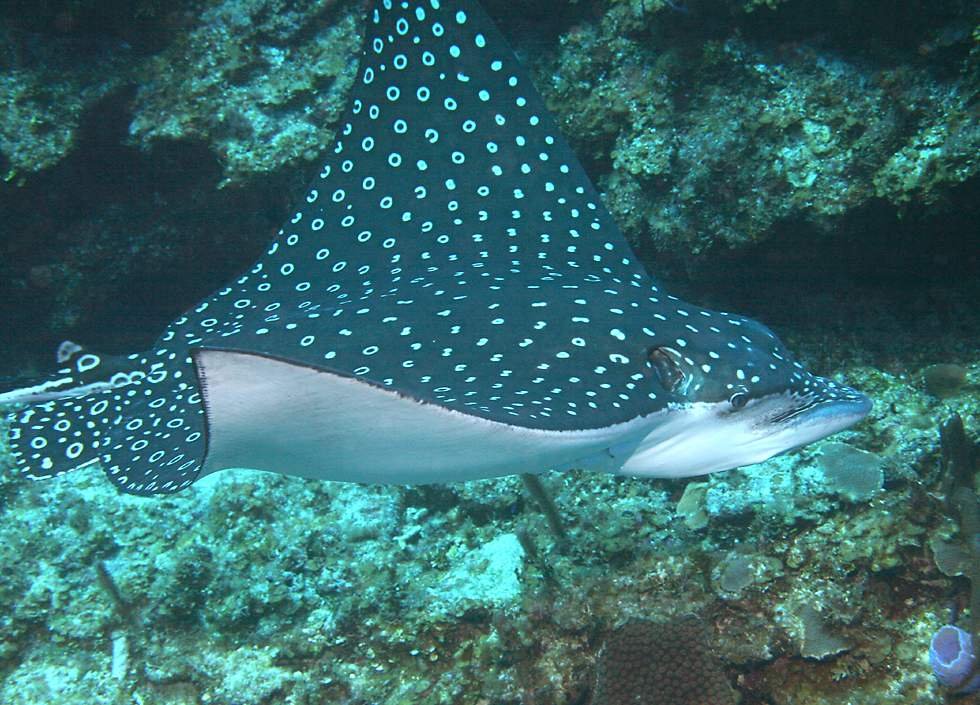
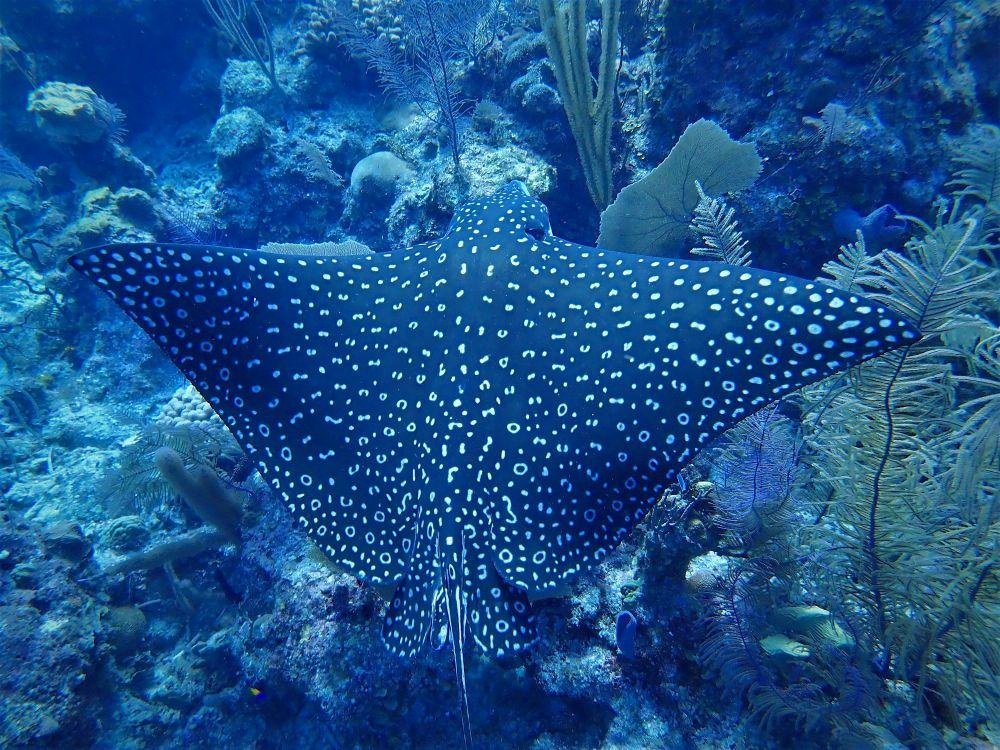
Large pelagic batoid distinguished by a rhomboidal disc with sharply pointed “wings,” long whip‑like tail (often > 3 × disc length) and prominent, up‑turned head bearing a blunt, shovel‑like snout. Dorsal surface dark chocolate‑brown to black, densely sprinkled with white to pale‑blue spots and ocelli; ventrum stark white. Adults reach disc widths of 180–330 cm and weights to 230 kg; females grow larger than males. A single dorsal fin sits just behind the pelvic fins; the tail carries one to five serrated venomous spines near its base. Spiracles are large, set behind eyes, and help respiration while the ray rests on sand. Juveniles show proportionally shorter tails and sparser spotting.
Note*
‡ Eastern‑Pacific populations formerly treated as Aetobatus narinari were separated in 2014; A. laticeps is the taxon occurring on Costa Rica’s Pacific coast, while A. narinari sensu stricto is found in the Caribbean. The two are virtually identical ecologically, so information below applies to both within Costa Rican waters.
Has Sexual Diamorphism?
Yes
Sexual dimorphism refers to the physical differences between males and females of the same species that go beyond reproductive organs. For example, size, colour or form.
Yes — females larger with broader discs; males possess claspers and slightly longer tails relative to disc width.
LIFE‑HISTORY & VITAL STATISTICS OF THE Spotted Eagle Ray(S)
Average Height / Length / Diameter
Disc width 1.8–3.3 m; total length (with tail) 3–5 m
Average Adult Weight / Mass
80–230 kg (females > males)
Typical Lifespan / Longevity
~25 yr in wild; max recorded 28 yr
Typical Lifespan / Longevity for males
Data deficient
Typical Lifespan / Longevity for Females
Data deficient
Age at Sexual Maturity
Females 4–6 yr (≈ 155 cm DW); males 3–5 yr (≈ 135 cm DW)
Breading Season
Mating observed mainly late dry–early wet season (Feb – May) in Pacific; year‑round in Caribbean
Gestation
Reproductive Outcome
–4 pups (mean 2) per litter; reproductive cycle biennial
Ecology and Behaviour for Spotted Eagle Ray(s)
Large pelagic batoid distinguished by a rhomboidal disc with sharply pointed “wings,” long whip‑like tail (often > 3 × disc length) and prominent, up‑turned head bearing a blunt, shovel‑like snout. Dorsal surface dark chocolate‑brown to black, densely sprinkled with white to pale‑blue spots and ocelli; ventrum stark white. Adults reach disc widths of 180–330 cm and weights to 230 kg; females grow larger than males. A single dorsal fin sits just behind the pelvic fins; the tail carries one to five serrated venomous spines near its base. Spiracles are large, set behind eyes, and help respiration while the ray rests on sand. Juveniles show proportionally shorter tails and sparser spotting.
Note*
‡ Eastern‑Pacific populations formerly treated as Aetobatus narinari were separated in 2014; A. laticeps is the taxon occurring on Costa Rica’s Pacific coast, while A. narinari sensu stricto is found in the Caribbean. The two are virtually identical ecologically, so information below applies to both within Costa Rican waters.
Habitat
Coastal and shelf waters from surf zone to ~80 m depth; frequents coral and rocky reefs, sandy bays, estuary mouths and offshore islands (e.g., Isla del Caño, Cocos Island).
Predominantly active during Day
Trophic Chain
Mid‑level predator feeding on benthic bivalves, gastropods, crabs and occasionally small fishes; prey excavation bioturbates sediment, enhancing nutrient cycling.
Interespecies relationships noted for Spotted Eagle Ray
Mutualism + / +
Cleaner gobies (Elacatinus spp.) remove ectoparasites at reef “cleaning stations.”
Symbiosis + / +
Specialized gut microbes ferment chitin and carbonates, improving digestion while gaining nutrients.
Commensalism + / 0
Remoras (Echeneis naucrates) hitch rides and feed on scraps without affecting the ray.
Inquilinism + / 0
Juvenile jacks (Caranx hippos) shelter beneath the disc for predator cover.
Phoresy + / 0
Planktonic copepods occasionally attach to the skin for passive dispersal.
Tanatocresis + / 0
No documented case.
Parasitism + / –
Copepods (Caligus spp.) and cestodes (Rhodobothrium spp.) feed on skin or intestinal resources.
Predation + / –
Tiger sharks (Galeocerdo cuvier) and great hammerheads (Sphyrna mokarran) prey on rays.
Amensalism 0 / –
Excavating clams stirs sediment that smothers nearby juvenile corals and sponges without harming the ray.
Competition – / –
Competes with cow‑nosed rays (Rhinoptera steindachneri) for clams and crabs on soft bottoms.
Social behaviour of Spotted Eagle Ray
A. Social Structure & Behaviour
Activity pattern: mainly diurnal‑crepuscular; forages over sandy flats and rests in mid‑water at night.
Group size: typically solitary or in pairs; loose groups of 5 – 20 at rich feeding sites; seasonal “schools” of up to 100 along seamount chains (e.g., the Cocos Ridge).
Reproductive system: aplacental viviparous; courtship “trains” of 2 – 4 males pursuing one female and competing by grasping her pelvic fins; gestation ≈ 12 months.
Territoriality: non‑territorial but shows strong site fidelity to feeding grounds and cleaning stations.
Communication: visual signals (synchronized gliding, accentuating spot pattern) and gentle nips during courtship; likely short‑range electroreceptive recognition.
Special behaviours: surface breaches up to 3 m—probably parasite removal or acoustic signaling; excavates bivalves leaving circular “feeding pits” on t
Distribution and Sighthings ofSpotted Eagle Ray(s) in Costa Rica
General Regions of Costa Rica where to find Spotted Eagle Rays
Coral reefs (Cocos and coastal bathymetries)
Pacific and Caribbean coastal zones
National Parks and Reserves of Costa Rica where to find Spotted Eagle Rays
Parque Nacional Marino Ballena
Parque Nacional Cahuita
Parque Nacional Isla del Coco
Parque Nacional Corcovado
Parque Nacional Marino Las Baulas de Guanacaste
Parque Nacional Volcán Turrialba
Reserva Forestal Golfo Dulce
Reserva Biológica Isla del Caño
Refugio Nacional de Fauna Silvestre Golfito
Reseva Absoluta Cabo Blanco
Best Time to seeSpotted Eagle Ray(s) in Costa Rica
Dry Season
January
February
March
April
June
July
August
September
October
November
December
Media
Videos
Sounds and calls
log in to help us with this an other posts.
This sheet is marked as: Complete
Taxonomy
Taxonomic classification is a hierarchical system used in biology to organize and name living organisms. It arranges species into nested groups based on shared characteristics and evolutionary relationships.
Kingdom Animalia
Phylum Chordata
Class Chondrichthyes
Order Myliobatiformes
Genus Aetobatus
Conservation Status
Status IUCN
🌍 The IUCN status refers to the conservation category assigned to a species by the International Union for Conservation of Nature, based on its risk of extinction
Endangered
Threats
⚠️Incidental capture in gill‑nets, long‑lines and shrimp trawls.
⚠️Targeted harvest for meat and cartilage in some Pacific ports.
⚠️Degradation of coral‑reef and seagrass habitats by coastal development and pollution.
⚠️Bioaccumulation of heavy metals and microplastics, particularly in enclosed gulfs.