Also known / common namespanish – Hongo pestañas, Copa de pestañas; Bribri – Tsüt'su; Cabécar – Dächû
Eyelash Cup Fungus(s) General Description
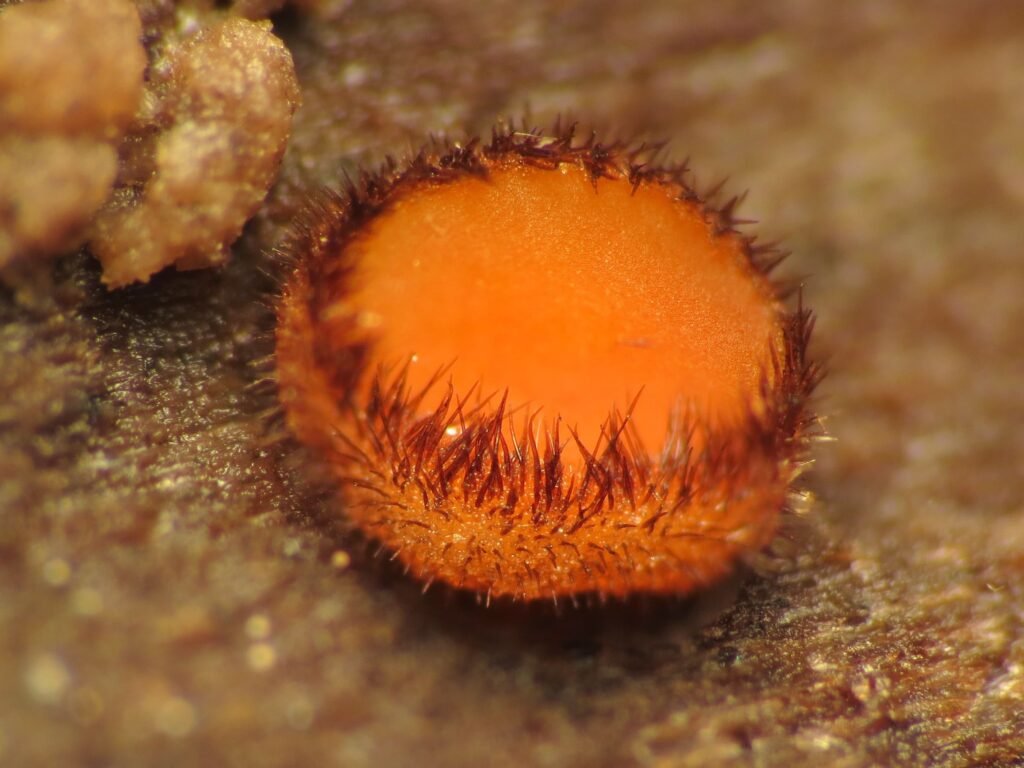
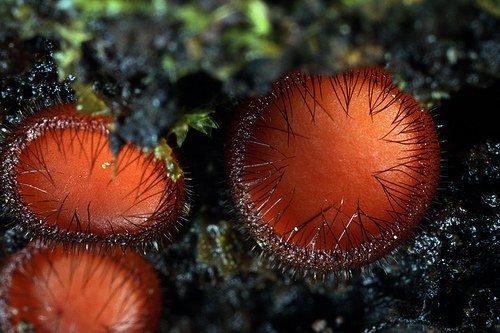
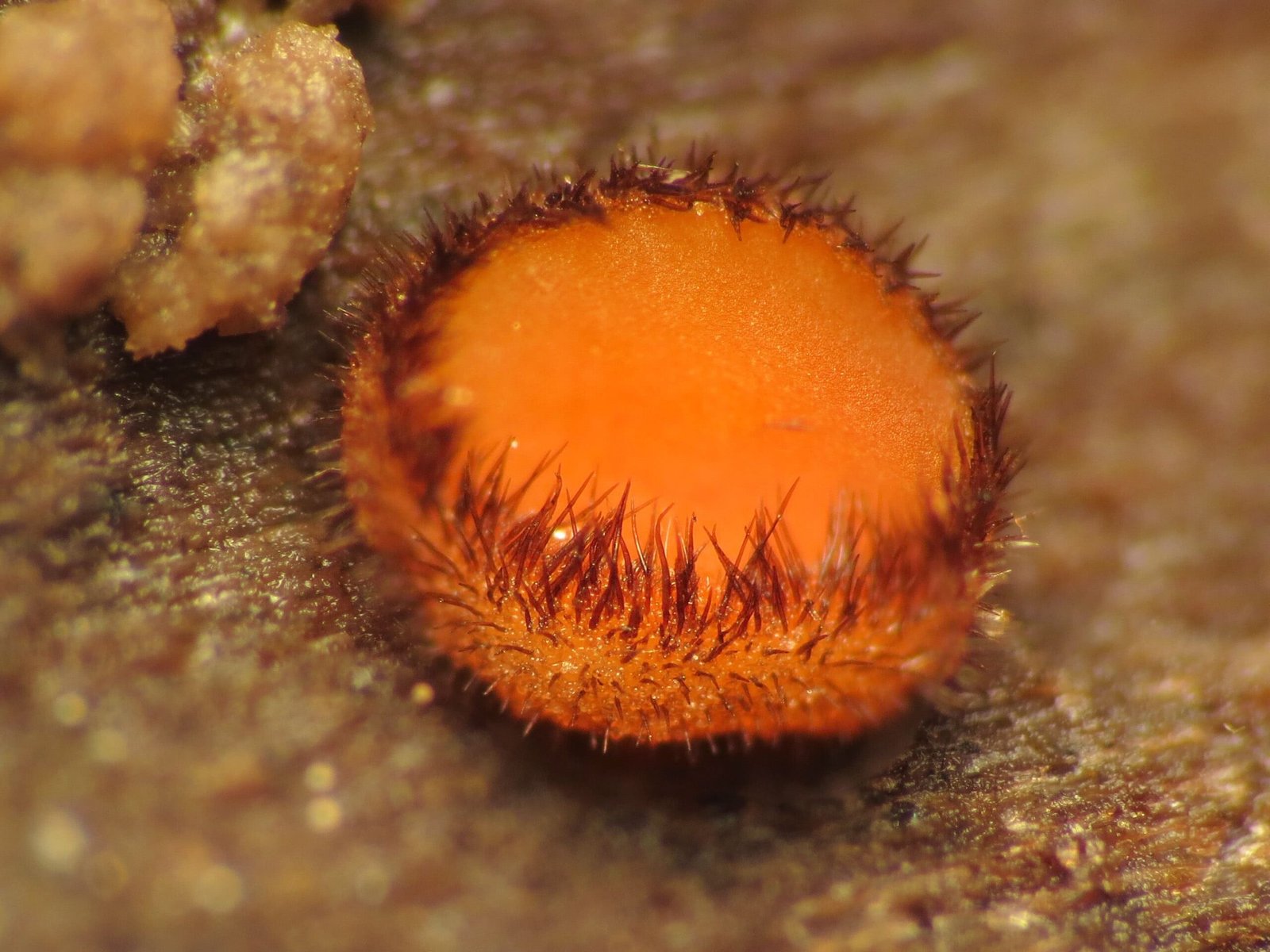
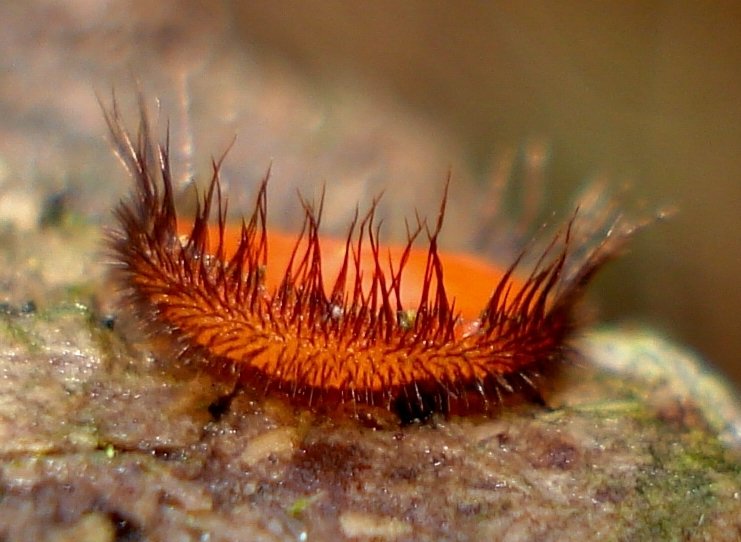
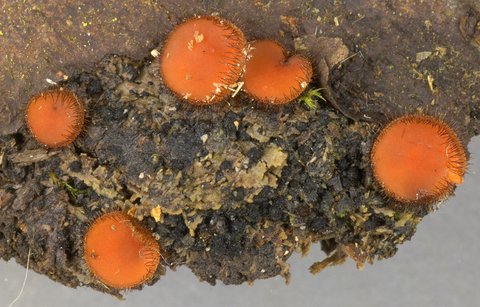
Small, sessile apothecia form bright orange‑scarlet discs 5–15 mm wide whose margins are fringed with conspicuous, stiff, dark “eyelash” hairs up to 1 mm long. The hymenial surface is smooth and vividly coloured, while the exterior is paler and densely tomentose. Flesh thin (< 1 mm), gelatinous when wet, becoming brittle on drying. Microscopy: asci cylindric 300 × 25 µm; ascospores ellipsoid, minutely warted, 17–20 × 11–13 µm, each containing one to several lipid droplets; paraphyses filiform, septate. No stipe is present. Young fruit bodies are nearly spherical, opening to shallow cups at maturity.
Has Sexual Diamorphism?
No
Sexual dimorphism refers to the physical differences between males and females of the same species that go beyond reproductive organs. For example, size, colour or form.
LIFE‑HISTORY & VITAL STATISTICS OF THE Eyelash Cup Fungus(S)
Average Height / Length / Diameter
Cap (disc) 5–15 mm Ø; thickness < 1 mm
Average Adult Weight / Mass
Data deficient
Typical Lifespan / Longevity
Individual apothecium 2–4 wk; mycelium potentially years
Typical Lifespan / Longevity for males
Not applicable (fungus)
Typical Lifespan / Longevity for Females
Not applicable (fungus)
Age at Sexual Maturity
Mycelium may fruit 3–6 mo after colonising substrate
Breading Season
Year‑round in humid tropics; peaks early rainy season (May–July)
Gestation
Reproductive Outcome
Ecology and Behaviour for Eyelash Cup Fungus(s)
Small, sessile apothecia form bright orange‑scarlet discs 5–15 mm wide whose margins are fringed with conspicuous, stiff, dark “eyelash” hairs up to 1 mm long. The hymenial surface is smooth and vividly coloured, while the exterior is paler and densely tomentose. Flesh thin (< 1 mm), gelatinous when wet, becoming brittle on drying. Microscopy: asci cylindric 300 × 25 µm; ascospores ellipsoid, minutely warted, 17–20 × 11–13 µm, each containing one to several lipid droplets; paraphyses filiform, septate. No stipe is present. Young fruit bodies are nearly spherical, opening to shallow cups at maturity.
Habitat
Predominantly active during Night
Trophic Chain
Decomposer breaking down lignocellulose; accelerates nutrient cycling in forest floor
Interespecies relationships noted for Eyelash Cup Fungus
No data was found
Social behaviour of Eyelash Cup Fungus
Distribution and Sighthings ofEyelash Cup Fungus(s) in Costa Rica
General Regions of Costa Rica where to find Eyelash Cup Funguss
Tropical
Mangroves
Tropical rainforest (Caribbean and North Pacific slopes)
National Parks and Reserves of Costa Rica where to find Eyelash Cup Funguss
Parque Nacional Volcán Arenal
Parque Nacional Barbilla
Parque Nacional Braulio Carrillo
Parque Nacional Carara
Parque Nacional Corcovado
Parque Nacional Juan Castro Blanco
Parque Internacional La Amistad
Parque Nacional Manuel Antonio
Parque Nacional Piedras Blancas
Parque Nacional Rincón de la Vieja
Parque Nacional Tapantí – Macizo Cerro de la Muerte
Parque Nacional Tortuguero
Parque Nacional Volcán Turrialba
Reserva Forestal Río Macho
Reserva Biológica Hitoy-Cerere
Reserva Bosque Nuboso Santa Elena
Refugio Nacional de Vida Silvestre Barra del Colorado
Refugio Nacional de Vida Silvestre Gandoca-Manzanillo
Refugio Nacional de Fauna Silvestre Golfito
Best Time to seeEyelash Cup Fungus(s) in Costa Rica
Dry Season
January
February
March
April
June
July
August
September
October
November
December
Media
Videos
Sounds and calls
log in to help us with this an other posts.
Taxonomy
Taxonomic classification is a hierarchical system used in biology to organize and name living organisms. It arranges species into nested groups based on shared characteristics and evolutionary relationships.
Kingdom Fungi
Phylum Ascomycota
Class Pezizomycetes
Order Pezizales
Genus Scutellinia
Conservation Status
Status IUCN
🌍 The IUCN status refers to the conservation category assigned to a species by the International Union for Conservation of Nature, based on its risk of extinction
Not Evaluated (NE)
Threats
⚠️Dark marginal hairs act as miniature “spring boards,” flicking away water droplets that could drown spores.
⚠️Often the first cup fungus to appear on freshly cut rainforest logs—an early successional decomposer.
⚠️Spores bear minute warts that enhance dispersal by adhering to passing insects.
⚠️Bright carotenoid pigments may protect asci from intense tropical UV radiation.
⚠️Featured in citizen‑science projects; recorded from Cloudbridge Reserve and Sarapiquí lodges, confirming wide Costa‑Rican range.
Fun Facts
Natural micro‑lenses Tiny water droplets that collect between the “eyelash” hairs act like miniature lenses, focusing sunlight onto the cup. This helps the fertile surface dry quickly after light rain, priming it for spore release.
Synchronized spore catapults The asci (spore sacs) discharge almost simultaneously when humidity drops and temperature rises, creating a brief orange “puff” of spores that can be seen drifting in back‑light.
Chemical bar‑code The fungus produces a unique cocktail of carotenoid pigments and organic acids; mycologists use this chemical “signature” to distinguish Scutellinia from other bright‑orange cup fungi.
Rapid ecological engineer It often colonizes freshly fallen wood within just two weeks, beginning lignin breakdown well before larger decomposers (e.g., Ganoderma species) arrive on the scene.
Global hitchhiker Its sticky, warted spores cling to boot soles and vehicle tires, allowing unsuspecting hikers and maintenance crews to spread the species into parks and urban gardens worldwide.