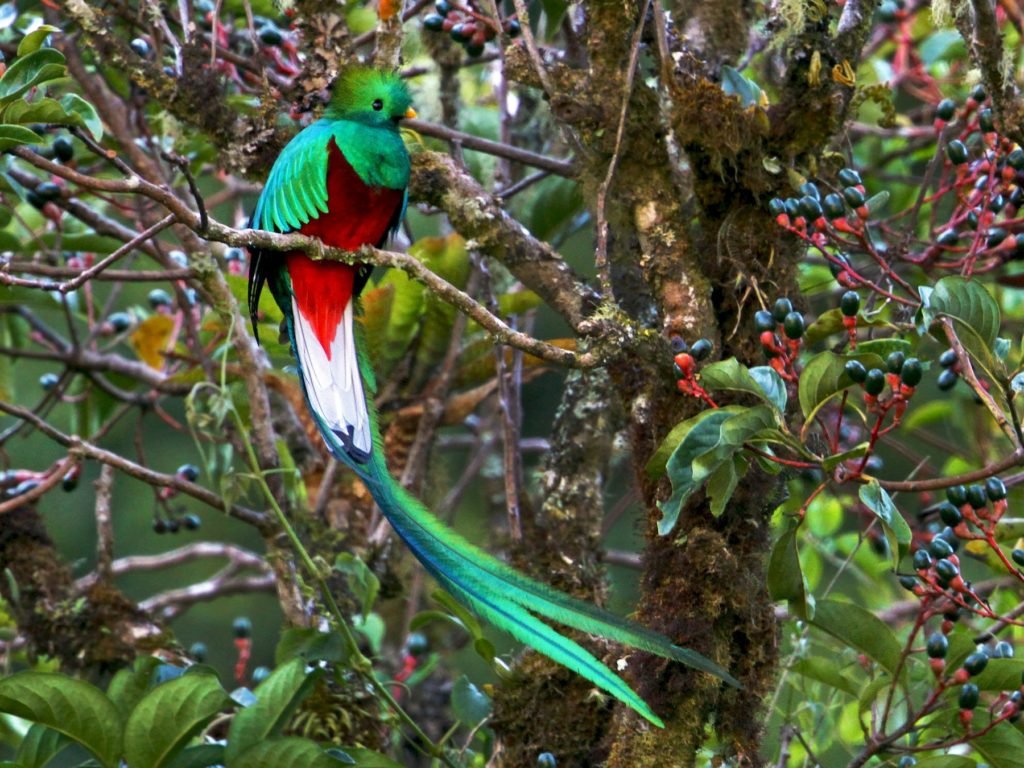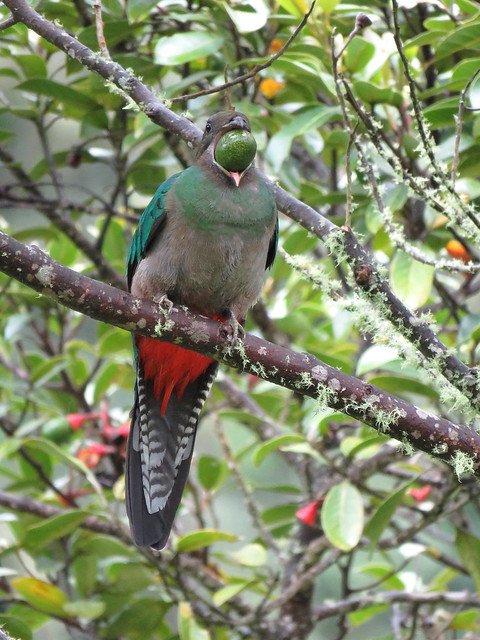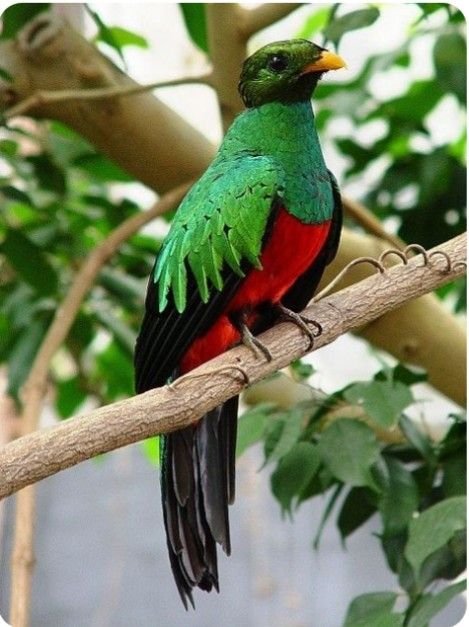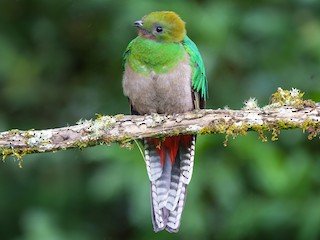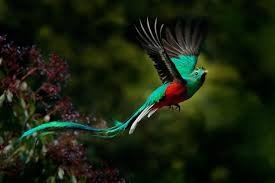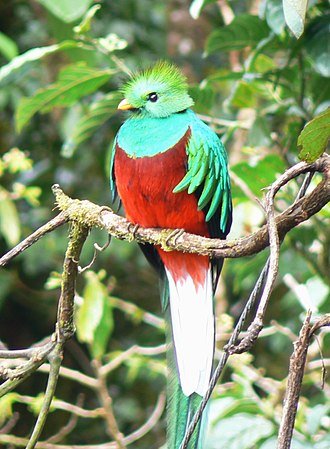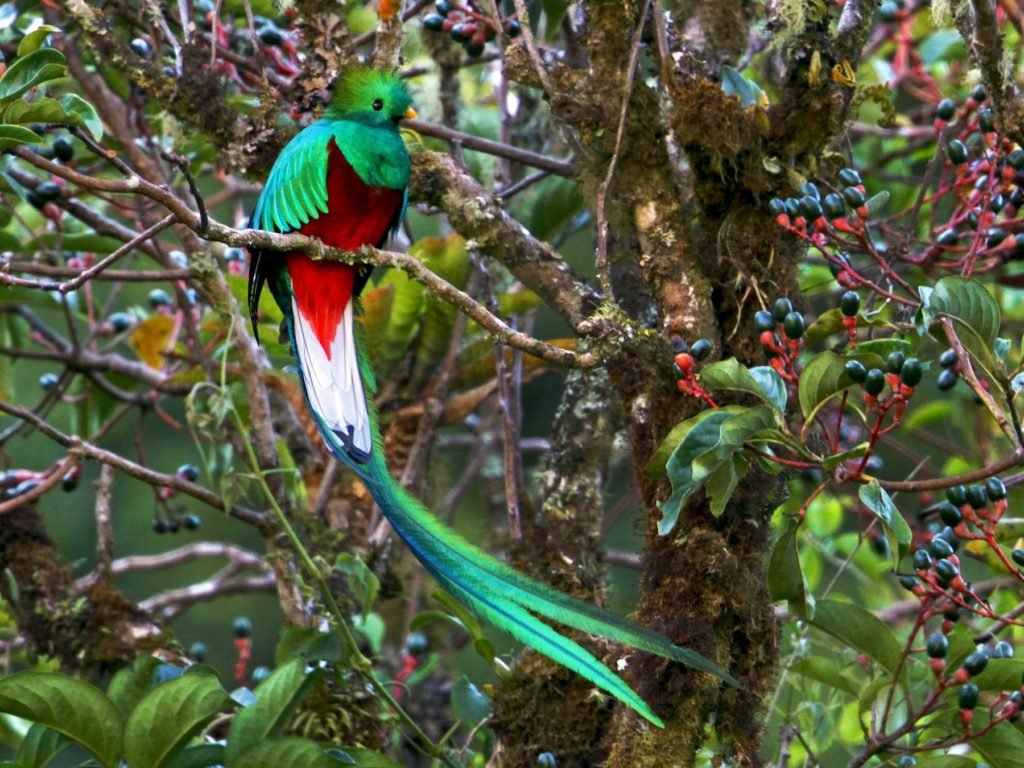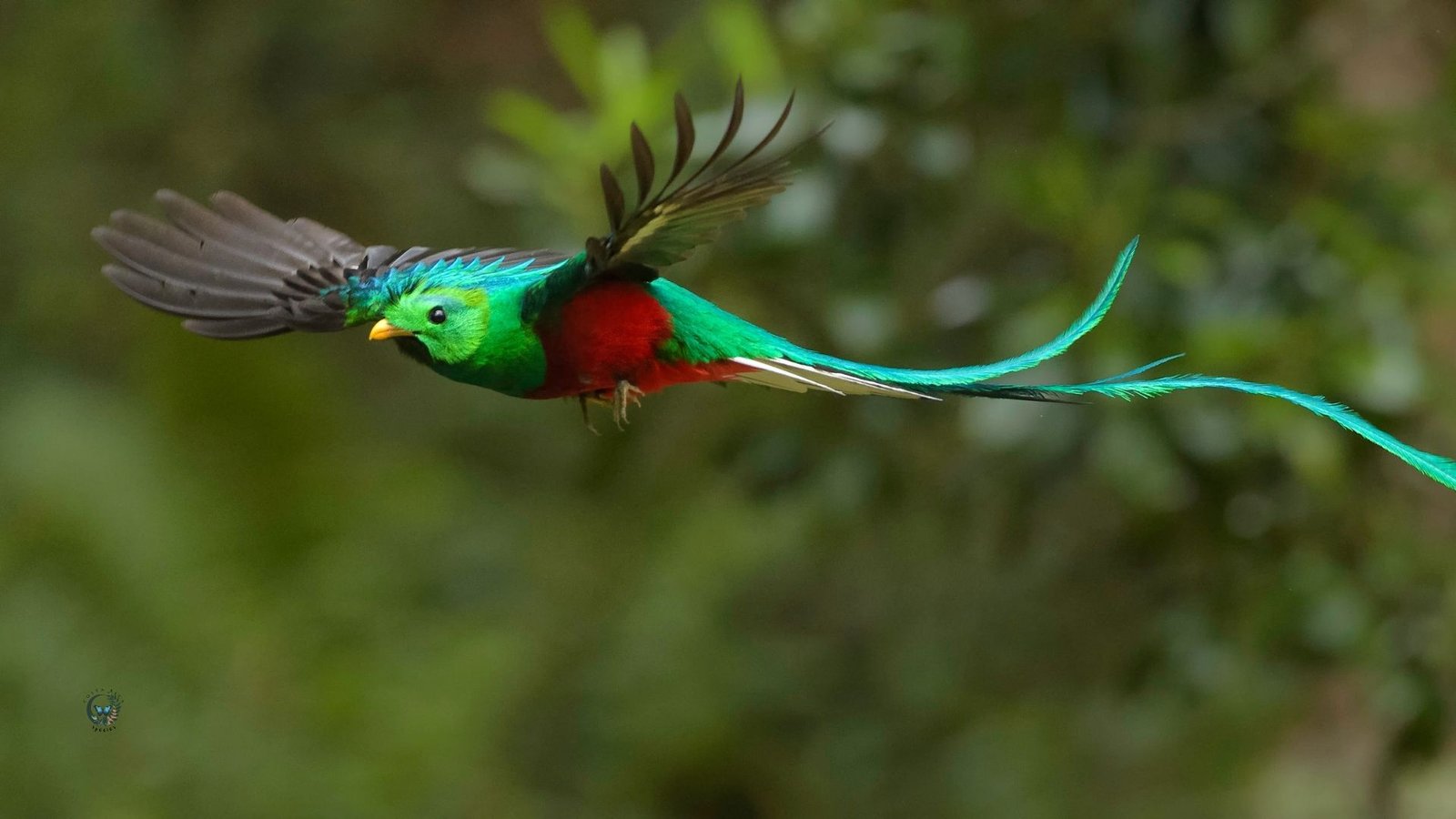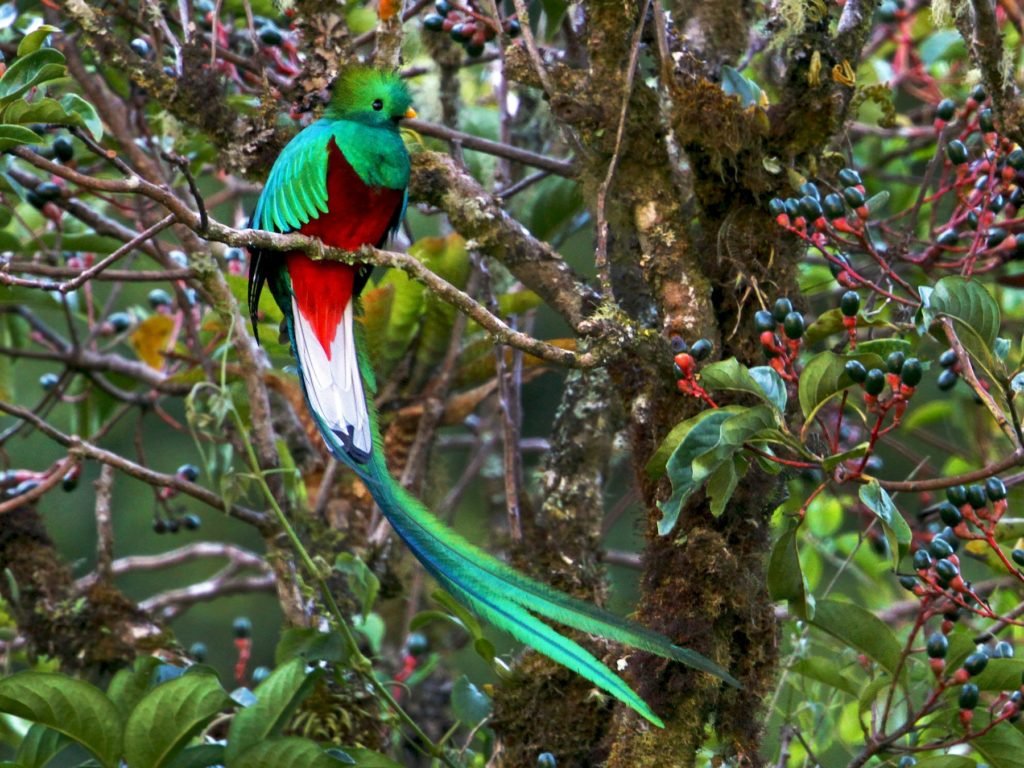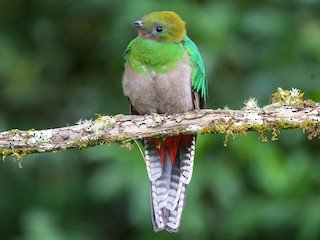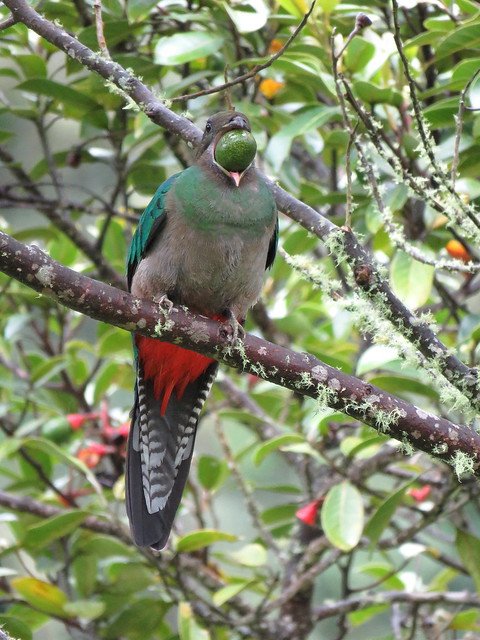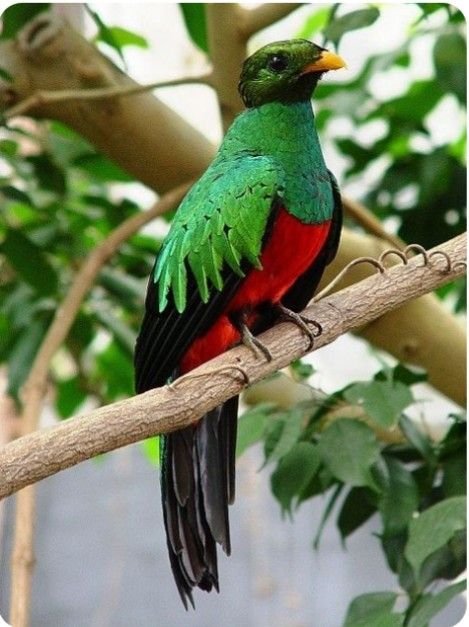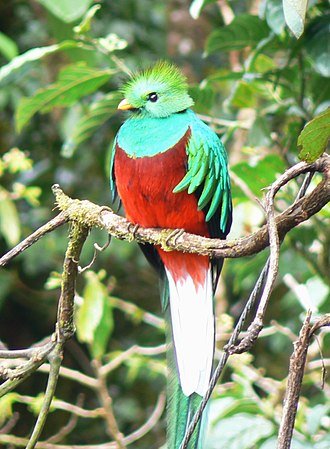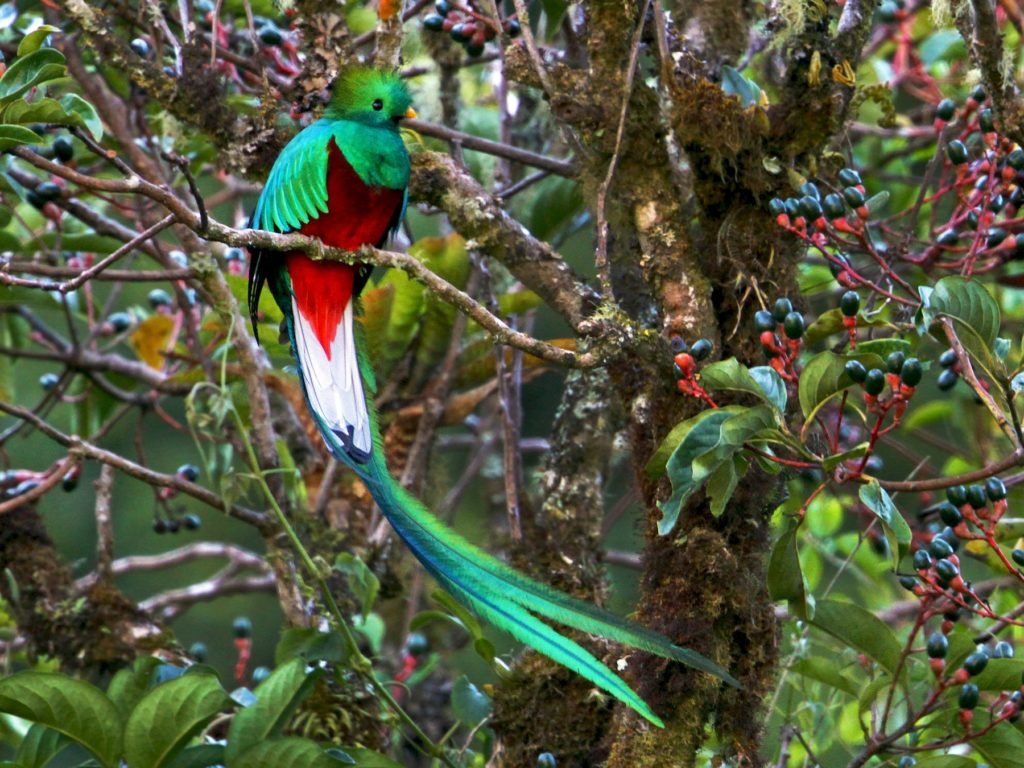



A medium‑sized trogon famed for brilliant iridescent emerald‑green upperparts that shift to gold or blue in different light, contrasting with a deep crimson belly. Adult males sport a wispy green crest and spectacular uppertail coverts extending 60–100 cm beyond the 14 cm tail, creating a total length up to 1 m; females lack these streamers and show olive‑green mantle, grey‑brown breast band and shorter white‑tipped tail. Both sexes have a stout yellow bill, large black eyes and zygodactyl feet. Body length (excluding coverts) is 36–40 cm; wingspan 63–70 cm. Juveniles resemble females but with mottled brown‑green plumage and dusky bills.
Sexual dimorphism refers to the physical differences between males and females of the same species that go beyond reproductive organs. For example, size, colour or form.
males possess long iridescent uppertail coverts, brighter plumage and a more pronounced crest; females duller, lacking tail streamers.
36–40 cm body; male uppertail coverts 60–100 cm; wingspan 63–70 cm
Males 190–225 g; females 150–200 g
10 yr in wild; up to 20 yr in captivity [2]
Data deficient
Data deficient
2–3 yr [2]
February – June (dry‑to‑wet transition)
Number of Offspring per Event: 2 eggs; one clutch yr
A medium‑sized trogon famed for brilliant iridescent emerald‑green upperparts that shift to gold or blue in different light, contrasting with a deep crimson belly. Adult males sport a wispy green crest and spectacular uppertail coverts extending 60–100 cm beyond the 14 cm tail, creating a total length up to 1 m; females lack these streamers and show olive‑green mantle, grey‑brown breast band and shorter white‑tipped tail. Both sexes have a stout yellow bill, large black eyes and zygodactyl feet. Body length (excluding coverts) is 36–40 cm; wingspan 63–70 cm. Juveniles resemble females but with mottled brown‑green plumage and dusky bills.
Specialist of humid lower‑ and upper‑montane cloud forest (900 – 2 500 m) with abundant epiphytes, decaying canopy snags for cavity nesting, and year‑round fruiting of wild avocados (Lauraceae). It undertakes short elevational shifts following fruit phenology but rarely descends below 500 m or enters open farmland except at forest edges
Primarily a frugivore; key seed‑disperser of Ocotea, Nectandra and Virola spp.; supplements diet with insects, small frogs and lizards.
Activity pattern: strictly diurnal; most active at dawn (courtship) and mid‑morning (foraging).
Grouping: usually solitary or in monogamous breeding pairs; outside breeding season may form loose frugivorous flocks of 3 – 6 when Lauraceae trees are fruiting heavily.
Breeding system: socially monogamous; both sexes excavate or enlarge old woodpecker cavities in decayed trunks; male performs spectacular vertical undulations and tail‑display flights.
Territoriality: pairs defend 1–3 ha core areas around nest tree with chattering calls and aerial chases; territories shift annually with snag availability.
Parental care: biparental—incubation alternates every 2–4 h; both parents provision chicks, delivering whole fruits and occasional insects.
Communication: flute‑like whistled “kee‑ow” for long‑range contact; soft clucks at nest; plumage displays (crest raising, wing‑droop) during pair bonding.
Special behaviours: uses serrated tomia to pluck slippery avocado fruits; regurgitates large seeds intact, aiding long‑distance dispersal; may hover briefly to pick canopy berries inaccessible by perch.
Taxonomic classification is a hierarchical system used in biology to organize and name living organisms. It arranges species into nested groups based on shared characteristics and evolutionary relationships.
🌍 The IUCN status refers to the conservation category assigned to a species by the International Union for Conservation of Nature, based on its risk of extinction
Sacred to ancient Maya and Aztec cultures; tail feathers were used as royal currency.
Cannot survive long in captivity—no successful long‑term breeding programs exist.
Plays a keystone role in seed dispersal of high‑elevation avocado relatives, helping maintain cloud‑forest dynamics.